



The Lottery Market Monitoring Bulletin is a quarterly publication of the Secretariat of Economic Monitoring of the Ministry of Finance, with the objective of showing, quarterly, numbers and statistics of lottery products regulated at the federal level. It is intended, therefore, to spread this theme to the academic community and society in general.
"It is important to publicize the lottery market, especially with the
ongoing process of privatization of the Exclusive Instant Lottery -LOTEX- , and
with the proximity of the implementation of the Fixed Quota Bet in Brazil,
whose Bill should soon be sent to National Congress. With the advent of these
two modalities, "substantial increases in the social transfers of lotteries are
envisaged," said the Secretary for Economic Monitoring, Mansueto Facundo
de Almeida Filho.
"We believe that the bulletin is an important instrument to increase
transparency in the exploitation of federal lotteries in the country,
increasing the visibility of this important sector with Brazilian society. This
is an unprecedented initiative to have a regular monitoring of the performance
of the lottery products in the country, which is in line with the current way
of regulating lotteries in the Ministry of Finance, "explained Mansueto
Almeida.
Overview of the Brazilian Lottery Market
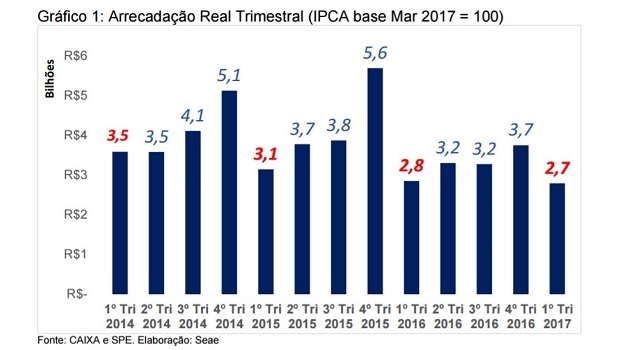
Of the collections and real rate of growth
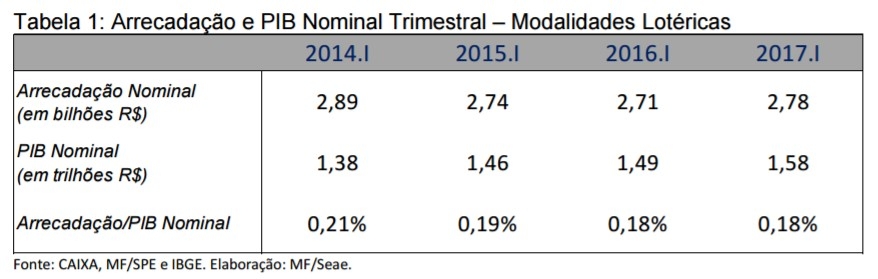
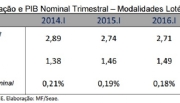
Table 1, in nominal
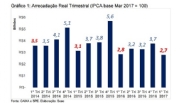
terms, shows that federal lottery revenues fell from US$ 927 million in the
first quarter of 2014 to US$ 891 million in the first quarter of 2017, down
3.9% in this period. In real terms, the ratio between collection and gross
domestic product (GDP) also shows a sharp fall in revenues in this period, as
it reached 0.18% of GDP in the first quarter of this year, 0.03 percentage
point (Pp) below the percentage reached in the first quarter of 2014, 0.21% of
GDP.
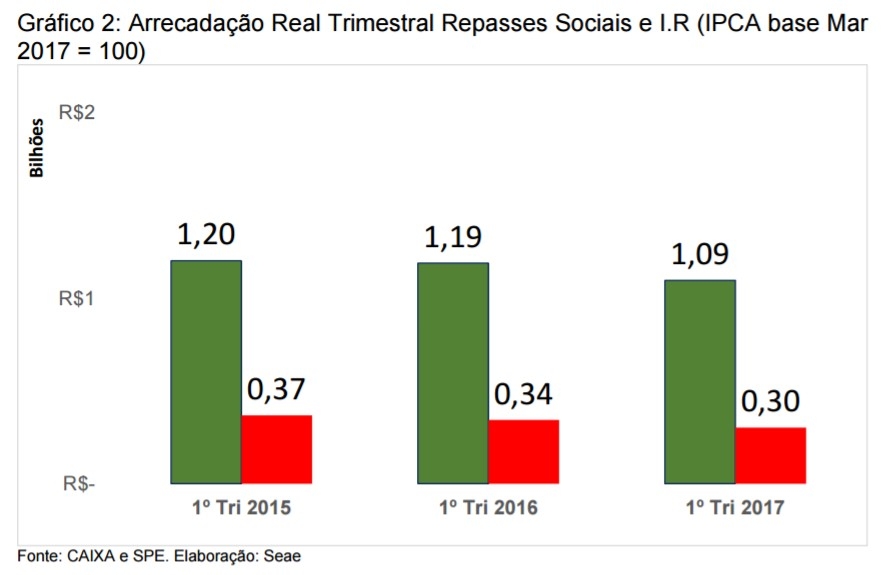
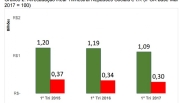
With this decrease in the collection, there was, consequently, a fall in the
allocation of lottery resources to social programs (social transfers), as well
as in the collection of Income Tax with the award granted. Social transfers
have fallen approximately 10% between the first quarter of 2015 (US$ 385 million)
and the first quarter of 2017 (US$ 350 million). In turn, income tax collection
from federal lottery winnings fell by 19%, from US$ 118 million in 2015 to US$ 96
million in 2017.
Lottery of Numbers and Lotteries based on Sports Predictions
Initially, it is worth
mentioning that in Brazil, currently, there are only two federal lottery types:
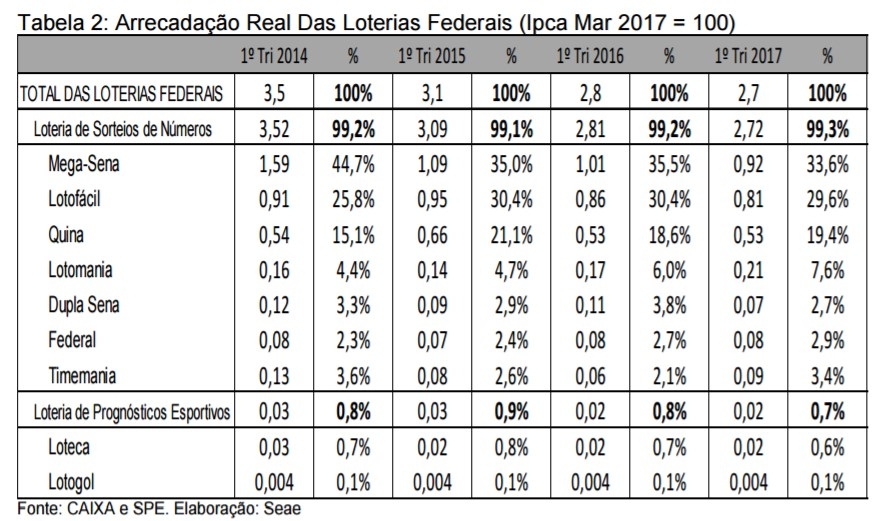
lottery draw and sports predictions. This second type concentrates less than 1%
of the revenues, consequently more than 99% of the federal collection comes
from lottery of numbers draw.
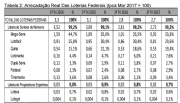
It should be noted that in the first quarter of 2017, the share of Mega-Sena,
the flagship of the federal lotteries, fell to 33.6% of the total
participation, considering that it was at the level of 44.7 % in 2014. This
phenomenon seems to be linked to two reasons: first, the price adjustment of
the Mega-Sena occurred early in 2015; Second, to the relative increase of other
products such us Lotomania, Quina and Timemania, which consequently made the
main lottery product of the country lose participation.