




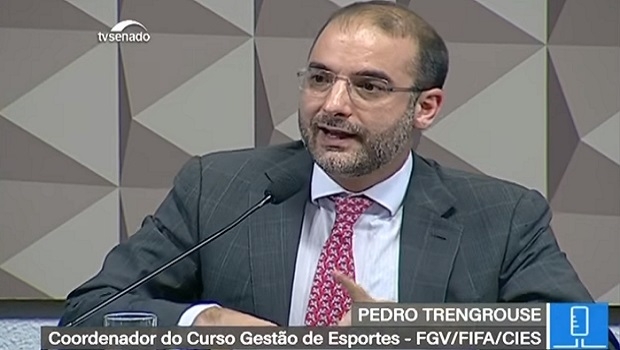
Senator Antonio Anastasia (PSDB-MG) and Federal Deputy Floriano Pesaro (PSDB-SP) emphasized the importance of regulation of gaming in Brazil and defended the creation of a Committee of Specialists in the Federal Senate to prepare a draft for General Law of Games and Lotteries. The parliamentarians were sensitized to the exposition of Professor Pedro Trengrouse at the Public Hearing held at the National Congress on MP 846/2018, last Tuesday.
"The lottery offer transvestite in capitalization bonds, US$ 5.95 billion (44%); federal lotteries, US$ 4 billion (30%); state lotteries, US$ 94.5 million (0.7%); horse racings, US$ 81 million (0.6%); sports betting, US$ 1.05 billion (8%); jogo do bicho, US$ 811 million (6%); casinos, US$ 810 million (6%); and bingos, US$ 635 million (4.7%), noting that in the IBGE's Household Budgets Survey, in which people declare their own expenses, is the estimate of unregulated games is underestimated," says Pedro Trengrouse. The proposal was well received by the parliamentarians Antonio Anastasia (PSDB / MG), and Floriano Pesaro (PSDB / SP).
Professor Trengrouse is the main academic reference of the country in subjects related to sports, games and lotteries. He is Professor of the Getulio Vargas Foundation and Visiting Professor at Harvard. He made FIFA Master, the world's best graduate in the sports industry, and is Certified in Casino Regulation by the University of Nevada Las Vegas.
Trengrouse is the author of several articles on sports, games and lotteries published in specialized magazines and newspapers of great circulation in Brazil and abroad; was a Member of the Commission of Jurists of the Federal Senate for the Draft of General Law of the Sport; Coordinated Study of the Federal Savings Bank on the Games Market in Brazil; was a Speaker of the World Lottery Association and is a Member of the Banking of the Monographs Competition of the Ministry of Finance on Lotteries.
The professor also called attention to "the lack of regulation of sports betting in Brazil, which puts at risk the popular economy and the integrity of the sport. 13 years ago, eleven matches of the Brazilian Championship were canceled by manipulation of results. In 2017, thousands of bettors were left without prizes when they did not honor the results of the 13th round of Serie A because visiting teams won the majority of games, significantly increasing the awards. Today, around 500 online betting sites offer Brazilian games, mostly registered abroad. They operate in Brazil without any taxation, regulation, control or monitoring."
For the FGV professor, another big issue that the federal government must address is the state lottery situation. "Why do some states have lotteries and others do not? Lottery is voluntary tax and its collection can finance policies of public safety, health, education and sport. The state lottery of New York raises US$ 9 billion per year. Rio de Janeiro and São Paulo, for example, could raise more than US$ 270 mbillion with their lotteries," explains the expert.
Trengrouse argues that PM 846 authorizes the Federal Executive to institute other types of lotteries and games. These new modalities could be explored, according to him, directly by the Caixa Econômica Federal; by organs or entities that are part of the State Public Administration; by tourist entities, upon authorization; and by other legal entities, upon concession.
Trengrouse believes that this proposal can give the regulation and supervision of lotteries and games greater dynamism and efficiency. He explains that in this case there would be no need to issue a new law for each new modality, centralizing the Ministry of Finance, including the authorization and supervision of promotional campaigns that currently contribute to the cannibalization of the national lottery market.
"Brazil is far from its potential in the currently regulated game modes. Lottery revenues in Italy reach US$ 34 billion per year with per capita sales of US$ 565; France, US$ 16 billion, of which US$ 249 per capita; United States, only in New York, US$ 9 billion and US$ 456 per capita. Brazil is no more than US$ 4 billion, with per capita sales of US $ 18.53. Behind also neighboring countries such as Uruguay, US$ 40, and Argentina, US$ 36, both figures per capita, in addition to Portugal, US$ 228," compared Trengrouse.
Finally, the expert also warns about the need to include the National Union of Professional Athletes in the list of beneficiaries of the resources of lotteries. According to Trengrouse, the agency must also divide the value that is currently earmarked for the National Federation of Sports Clubs (Fenaclubes), a union association of the clubs.
"It is unconstitutional and an affront to the Principle of Isonomy that the Fenaclubes, a union of the clubs, receive resources from the lotteries and the National Union of Professional Athletes, an employee union, does not receive the same value. Why does one receive and the other does not? ", asks Pedro Trengrouse.
Source: GMB