




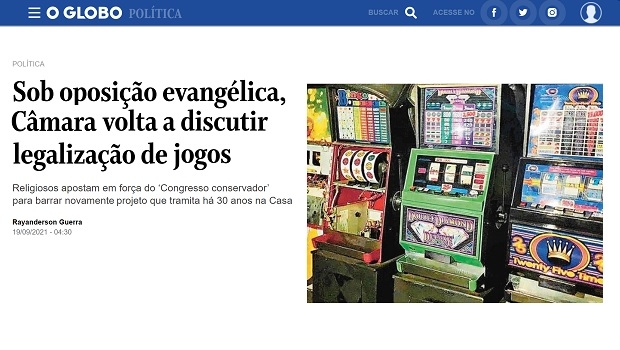
With the support of the president of the Chamber, Arthur Lira (PP-AL), deputies resumed the discussion of the legalization of the gaming sector in Brazil. A work group was installed in the House to analyze a bill presented in 1991 - even with the requirements fulfilled to be considered in plenary, the text has not reached this level in three decades due to the division that the subject generates. Evangelical bench bets on the strength of the 'Conservative Congress' to bar the project again.
In general terms, the subject opposes enthusiasts of the economic revenue potential of the installation of casinos and the release of other modalities to those who warn of the open path to money laundering and other crimes. The possibility of addiction and the consequences for family relationships - the argument more linked to morality is often evoked by religious sectors - are also cited by opponents.
Entrepreneurs in the sector saw in the ascension of Jair Bolsonaro to the Presidency, in 2019, an open path for advancing the agenda. Casino tycoon Sheldon Adelson, who died in January of this year, was in Brazil at the beginning of Bolsonaro’s term and received senator Flávio Bolsonaro (Patriota-RJ) and a delegation in Las Vegas (USA) in January of last year. In the correlation of the internal forces that sustain Bolsonaro, however, the evangelicals had the upper hand in the first chapter of the battle—the second is still in its infancy.
"We have the most conservative Congress in 30 years. There are no votes for approval. We know that Ciro (Nogueira, Minister of the Civil House) has always been in favor of the issue. Ministers Paulo Guedes (Economics) and Gilson (Machado, Tourism), at the right time, we are going to look for them and we are going to prove that the damage caused by the legalization of gaming is bigger than the potential revenue," maintains federal deputy Sóstenes Cavalcante (DEM-RJ), of the Assembly of God Victory in Christ and close to Pastor Silas Malafaia, one of Bolsonaro's most frequent interlocutors.
Internal divergence
Leader of the Evangelical bench, Deputy Cezinha de Madureira (PSD-SP) is also working to end the debate — the group he coordinates must officially take a stand against the project.
On the opposite side of the discussion, more than just a defender of the issue, the minister of the Civil House is the author of a bill that legalizes all gaming verticals, including the local popular jogo do bicho. Within the government, the initiative is not seen with good eyes, for example, by minister Damares Alves (Family, Women and Human Rights), from the Evangelical wing.
The content of the text presented by Nogueira, who is walking very slowly in the Senate, also exposes another type of resistance, this one internal. In the wing of legalization advocates, one group favors a more restricted model, focused on resort-integrated casinos, excluding modalities such as jogo do bicho. The lack of understanding stopped the process at a time when Rodrigo Maia (no party-RJ), then president of the Chamber, was willing to take the matter to a vote.
President of the working group installed in the Chamber, Federal Deputy Bacelar (Podemos-BA) cites the economic crisis that the country is going through as a factor capable of boosting the approval of the bill in Congress.
"There are 14 million unemployed, in need of income, and we only receive six million tourists a year. I respect the religious issue: if religion does not allow it, then the religious do not play; but they can’t impose it on everyone. It's an economic and social issue. They say it can favor money laundering, but they don't talk about how it would happen, where... It's easier to launder money in a parking lot, which charges less taxes," says Bacelar.
Source: O Globo