




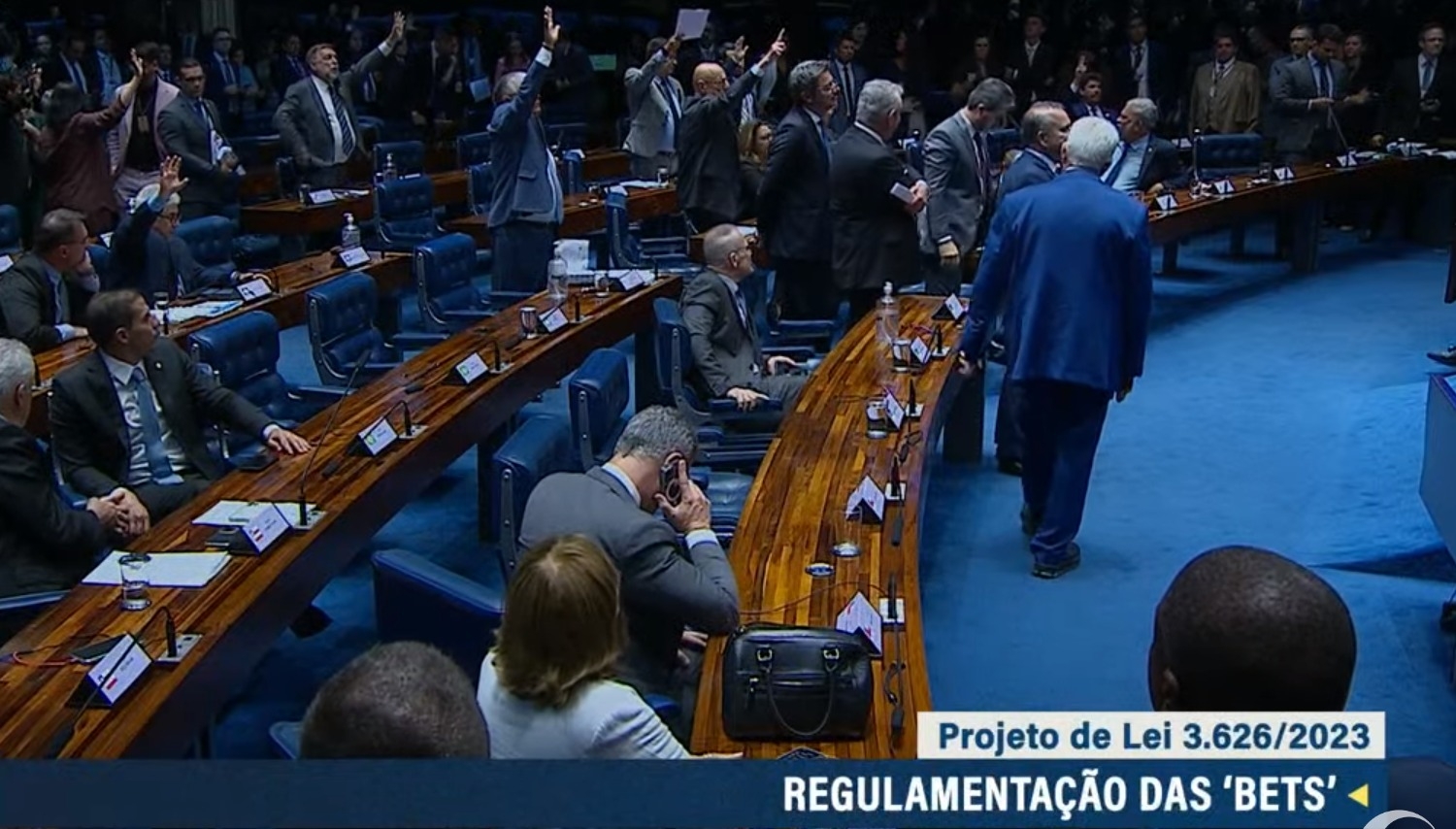
The Bill 3626/2023 report prepared by senator Angelo Coronel (PSD-BA) was approved by the Senate on Tuesday (12) night regulating sports betting in Brazil.
The project determines that bookmakers will pay 12% on the GGR and bettors, once a year, will collect 15% on anything exceeding R$2,112.
For those who bet, the taxation, which will be 15%, will only apply to the gain obtained, minus the amount bet.
The approved rates are lower than those initially suggested by the economic team of the Minister of Finance, Fernando Haddad. Previously, there would be an 18% tax for sports houses; and up to 30% on prizes for individuals.
The matter, as it happened, will not allow the government to raise at least R$10 billion (US$ 2.02bn) in 2024, as estimated by senator Angelo Coronel.
The opposition, mainly the evangelical group and led by senators Carlos Portinho, Eduardo Girão, Magno Malta and Carlos Viana, took a vocal stance against the measure due to the authorization to tax gambling. The proposal opens a loophole for this type of game because it deals, in a generic way, with "online games" and "virtual online gaming events".
Given the exclusion of online gambling, it is already clear that revenue will not even reach R$700 million (US$ 142m), that is, less than half of what the government had predicted, in an undervalued way, for the 2024 Budget Law.
In addition to excluding online gambling, the Senate approved another amendment that prevents the installation of sports betting terminals in physical environments, keeping them only in the virtual model.
The last amendment put up for discussion and voting dealt with the prohibition of advertising by sports betting houses in stadiums or other places for sports. Furthermore, it intended to prevent sponsorship of athletes, referees, coaches and people considered celebrities. It was rejected by 36 votes.
Fixed Quota
The text amends the law regarding the free distribution of prizes for advertising purposes (Law 5,768, 1971) and the law that deals with the destination of lottery proceeds and the fixed-odds betting lottery modality (Law 13,756, 2018). The fixed-odds betting lottery is a betting system that includes virtual events of online games and real events of sports themes, such as football and volleyball games, for example. In this modality, the bettor will win if they correctly predict some condition of the game or the final result of the match.
The project establishes the taxation of operators of betting companies and winning bettors. Law 13,756, 2018, which created this lottery modality, provided that companies would retain 95% of gross revenue (after payment of prizes and income tax), while the project allows for 88%. The text also stipulates that operators must pay a fee of up to R$30 million for the exploitation of bets.
According to the project, fantasy sports, an electronic sport where disputes occur in a virtual environment based on the performance of real people, does not constitute the exploration of a lottery modality. Thus, this modality is exempt from public authorization.
Revenue Distribution Of the amount collected, 2% will go to social security. Other recipients of the funds will be the sports (6.63%) and tourism (5%) sectors.
In sports, the funds will be divided among the Ministry of Sports (4%), athletes (1.13%), and specific sports federations, with percentages ranging from 0.05% to 0.4%. Half a percent of the amount will be directed to state sports departments, which must distribute half to municipal sports departments, proportionally to the population of the city.
In tourism, 4% will be allocated to the Ministry of Tourism, and 1% will go to Embratur.
According to the proposal, education will receive 1.82% of the amount collected. Within this amount, 0.82 percentage points will be allocated to preschools or elementary and secondary schools that have achieved goals for national assessment results. The remainder (1%) will go to public technical high schools.
Authorization
For the exploitation by the operating agent (i.e., the company that exploits the betting system) to be possible, the future regulation will require authorization from the Ministry of Finance, with a duration of up to five years and subject to review at any time. Legal entities must meet various requirements, such as having headquarters and administration in the national territory, having at least one member of the control group with proven knowledge and experience in games, betting, or lotteries, and meeting technical and cybersecurity requirements.
The administrative authorization procedure will be processed electronically, and during its analysis, access will be restricted only to the interested party and their representative. Authorization will only be issued if, after examining the documentation and evaluating the technical and financial capacity of the company and the reputation and knowledge of its controllers and administrators, the Ministry of Finance concludes that all legal and regulatory requirements are met. A fixed consideration amount will also be collected, stipulated by regulation (limited to R$30 million).
Advertising
The electronic channels used by the operating agent must clearly display data such as the number and date of publication of the authorization ordinance, the physical address of its headquarters, contact information for customer service, and ombudsman.
Communication and advertising actions for betting lotteries, disseminated by operating agents, must include warnings discouraging gambling and warnings about its harmful effects, as well as adhere to restrictions on broadcasting times and channels. Advertisements that present betting as socially attractive or contain statements from well-known personalities suggesting that gambling contributes to social or personal success will be prohibited.
Moreover, advertisements making unfounded claims about the odds of winning, or implying that betting can be an alternative to employment, a solution to financial problems, or a form of financial investment will be prohibited. The text also prohibits the operating agent from acquiring rights to sporting events for any form of audio and visual display.
Integrity of Bets
Sports events subject to fixed-odds betting will have measures to mitigate manipulation of results and corruption in live events, with bets proven to be made through manipulation of results and corruption being void.
The resources of bettors cannot be used as collateral for debts incurred by the betting company, and the operating agent must adopt identification procedures to verify the validity of the bettors' identities.
Minors, individuals with significant influence, or employees of the betting company, public officials with responsibilities directly related to the regulation and oversight of the activity, individuals with access to lottery betting systems, and anyone who may influence the outcome of the lottery event, such as athletes and other participants, will be prevented from betting.
Prescription of Bets
The bettor loses the right to receive their prize or request refunds if the due payment is not credited to their graphical account held by the operating agent and is not claimed by the bettor within 90 days from the date of the publication of the result of the event on which the bet was placed.
Unclaimed prize amounts will be reverted, with 50% going to the Student Financing Fund (Fies) and 50% to the National Fund for Public Calamities, Protection, and Civil Defense (Funcap), in accordance with the federal Executive's financial and budgetary program.
Penalties
Violations will be investigated through an administrative process, with penalties for operating agents who violate legal and regulatory rules, ranging from warnings to fines of up to 20% of the collection. According to the text, the fine cannot be less than the advantage gained by the offender and not more than 2 billion reais per violation.
Among the imposed penalties, partial or total suspension of activities for up to 180 days, revocation of authorization, prohibition from obtaining new authorization for up to 10 years, prohibition from participating in bids for a period not less than 5 years, and disqualification from acting as a director of a company that exploits any lottery modality for up to 20 years may occur.
For other individuals or legal entities, when it is not possible to use the collection product criterion in case of fines, the fines may range from 50,000 reais to 2 billion reais per violation.
The Ministry of Finance may also choose not to initiate or suspend, at any stage prior to the decision of the first-instance process, the administrative process for investigating the offense if the investigated party signs a commitment agreement to cease the investigated practice and correct the identified irregularities.
Report
The project was approved in the form of the report, also by Angelo Coronel, previously approved in the Committee on Economic Affairs (CAE), with amendments — the text simultaneously went through the Sports Committee (CEsp). Among the modifications added in the CAE is the proposal to extend the authorization period given by the Ministry of Finance to the betting operating agent from three to five years. Regarding the maximum value of the consideration by the operating agent, another amendment increases the limit from one to up to three commercial brands to be exploited by the legal entity in its electronic channels by authorization act.
The use of facial recognition technology in identifying the identities of bettors and the taxation of individual income tax (IR) on the net prize at 15% were also added to the text.
Among the accepted amendments is the one that deals with the exploration of lotteries by states and the Federal District, an activity authorized by the Supreme Federal Court. In the case of fantasy sports, considering the need for new sources of resources for social security and the regulation of a sector whose results safeguard, albeit in part, randomness, a provision for increasing the Social Contribution on Net Income (CSLL) to 12% for this sector was added.
Finally, Coronel accepted four Plenary amendments: two that equate the tax treatment of fantasy sports prizes with sports betting prizes, one that specifies that Brazilian professional sports organizations cannot have participation from partners or shareholders of lottery operators, and one that instructs the Ministry of Finance to take measures to monitor the activity of bet customers to prevent gambling addiction.
In the discussion of the matter, Rogério Carvalho (PT-SE) pointed out that Brazil is already the second-largest gaming market in the world. For him, regulation is necessary, "without loopholes," to generate jobs in the country and control access to betting platforms.
— Some people don't want regulation and are exploiting games. They don't want regulation because their gain is much greater. Because they don't distribute any kind of gain with the government.
Advertising
Girão defended his highlight with restrictions on advertising in stadiums, drawing attention to the excesses observed.
— Even visually, it's bad to watch a game today: it's just "bet, bet, bet." It's brainwashing.
Jorge Kajuru, on the other hand, advocated maintaining betting advertising, which he considers a significant source of income for television and many clubs. Angelo Coronel and Otto Alencar (PSD-BA) also spoke against the highlight.
Physical Machines
In defense of his report, Angelo Coronel criticized colleagues who try to "brainwash" public opinion against a project he considers beneficial for Brazil.
— They've been saying there will be casinos in bakeries, in stores, in bars. This is a fallacy. There is nothing like that with machines installed in physical places. Whoever wants to play will not fail to grab their phone in the comfort of their home.
Girão, in turn, defended Tereza Cristina's highlight that excludes the possibility of physical machines — according to him, the base text would effectively open a loophole for the installation of electronic devices in commercial establishments. Portinho argued that the installation of physical machines would lead to a public security problem around territorial disputes.
Virtual Games
In defending his amendment that limits the scope of the project to games based on real events, Carlos Portinho emphasized that the highlight restores the position of the original provisional measure, which excluded casino games — which, according to him, could be addressed in another project. He protested against the inclusion of virtual games in the text, noting that in real games, the profit margin is lower.
— It's a free-for-all, my friends. It's the disgrace of the Brazilian family. It's the casino, it's blackjack. (...) The rule is manipulation. The profit of virtual games betting houses is 70%.
Carlos Viana (Podemos-MG) lamented the lack of action against virtual casinos and called for higher tax rates on betting houses to meet health demands.
Angelo Coronel, on the other hand, argued that regulation will provide means of supervision and control for a practice that already exists.
After the vote, Kajuru assessed that the approval of the highlight would discredit the Senate because he believes that, in defense of revenue, the government will make an agreement to overturn the item when the Chamber reexamines the project.
— That's what will happen. We, senators, are wearing the idiots' shirt for the country
Source: GMB