
 Facebook
 Twitter

ENGLISH
Brazil registers 36% decrease of alerts on suspicious sports betting in IBIA 2022 report
The International Betting Integrity Association (IBIA) has published a list of its annual suspicious betting alerts for 2022, with 268 alerts reported throughout the year. This is a 14% increase of 32 alerts on the 2021 figure. However, for Brazil the statistics were positive since its alerts were reduced by 36%. Most come from football, although new sports were added to the list.
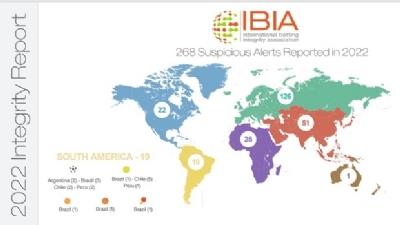



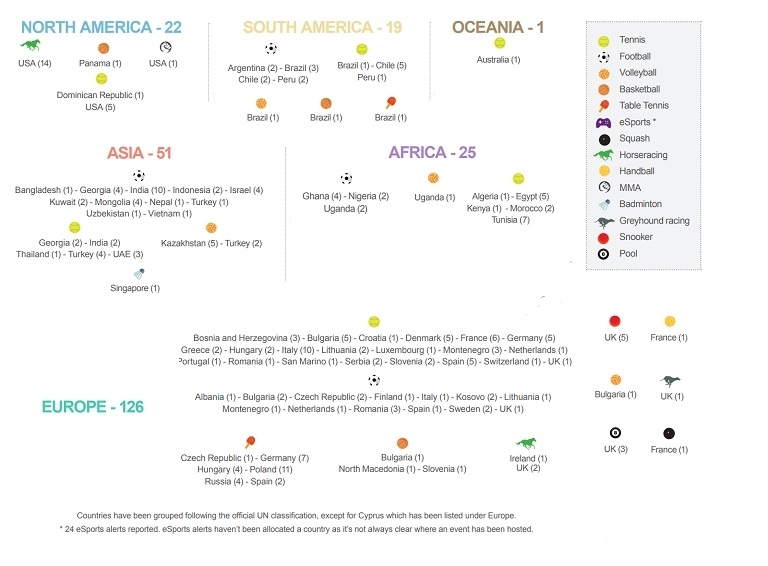
According to IBIA data, in 2022 Brazil added 7 alerts of suspicious activities related to sports betting, 3 of them correspond to football and the rest are distributed 1 each between tennis, volleyball, basketball and table tennis.
In 2021, the same report informed about 11 suspicious activity alerts in Brazil, of which 7 came from football, 2 from tennis, 1 from beach volley and 1 from futsal.
In summary, the positive data for 2022 for Brazil is that its alerts dropped 36% (from 11 to 7 although cases were added in disciplines that in 2021 did not appear on the list, such as volleyball, basketball and table tennis.
The 268 cases reported represents a 14% increase on the previous year, albeit the figure is reasonably consistent with the 230 average annual alerts during 2019-21. There were 50 alerts in the fourth quarter (Q4) of 2022, adding to revised figures of 48 alerts (Q1), 80 (Q2) and 90 (Q3). The 2022 alerts spanned 14 sports and 61 countries, with tennis and football continuing to dominate. Europe also continued to provide the highest number of alerts with nearly 50% of the annual total.
During 2022, successful sporting or criminal sanctions were announced against 15 teams, officials or players where IBIA had reported suspicious activity on their matches. In several of the cases, data from IBIA and its members helped contribute to significant sanctions, such as life bans, being issued. This collective action attests to the powerful impact of IBIA’s data and cross-sector partnership working.
Khalid Ali, CEO of IBIA, said: “The protective shield provided by IBIA is a vital tool in identifying and sanctioning attempted corruption on regulated betting markets. That has been underlined by welcome successful prosecutions during 2022 based on IBIA data, and we expect further corroboration of the association’s important positive impact and collaborative approach to be evident throughout 2023.”
IBIA’s network involves over 45 companies and 125 sports betting brands, including many of the leading regulated betting operators in the world, making IBIA the largest organisation of its nature. Whilst mitigating integrity activity continues across all of our members’ markets, North America has understandably been the focus of much attention: IBIA is the largest integrity monitor in Ontario, with a number of new members set to be announced across U.S. states over the coming weeks and months.
Khalid Ali adds: “The addition of 16 new members in 2022 has undoubtedly strengthened our monitoring and alert network and our ambition is to see all responsible regulated sports betting operators collaborating through IBIA. Proactive and collaborative action by our sector is an essential component in the fight against match-fixing, and to enhancing the overall reputation of the sector in general.”
Over the period 2018-22, IBIA reported 1,224 alerts across 21 sports and 102 countries. This involved 559 alerts in tennis and 295 in football during that five-year period and which accounted for 70% of all cases. The generation of these alerts involved important customer account transactional data which is only available via IBIA and its members, and which is often the initiator of investigative action by sport bodies, regulators and law enforcement, and is the cornerstone of subsequent sanctions.
More data globally:
268 alerts were reported to the relevant authorities in 2022. This is a 14% increase of 32 alerts on the 2021 figure;
This number is within expectations, with the average number of annual alerts at 230 during the past three years, 2019-2021.
The 268 alerts spanned 14 sports and 61 different countries;
Tennis and football continue to provide the majority of alerts. Geographically, Europe recorded the highest number of alerts by continent, with 126;
This figure is consistent with previous years, with the average number of annual alerts at 115 during the past three years, 2019-2021.
In North America 22 alerts were reported for further investigation;
20 of these events were in the United States, however 14 alerts were in relation to a linked issue on U.S horseracing.
Tennis saw 102 alerts, an increase of 27% on the 80 reported in 2021;
Of the 102 tennis alerts, 25 matches were provided to the International Tennis Integrity Agency (ITIA) as intelligence reports as they do not relate to events sanctioned by the main tennis tours. However, some players engaged in those events may fall within the scope of that body’s Tennis Anti-Corruption Program (TACP).
Football saw 67 alerts, a similar figure to the 66 reported in 2021;
A significant proportion of these football alerts came from just one country, India, with ten alerts (15%).
During 2022, successful sporting or criminal sanctions were announced against 15 teams, officials or players where IBIA had reported suspicious activity on their matches;
*In several of the cases data from IBIA and its members helped contribute to significant sanctions, such as life bans, being issued.
IBIA’s Monitoring & Alert Platform
IBIA’s Monitoring & Alert Platform is a highly effective anti-corruption tool that detects and reports potential fraudulent activity on our members’ betting markets. The bespoke system tracks suspicious transactional activity linked to individual consumer accounts using operators’ internal risk and security control systems:
*If a member identifies suspicious betting activity they create an alert in the platform which is shared with all members.
*Other members must respond quickly and in detail indicating whether they saw similar activity.
*We then review the activity based on our own risk-based criteria to determine whether it warrants further investigation.
*Any suspicious activity is then reported to the relevant sports governing bodies and regulator we have an agreement with. Members also make their own reports as required under their respective licensing conditions.
*Sports governing bodies and regulators are encouraged to request potentially suspicious events be reviewed by us and our members.
Source: GMB