




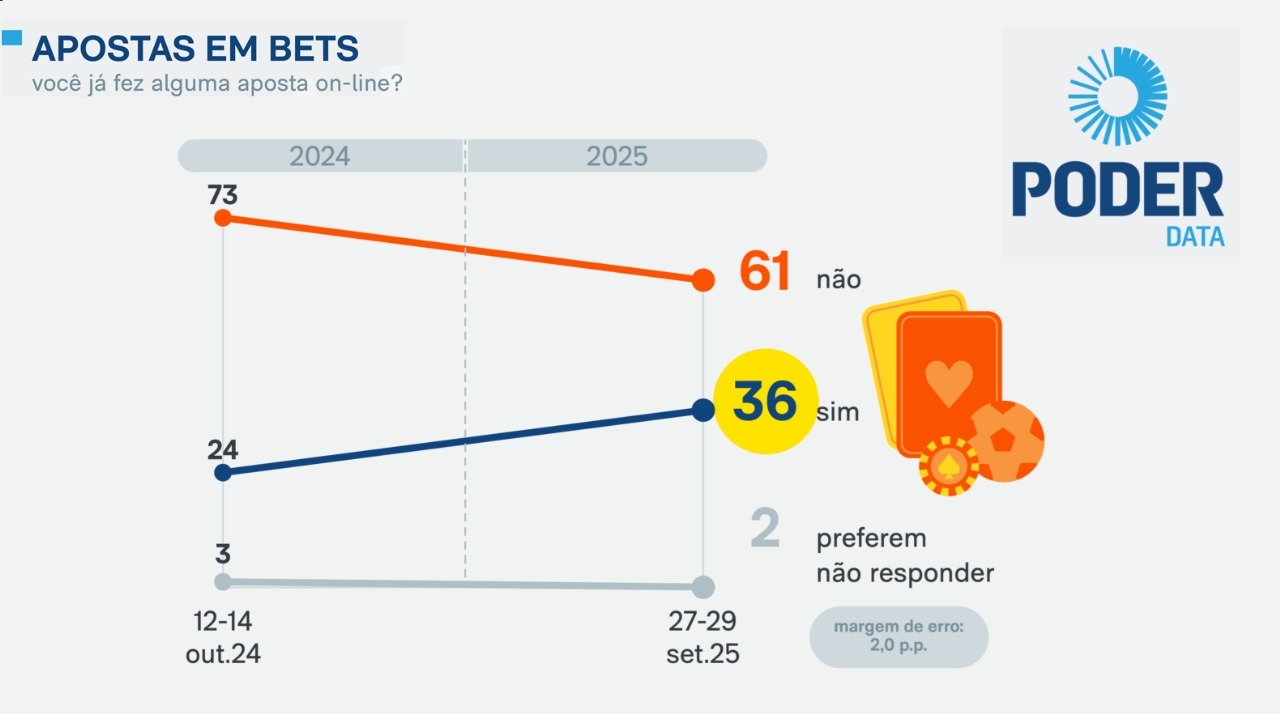
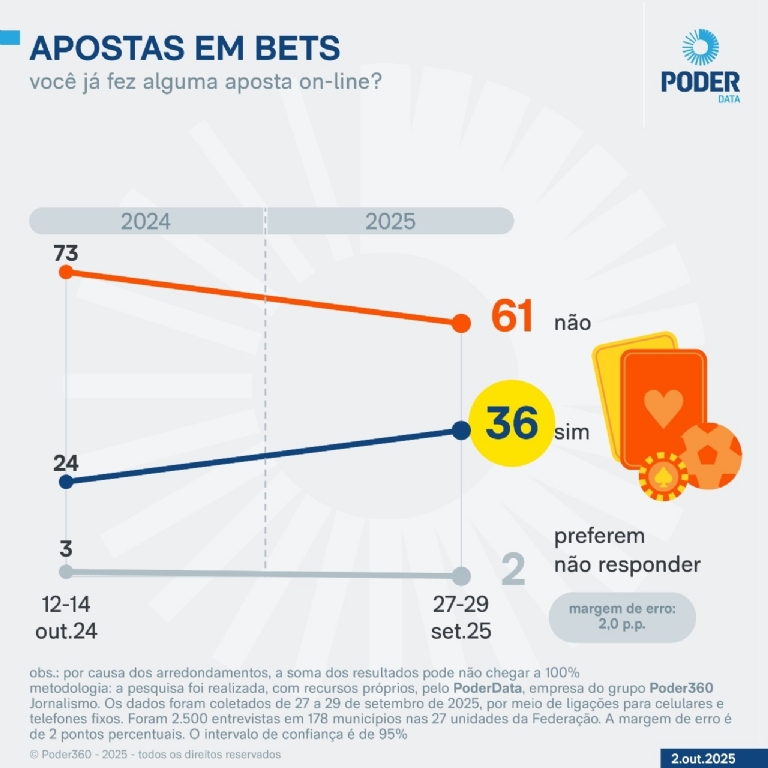
The survey results show that the betting market in Brazil reaches a considerable portion of the population. When projecting this percentage (36%) onto the Brazilian electorate (those over 16 years old), 56.1 million people gamble in a market that until recently operated without regulation.
Sports betting was legalized in Brazil in 2018 through Law 13,756 of 2018, which authorized the practice as long as bookmakers comply with established rules and laws. However, the market was only regulated by the government on January 1st of this year. In addition to organizing the sector, regulation is also one of the Ministry of Finance's strategies to increase revenue.
Despite the economic benefits, the government has taken measures to mitigate potential damage caused by online betting. It created an action plan to protect gamblers, which includes mental health initiatives, self-exclusion, allowing users to block access to all their accounts on authorized websites, and a ban on Bolsa Família and BPC (Continuous Cash Benefit) beneficiaries from placing fixed-odds bets.
Another aspect of the survey justifies the government's measures: the debt rate due to online gambling has more than doubled since October. It went from 16% in October 2024 to 35% in September 2025.
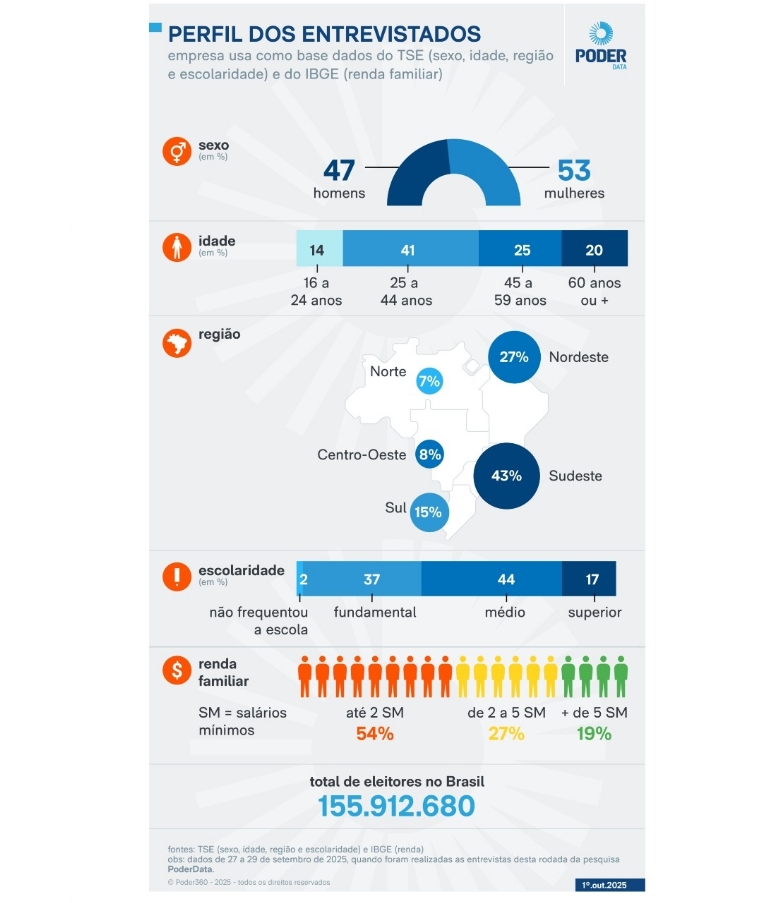
The survey was conducted by PoderData, a company of the Poder360 Journalism group, using its own resources. Data were collected from September 27 to 29, 2025, through calls to cell phones and landlines. 2,500 interviews were conducted in 178 municipalities across the 27 states of the Federation. The margin of error is 2 percentage points. The confidence interval is 95%.
To reach 2,500 interviews that proportionally fill out the groups (based on their social appearance) by sex, age, income, education, and geographic location, PoderData makes tens of thousands of phone calls. Often, more than 100,000 calls are made until interviewees who accurately represent the entire population are found.
Stratification
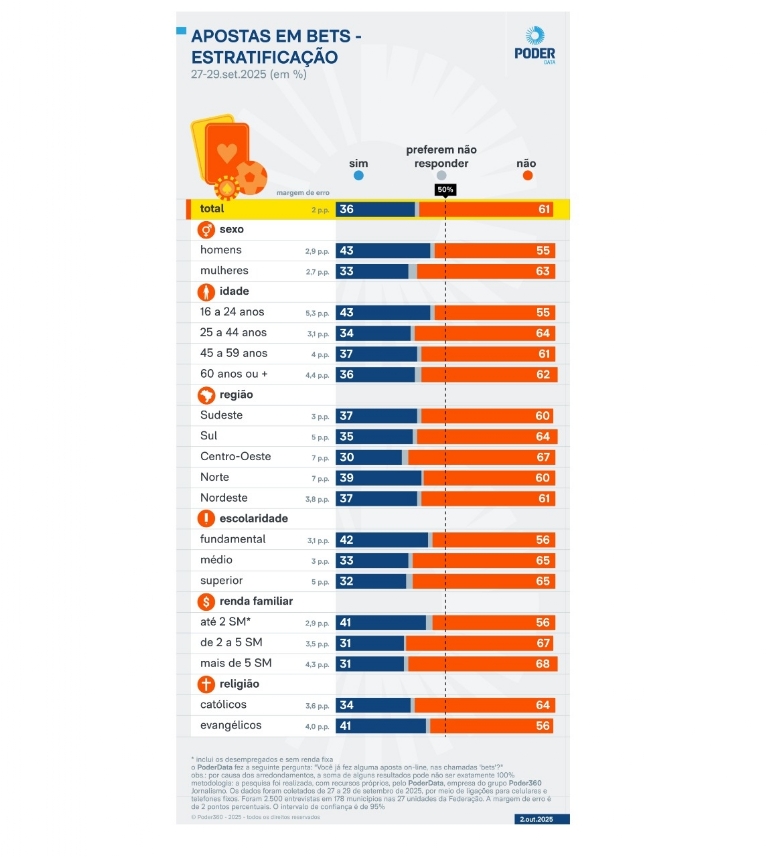
Poder360 stratifies the data by demographics (sex, age, region, education, and income). Here are the highlights:
- gamble more – the rates of those who report having gambled are higher among men (43%), young people aged 16 to 24 (43%), those with a primary education (42%), and those with a family income of up to 2 minimum wages (41%).
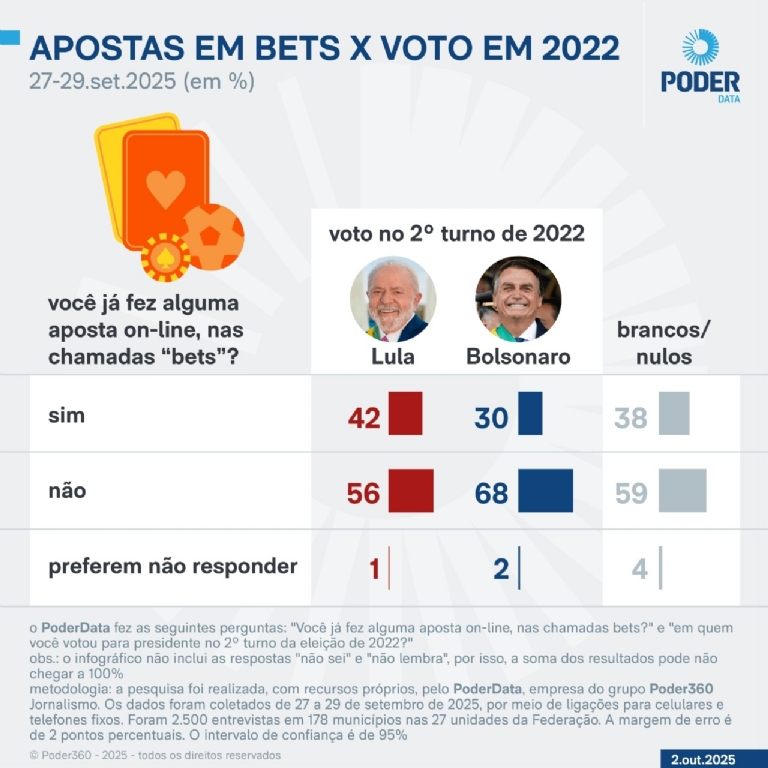
Lula supporters bet more
The responses regarding online betting were cross-referenced with respondents' vote in the 2022 runoff election. The percentage of voters who say they have already placed a bet on a website is higher among president Lula supporters (42%) than among Bolsonaro supporters (30%).
Research aggregator
Poder360 maintains a collection of thousands of surveys using well-known methodologies, for which the source of the information can be verified. Studies have been conducted since the 2000 municipal elections. This is the largest and longest-running survey of electoral research available on the Brazilian internet. The database is interactive and allows you to track the progress of each candidate.
Methodology
The PoderData survey was conducted from September 27 to 29, 2025. 2,500 people aged 16 or older were interviewed in 178 municipalities across the 27 states of the Brazilian Federation. Parametric weighting was applied to compensate for disproportionalities in the variables of gender, age, education level, region, and income. The margin of error is plus or minus 2 percentage points.
The interviews were conducted by telephone (landlines and cell phones) using the IVR (Auditory Response Unit) system, in which the interviewee listens to recorded questions and responds using the device's keypad. The study's confidence interval is 95%.
For ease of reading, the survey results have been rounded. Because of this process, the sum of some results may differ from 100. Differences between total frequencies and percentages in cross-tabulations may arise due to non-response. This study was conducted with the resources of PoderData, a research company that is part of the Poder360 Jornalismo media group.
Source: Poder360