




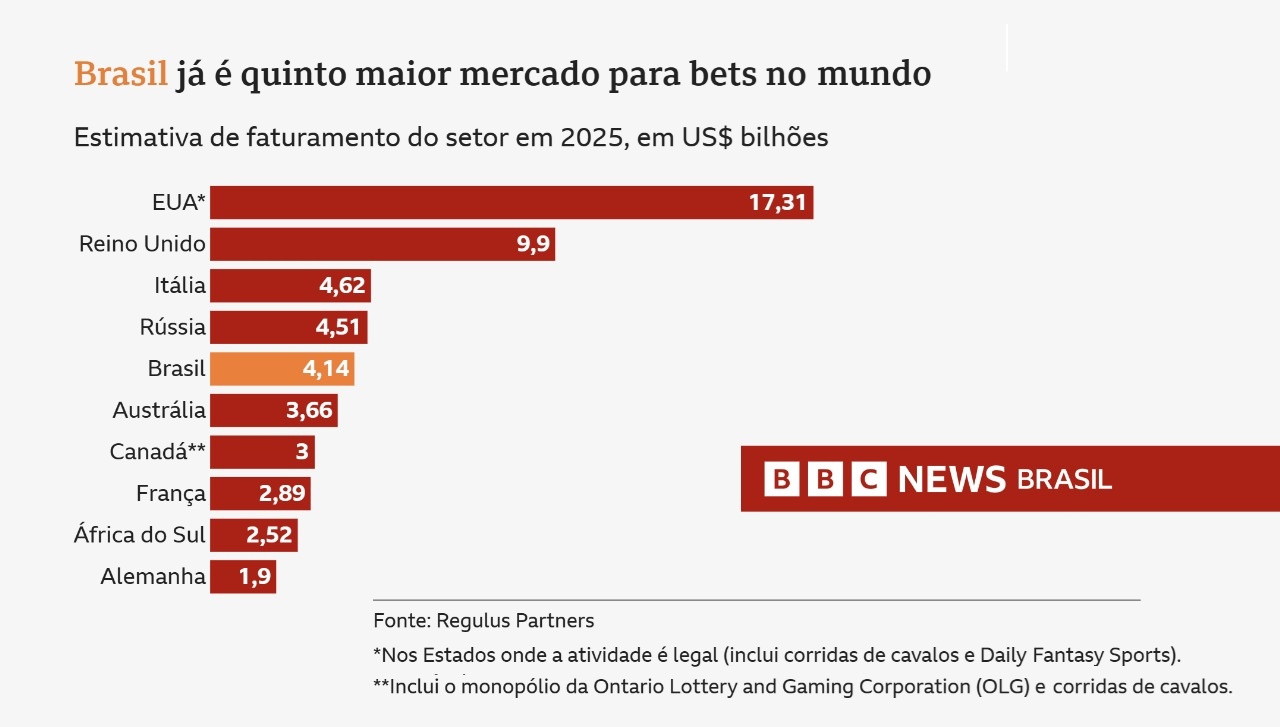
Brazil’s online betting market has experienced exponential growth in recent years, earning its first-ever inclusion in the Regulus Partners’ list of the top five global markets, behind only the United States, the United Kingdom, Italy, and Russia.
Projections based on public company financial reports and market data place the United States in first place with net revenue (after taxes) of US$17.312 billion, followed by the United Kingdom with US$9.901 billion, Italy with US$4.617 billion, and Russia with US$4.515 billion.
These figures align with data from Brazil’s Prizes and Betting Secretariat, which recently reported that the 78 companies currently authorized to operate in the country generated R$17.4 billion (US$3.23 bn) in revenue in the first half of 2025.
This is the first time Brazil has appeared in Regulus Partners’ ranking, as the country had no betting regulation prior to 2024.
Although historical data is limited, Paul Leyland, an expert in gambling economic and business models at Regulus, noted the aggressive expansion of the Brazilian market over the last decade, which was valued at only US$300 million in 2014. “The biggest boost came during the COVID-19 lockdowns,” he observed.
The market’s rapid expansion was driven not only by the pandemic and increased digital consumption, but also by structural factors: a high level of financial inclusion, the widespread use of Pix, the country’s long history of gambling prohibition (which created pent-up demand), openness to new technologies, and aggressive marketing strategies by operators.
Between the legalization of betting in 2018 and the effective regulation in 2024, the sector operated virtually without rules, allowing companies to develop highly persuasive strategies to attract users.
Intuitive platforms, reward systems, notifications, missions, and in-app games made mobile betting quick, accessible, and engaging. Experts such as Victor Silva, a researcher at the Center for International Development at Harvard Kennedy School, say Brazil has become a true behavioral economics laboratory, systematically exploring bettors’ cognitive and social biases.
Football’s central role
Football plays a key role in this scenario. Among the 20 clubs in Brazil’s Série A, 18 have betting sponsors, with the five largest contracts totaling over R$500 million (US$92.9m).
In countries such as Colombia and Mexico, bettors often deposit and withdraw winnings in cash at physical retail points, explains Antonio Forjaz, Entain’s Managing Director for Latin America.
“In Colombia, for example, people make deposits at newsstands or small shops. Here, it’s different — everything is Pix, everything is instant,” Forjaz notes, highlighting Brazil’s advanced digital payment ecosystem and high banking penetration as key advantages.
According to him, Brazil is now one of Entain’s most important markets.
“It’s like the U.S. — a high-growth country with strong focus and potential,” he says.
André Gelfi, CEO of the Brazilian Institute for Responsible Gaming (IBJR) and Managing Partner at Betsson, adds that beyond financial inclusion, Brazilians are more open to new technologies and digital consumption, which aligns perfectly with an industry that is now fully digitalized.
He also attributes growth to Brazil’s long-standing gambling ban, which created a latent demand for gaming entertainment.
“Brazil has had an almost total ban on gambling for over 80 years. When a new form of gaming appears on your phone, people say, ‘Wow, that’s amazing! I’ve never seen this before,’” Gelfi explains.
Sponsorship and exposure
Betano, sponsor of Flamengo, tops the list with a contract worth R$220 million (US$40.9m), followed by Superbet (R$113 million / US$21m), Esportes da Sorte (R$103 million / US$19.1m), Sportingbet (R$100 million / US$18.6), and H2Bet (R$60 million / US$11.2m).
For betting companies, this association with Brazil’s most popular sport not only guarantees visibility but also socially legitimizes betting, integrating it into fans’ daily lives and culture.
Despite economic growth and rapid digitalization, experts warn of social and financial risks. Silva compares betting to “temptation goods” like cigarettes — products that must be regulated to prevent harm. Data shows that millions of Bolsa Família welfare recipients transferred funds via Pix to betting companies, prompting Brazil’s Supreme Court (STF) to recently restrict the use of social benefits for that purpose.
Widespread advertising has also been a driving factor. Once little-known, betting brands now appear everywhere in Brazil — on football jerseys, at Carnival VIP boxes, on social media, on influencer pages, and even on public buses in Rio de Janeiro and São Paulo.
According to Silva, this constant exposure has normalized betting and the very concept of “bets” in Brazilian society. From the companies’ perspective, Forjaz notes that in a market with little product differentiation, such as betting, advertising is key to building brand recognition and staying top of mind.
Football, therefore, acts as a double engine — both as an advertising platform and as the main object of betting.
Regulation and advertising debate
Current regulations prohibit advertising aimed at minors, but a bill pending in Congress since 2023 proposes stricter rules, including bans on ads featuring athletes, artists, and influencers. The Senate approved the bill in May 2025, and it is now awaiting review in the House of Representatives.
For Gelfi, from IBJR — which represents 24 betting brands — this discussion is premature. “There’s still a huge illegal market. Advertising helps channel demand toward legal, registered companies,” he argues.
Forjaz from Entain agrees, adding that in the illegal market, there are no ID checks, anti–money laundering controls, age verification, responsible communication, or tax payments.
Regarding football partnerships, he notes that betting revenue has helped develop Brazilian football. “If you remove betting from football, you might see fewer logos — but clubs will clearly lose a vital source of funding for their growth,” Forjaz concludes.
Source: BBC News / GMB