




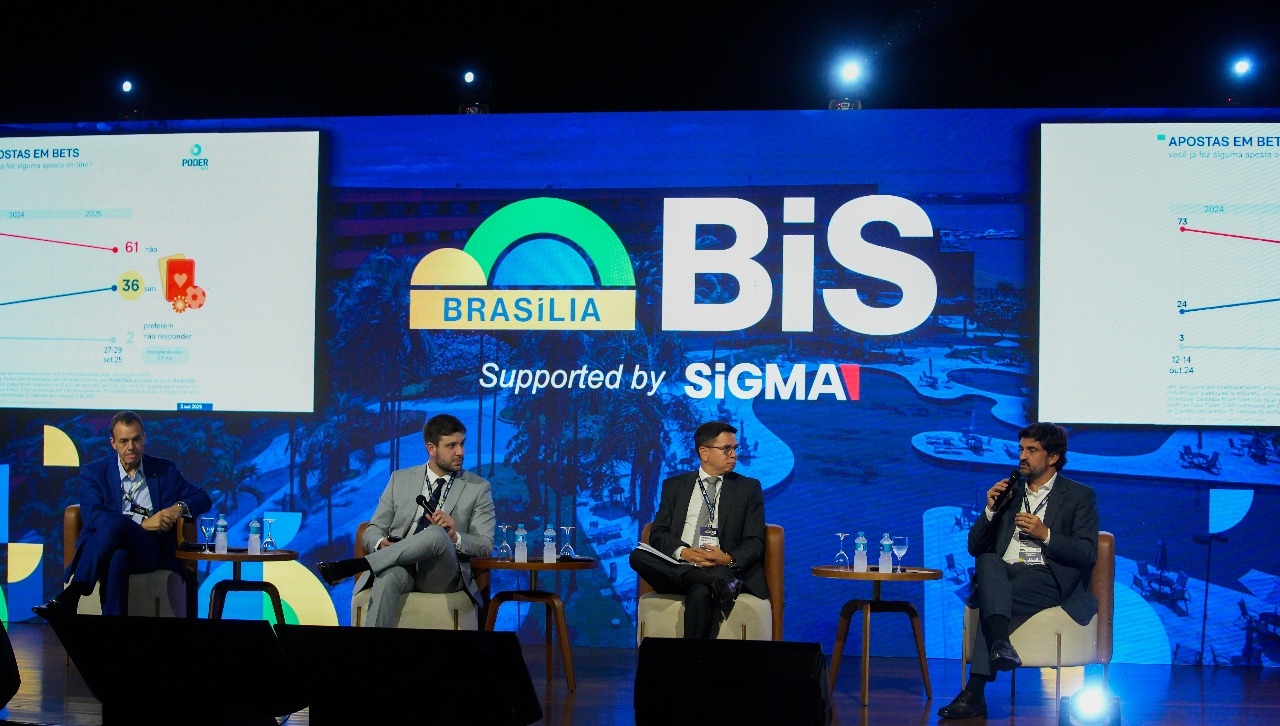
During the panel “The Arena of Numbers: The Betting Market from the Perspective of Entrepreneurs and Government in Brazil,” held at the Brazilian iGaming Summit (BiS) in Brasília, Rocco Neto, who also serves as Secretary for Economic Development of Sports, stated that the government has received reports of professional players from Brazil’s Série C and Série D football championships betting during matches.
The panel also featured Plínio Lemos Jorge, President of the National Association of Gaming and Lotteries (ANJL), and Renato Siqueira, CEO of Caixa Loterias, with João Gallucci Rodrigues, Managing Partner at Poder360, moderating the discussion.

“Many athletes don’t even know they are prohibited from betting. We’ve received reports of players placing bets during halftime — it’s rare, but it happens frequently enough to be concerning,” said Rocco Neto.
He explained that one of the government’s initiatives to combat this type of conduct will be the creation of the PED (Sports Exposed Persons) registry — similar to the PEP (Politically Exposed Persons) model — to monitor and prevent betting and match-fixing involving athletes.
The Secretary also warned about the vulnerability of younger players or those in lower divisions:“Ninety percent of Brazilian football players earn no more than the minimum wage.”
He linked this scenario to criminal groups involved in match manipulation and the illegal betting market.
For Rocco Neto, monitoring and prevention initiatives are urgent to safeguard the fairness of competitions and protect players’ careers.
“Our responsibility is to protect the integrity of results, the integrity of athletes, and those who keep the game moving,” he emphasized.

He also recalled that a working group was established with the Ministries of Sports, Finance, and Justice, as well as the Federal Police, to develop a National Policy to Combat Match-Fixing in Sports.
“We believe this must be treated as a matter of public policy,” he concluded.
Government task force to combat match-fixing
Also on Tuesday (21), the inter-ministerial task force responsible for creating the National Policy to Combat Match-Fixing in Sports met to discuss its work plan. The group, formed by the Ministries of Sports, Justice and Public Security, and Finance, along with the Federal Police, was established on September 9.
The creation of this task force is a concrete response from the Brazilian government to the rising number of match-fixing reports. The initiative underscores the country’s commitment to sports integrity by uniting the technical expertise of three ministries and the Federal Police, institutions that play a key role in tackling such crimes.
Industry accuses government of “revenue-driven overreach” over retroactive tax proposal
Tensions between betting industry representatives and the federal government flared once again during BiS Brasília. The main controversy revolves around the possibility of retroactively taxing operations carried out before the official regulation of Brazil’s sports betting and iGaming markets — approved in 2023 and implemented in 2024.
Plínio Lemos Jorge, President of ANJL, was among the strongest critics of the measure, calling it a “revenue-driven overreach” by Brazil’s Federal Revenue Service. According to him, the proposal lacks a clearly defined taxable event and legal basis, threatening the regulatory security and predictability the industry has been striving for.
“There is no taxable event that justifies retroactive taxation. The market needs stability, not tax surprises,” said Lemos Jorge, noting that the sector has always shown willingness to engage in dialogue with the government to build a long-term, stable regulatory framework.

What’s under discussion
The proposal is linked to the “Litígio Zero Bets” program, a special regime for foreign exchange and tax regularization. The plan would allow the repatriation of funds sent abroad until December 31, 2024, covering the period prior to the full implementation of Brazil’s regulatory system.
According to the Federal Revenue Service, the collection would include a 15% income tax on capital gains, plus a 100% penalty on the assessed tax, effectively doubling the rate. The initial revenue estimate stands at R$5 billion (US$929m).
Risk of setbacks and capital flight
Lemos Jorge also warned that new tax increases or sudden regulatory changes could drive operators away from Brazil.
He cited, for example, the proposal by Deputy Lindbergh Farias to raise the betting tax rate from 12% to 24% of gross revenue, a move considered unfeasible by much of the market.
“If the regulatory environment ceases to be competitive, operators will simply migrate to other jurisdictions or return to the informal market. That’s the opposite of what legalization is supposed to achieve,” said the ANJL president.
He also stressed that the regulated betting sector generates jobs, pays taxes, and invests in technology and sports integrity, while the illegal market, estimated at billions of reais annually, continues to operate unchecked.
Caixa bets on credibility in the new market
One of the most anticipated announcements at BiS Brasília was Caixa Econômica Federal’s entry into the online betting market, scheduled for November 2025.

Renato Siqueira, CEO of Caixa Loterias, stated that the goal is to bring greater transparency to the market and reinforce the state bank’s commitment to responsible gaming.
“Our commitment is to responsible gaming — making sure players understand they are engaging for entertainment, not for guaranteed financial gain,” said Siqueira.
For Rocco Neto, Caixa’s entry marks a turning point for the industry: “The arrival of a state-owned bank brings institutional credibility and will allow the market to stabilize by 2026,” he concluded.
Source: GMB