





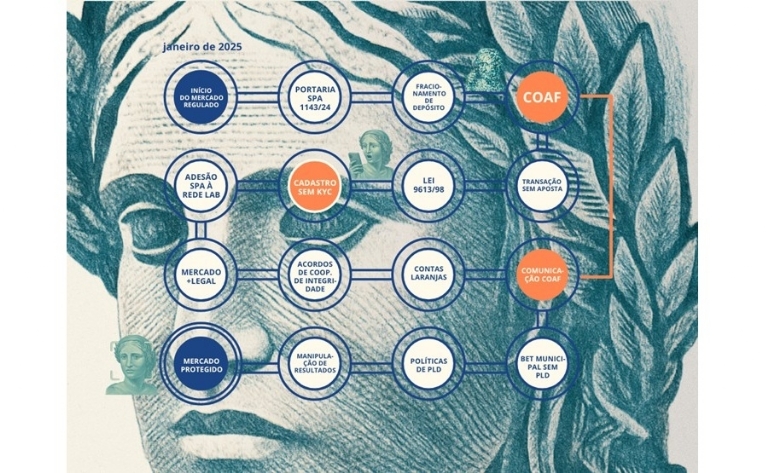
Imagine a game board where the challenge is to move forward, square by square, until you reach the ultimate goal. It may sound like just another game, but it perfectly mirrors the complex challenge of preventing money laundering.
When the Secretariat of Prizes and Betting (SPA) rolled the dice in January this year, it faced numerous regulatory challenges—one of them being to prevent the sector from becoming a shortcut for crimes such as money laundering, terrorism financing, and the proliferation of weapons of mass destruction.
The creation of a specific ordinance to address the issue helped SPA move a few squares ahead, but to reach the ultimate goal, it must overcome obstacles and keep advancing.
SPA’s membership in Rede-Lab: A strategic partnership against financial crimes
The SPA has signed a Technical Cooperation Agreement with the National Network of Anti–Money Laundering Technology Laboratories (Rede-Lab), a program coordinated by the Department of Asset Recovery and International Legal Cooperation (DRCI) of the Ministry of Justice and Public Security (MJSP).
This partnership, formalized through the Technical Cooperation Agreement, will be of great importance to both entities. As the regulator of a sensitive sector, SPA will be able to share information and expertise gained during the betting regulation process. Meanwhile, Rede-Lab will assist the iGaming regulator by providing staff training and sharing best practices in combating money laundering.
With this alliance, it’s fair to say that SPA has gained a powerful advantage, not just one, but several squares ahead. As the earlier analogy suggests, strategy is key to making good decisions, and SPA’s partnership with Rede-Lab was truly a master move!
What is Rede-Lab?
According to the MJSP (Ministry of Justice and Public Security), the Anti–Money Laundering Technology Laboratories (LAB-LD) are specialized units that use technology to process large volumes of information in the fight against money laundering and related crimes. These laboratories are staffed by professionals with specific training and expertise in the field.
The creation of LAB-LD fulfills Goal 16 of the 2006 National Strategy for Combating Corruption and Money Laundering (ENCCLA), which called for the “implementation of a model laboratory to apply technological analysis solutions to large data volumes and to promote studies on best practices in hardware, software, and professional training.”
The motivation behind LAB-LD came from ENCCLA’s observation that investigations into money laundering, corruption, and related crimes often involved lifting financial, telecommunication, and tax secrecy for numerous accounts over long periods.
This produced vast amounts of data that required analysis—often carried out without the necessary technical specialization.
How does LAB-LD work?
The Anti–Money Laundering Technology Laboratories operate at the request of their affiliated institutions, conducting specialized analyses in high-priority cases.
Their focus is on identifying suspicious patterns and connections between individuals and potential criminal organizations. Their work helps map illicit networks, trace assets tied to crimes, and identify the leaders, intermediaries, collaborators, and ultimate beneficiaries of these resources.
Through this work, the LAB-LDs contribute to dismantling criminal organizations and recovering assets obtained through illegal activities—returning them to victims or, in many cases, to the State itself.
Rede-Lab’s restructuring and current composition
Rede-Lab was restructured by MJSP Ordinance No. 145 of August 15, 2022, becoming a permanent Institutional Cooperation Program of the Ministry of Justice and Public Security.
Its goal is to foster collaboration among participating agencies by promoting the sharing of technologies, methodologies, analytical techniques, and data related to anti–money laundering efforts.
In addition, Rede-Lab seeks to expand technical knowledge, encourage research, training, and the development of specialized teams among its members—the LAB-LDs.
Currently, Rede-Lab is composed of 64 institutions, including the Civil Police and Public Prosecutors’ Offices from all 27 states, the Federal Police, the Military Public Prosecutor’s Office, the Federal Public Prosecutor’s Office, and now, the Secretariat of Prizes and Betting of the Ministry of Finance.
Fred Justo
Director of AML at Legitimuz, a Brazilian company that provides integrated solutions for the iGaming sector, including identity verification (KYC) and anti–money laundering (AML) prevention. The company develops advanced technologies to identify, monitor, and analyze customer profiles, ensuring regulatory compliance and mitigating risks related to fraud and illicit activities. Its solutions help operators protect the betting market, promoting a safe, transparent, and fully compliant environment.