





IBJR official position
The Brazilian Institute for Responsible Gaming (IBJR) — which brings together the leading sports betting companies in Brazil and worldwide — considers the proposal by the National Confederation of Industry (CNI) to create the “CIDE-Bets,” with a 15% tax on each bet in the regulated market, to be gravely harmful to the country.
Such a tax would penalize law-abiding players while directly benefiting the illegal market, which would continue to operate without paying anything. As the industry clearly puts it: if betting legally becomes more expensive, Brazilians will bet illegally.
The market already bears one of the highest tax burdens in the world for the sector: 12% on GGR, plus PIS/Cofins and ISS, resulting in a total consumption tax burden of around 25%. There is no “tax benefit” — only a developing industry trying to survive unfair competition from operators that pay no taxes.
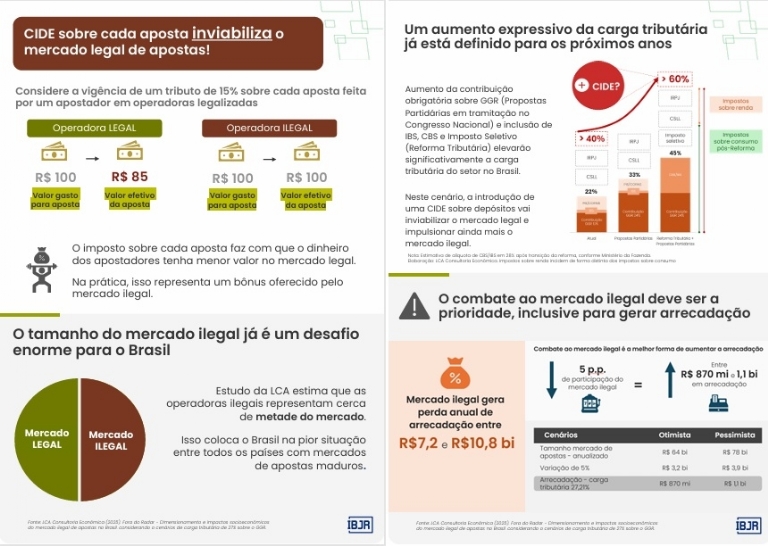
The CNI proposal is also based on a serious economic mistake. The estimated revenue of R$ 8.5 billion is vastly overstated, as the measure would further stimulate the illegal market, which already accounts for about half of all bets placed in Brazil.
Illegal platforms do not pay taxes — and they will not start doing so under the CIDE-Bets. The effect would be the opposite: a shrinking tax base and faster migration to the illegal market. According to a study by LCA Consultoria, reducing the illegal market by just five percentage points could generate around R$ 1 billion (US$ 185m) more per year in public revenue.
“In practice, a 15% tax on each bet is equivalent to giving a reverse bonus of 15% to the illegal market — an incentive created by the State itself, artificially increasing the appeal of unregulated platforms. It would reward those who don’t pay taxes and punish those who do. The inflated revenue projection for the CIDE-Bets does not hold up under any realistic model of consumer behavior. By making the regulated market more expensive, revenue falls and crime rises,” says André Gelfi, founding member and board director of the IBJR.
The IBJR will continue to advocate for a balanced and effective taxation policy — one that strengthens the regulated market, protects consumers, and increases tax revenue by fighting illegality, not punishing compliance.
Brazilian Institute for Responsible Gaming (IBJR)
Source: GMB