


Just like in 2024, the champion will pocket US$ 2 million, while the runner-up will take home US$ 750,000. Simply participating in the group stage will earn the teams US$ 50,000.
The 16 teams have been divided into four groups, with the top two from each advancing to the quarterfinals. Brazil is represented by three clubs: defending champion Corinthians, São Paulo, and Ferroviária.
In addition to sponsorship revenues, the Women’s Copa Libertadores counts on several major official partners, including Amstel, Coca-Cola, EA Sports, Mastercard, and Mercado Livre, as well as commercial partners such as DHL, Powerade (also part of The Coca-Cola Company), and Puma.
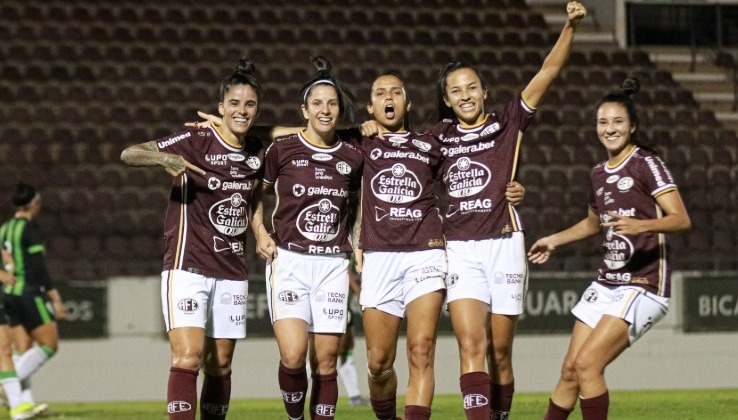
It is true that the figures are nowhere near those in men’s football, but women’s teams also feature numerous sponsors on their jerseys or as institutional backers, reaching a total of 105 across the 16 participants.
As in the men’s Série A, which is 100% backed by sports betting companies, women’s teams also show a strong presence of betting sponsors — 10 of the 16 clubs, with 9 of them having a betting brand as their main sponsor.
Unlike clubs that share the same sponsor for both men’s and women’s teams, such as Corinthians and São Paulo, what stands out most in women’s football is Ferroviária’s sponsorship deal with GaleraBet, in place since 2022 and one of the most consistent and long-lasting partnerships in the sport.
“We know how much the sport has grown since then and how investments in women’s football sponsorships contribute to this expansion. GaleraBet has been part of this major project since 2022 when we became pioneers by sponsoring Ferroviária’s women’s team, proving that long-term work produces significant results,” said Marcos Sabiá, CEO of GaleraBet, a company that was one of the pioneers in women’s football sponsorships and has also been involved with Corinthians and the Brazilian Women’s Championship.
For Fábio Wolff, one of the creators of the Brasil Ladies Cup, which this year reached its fifth edition, partnerships with these brands are essential for the competition’s development. “With the strengthening of women’s football, we’ve seen a large number of companies interested in supporting the category. These partnerships drive the sport’s development both on and off the field. A great example is the number of new deals being signed by Brazilian football clubs,” he said.
“It’s important to see brands supporting women’s football on a recurring basis, because the sport needs it. Beyond the growing visibility and popularity, when it comes to brand activations and interactions, the athletes deliver a show. They strongly embrace the arrival of sponsors and are extremely professional in connecting with fans, which greatly facilitates the work of club marketing departments,” explained Renê Salviano, CEO of Heatmap and an expert in sports sponsorship and marketing activations.
Camila Estefano, general manager of “Estrelas”, a women’s football social program now in its fourth season that offers medical, dental, nutritional, and other services to 120 girls every year, also commented on the sport’s growth.
“Women’s football has been experiencing significant growth in recent years, in terms of viewership, audiences, and social media engagement. I believe the 2027 Women’s World Cup will certainly break barriers and further expand Brazilian fans’ interest in the sport. It will be a turning point for the recognition of women’s football in the country,” she said.
In Brazil, sponsorship acquisition was key to expansion
The sport’s wide exposure reflects not only its athletic growth but also its consolidation as a business platform. Until August, the only company confirmed for the tournament was Amazon. With the involvement of Heatmap — a sports marketing agency — negotiations accelerated, and now more than 15 brands are confirmed for the decisive matches of the competition.
Among the companies that signed contracts are: Banco Sicoob, Itambé, Plié, Perdigão, Sadia, Start Bet, Ciclic, Arizona, Dover Roll, Alfapet, Aposta Ganha, Zaeli, Esportes da Sorte, Wega Motors, Luck.bet, Embalixo, and Perfil Líder.
A study by Nielsen Sports — a global sports analytics company — in partnership with PepsiCo, indicates that women’s football is set to consolidate itself among the world’s top five most-followed sports by 2030, representing 38% growth and reaching over 800 million people.
The global audience of major tournaments is expected to increase by 30% over the same period, while sponsorship revenues are already showing major advances, with sponsorship deals tripling at the 2023 Women’s World Cup compared to 2019, alongside a significant growth in fan bases in countries like China, Brazil, and India.
Commercial interest is already following audience growth. In May 2025, a friendly match between Brazil and Japan, broadcast in prime time on TV Globo, reached 30 million viewers across Globo and SporTV — the highest audience ever recorded for the Brazilian women’s national team.
In the current edition of the Brasileirão, the National Public Communication Network, which runs TV Brasil, expanded its first-phase reach by 42.8% compared to 2024, rising from 2.1 million to 3 million viewers. The average household audience per match reached 140,000, a nearly 20% increase year over year.
TV Globo registered the highest audience of the 2025 Women’s Brasileirão during the first leg of the final between Cruzeiro and Corinthians. The match scored 11 points with a 27% share of TVs turned on in both São Paulo and Rio de Janeiro. According to Kantar Ibope Media, each point represents 77,488 households and 199,313 people in Greater São Paulo, and 48,836 households and 120,893 viewers in the Rio de Janeiro metropolitan area. The previous record was set in 2024, when the tournament reached 10 points.
“Women’s football is living a great moment — it is a product with fantastic visibility across multiple forms of fan engagement. It’s a real market force and will grow even more ahead of the 2027 Women’s World Cup in Brazil. We have already started selling sponsorship packages for the 2026 Women’s Championships, including the Copa do Brasil, Supercopa, Brasileirão, and the Women’s National Team. There are boards, activations, and even naming rights available, plus the opportunity to customize exclusive sponsorship packages for any sector. We are living a strategic moment, and the brands that arrive early will certainly benefit from even bigger opportunities in the coming years,” added Salviano.
Source: GMB