



My first law school classes at the Faculdade Mineira de Direito, in a small classroom at PUC Minas São Gabriel in Belo Horizonte, covered Brazilian federalism. Although Brazil, like the United States, is a republic made up of autonomous entities, the origins of its federalism deeply influence how we live and govern today.
While in the North, the union of the American states gave birth to the nation—hence the United States of America—in Brazil, the process was the opposite. We were born as a unit when the Empire gave way to the Republic. Since the imperial territory was already divided into provinces, the new form of government changed little in structure, though it adopted the label of “federalism.”
Legal scholars often borrow from physics—centripetal and centrifugal forces—to explain how federalism operates differently across nations. In countries like the U.S., federalism is centripetal: peripheral states tend to converge toward a stronger union. In Brazil, however, it’s centrifugal: the center (the Union) gradually transfers power outward to the periphery (the states).
Years after learning this, Brazil’s online betting market brings those lessons vividly to life as we watch the surge of state-level licenses. The point here isn’t to criticize existing models, but to question the imbalance between state and federal betting licenses.
What once seemed confined to constitutional law textbooks has now become a practical—and billion-dollar—debate, as the online betting industry explodes. We’ve seen similar situations in other disruptive digital markets, like ride-hailing and delivery services.
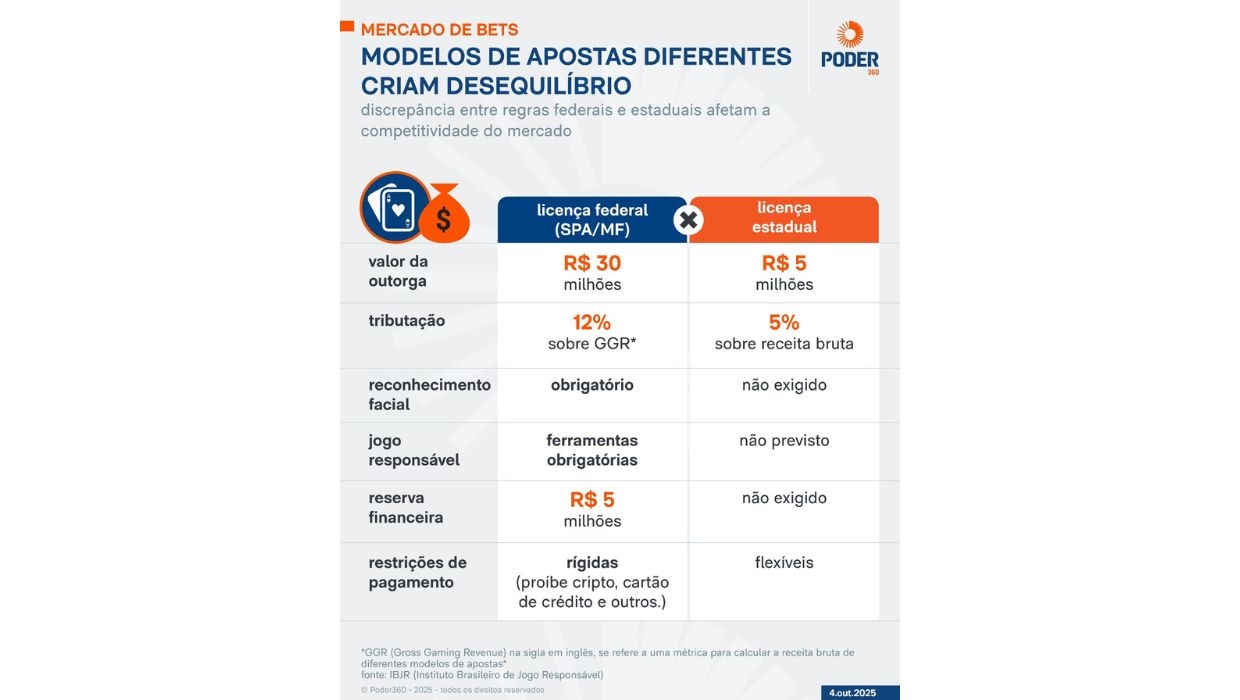
On one side, the Union, through the SPA (Secretariat of Prizes and Betting) under the Ministry of Finance, has established a strong federal framework under Law No. 14,790 of 2023. The goal is to create a safe, transparent business environment that generates revenue for the country. The federal license—priced at R$30 million (US$5.6m), with a 12% monthly tax on Gross Gaming Revenue (GGR)—comes with strict requirements in compliance, responsible gaming, anti–money laundering, and data protection.
On the other side, backed by a 2020 Supreme Court ruling (ADPFs 492 and 493) recognizing the states’ right to operate lotteries, several states—such as Rio de Janeiro, Paraná, and Minas Gerais—have launched their own licenses. These come with significantly lower fees and taxes: some cost as little as R$5 million (US$936,000) and charge only 5% on gross revenue. This has sparked an intense regulatory race to the bottom.
The gap between the federal and state frameworks is striking—and dangerous. The federal model requires facial recognition of bettors, a R$5 million financial reserve to guarantee prize payments, and responsible gaming tools such as time limits and self-exclusion. Many state licenses, however, are silent on these key safeguards.
According to data from the IBJR (Brazilian Institute of Responsible Gaming), the table below illustrates this asymmetry well:
This “predatory competition,” as IBJR calls it, not only grants unfair advantages to state-licensed operators but also exposes bettors to greater risks, with fewer guarantees and protections. It weakens the fight against crimes such as money laundering and match-fixing—issues the federal regulation seeks to combat with higher rigor.
At the heart of the issue lies the very nature of the internet. How can regulators ensure that a platform licensed by one state is accessed only by bettors physically located within that territory? Imposing territorial limits on a service that is inherently global is both a technical and legal challenge—one that bolsters the argument of those who defend the Union’s exclusive authority over online betting, as noted by many constitutional scholars.
The Supreme Court and the future of betting in Brazil
Amid this dispute, the Supreme Federal Court has once again been called to intervene. In a more recent ruling (ADI 7640, September 2025), the Court struck down parts of Law No. 14,790/2023 that restricted companies from operating in more than one state and prohibited nationwide advertising of state lotteries. The unanimous decision reinforced state autonomy and the principle of free enterprise—but in practice, it added yet another chapter to Brazil’s complex regulatory saga, empowering state-licensed operators to compete even more aggressively with the federal model.
We now face a paradox: as Brazil strives to position itself among the world’s most robust regulated betting markets, regulatory fragmentation and legal uncertainty threaten to undermine the entire effort.
The centrifugal force of our federalism, mentioned at the start of this article, seems to be in full effect—creating a scenario of uncertainty that benefits neither serious operators, nor the government, nor, ultimately, the bettors themselves.
The question remains: can Brazil strike a balance that preserves state autonomy while ensuring a cohesive and safe national regulatory standard? Or are we heading toward a “regulatory and fiscal war” that could jeopardize the integrity and potential of one of today’s most promising industries? The game is on—and the stakes are high for the future of Brazilian federalism in the digital era.
Fellipe Fraga
Chief Business Officer and Head of Institutional Relations at EstrelaBet. He has worked in the Brazilian betting market since its inception. Fraga holds a law degree from PUC Minas and a specialization in public law from Estácio de Sá University. He has extensive experience in public, electoral, and international law, served as a founding member of the STJD-FA (Superior Court of Sports Justice for American Football), and was part of the Sports Law Committee of the OAB (Brazilian Bar Association) in Minas Gerais.