



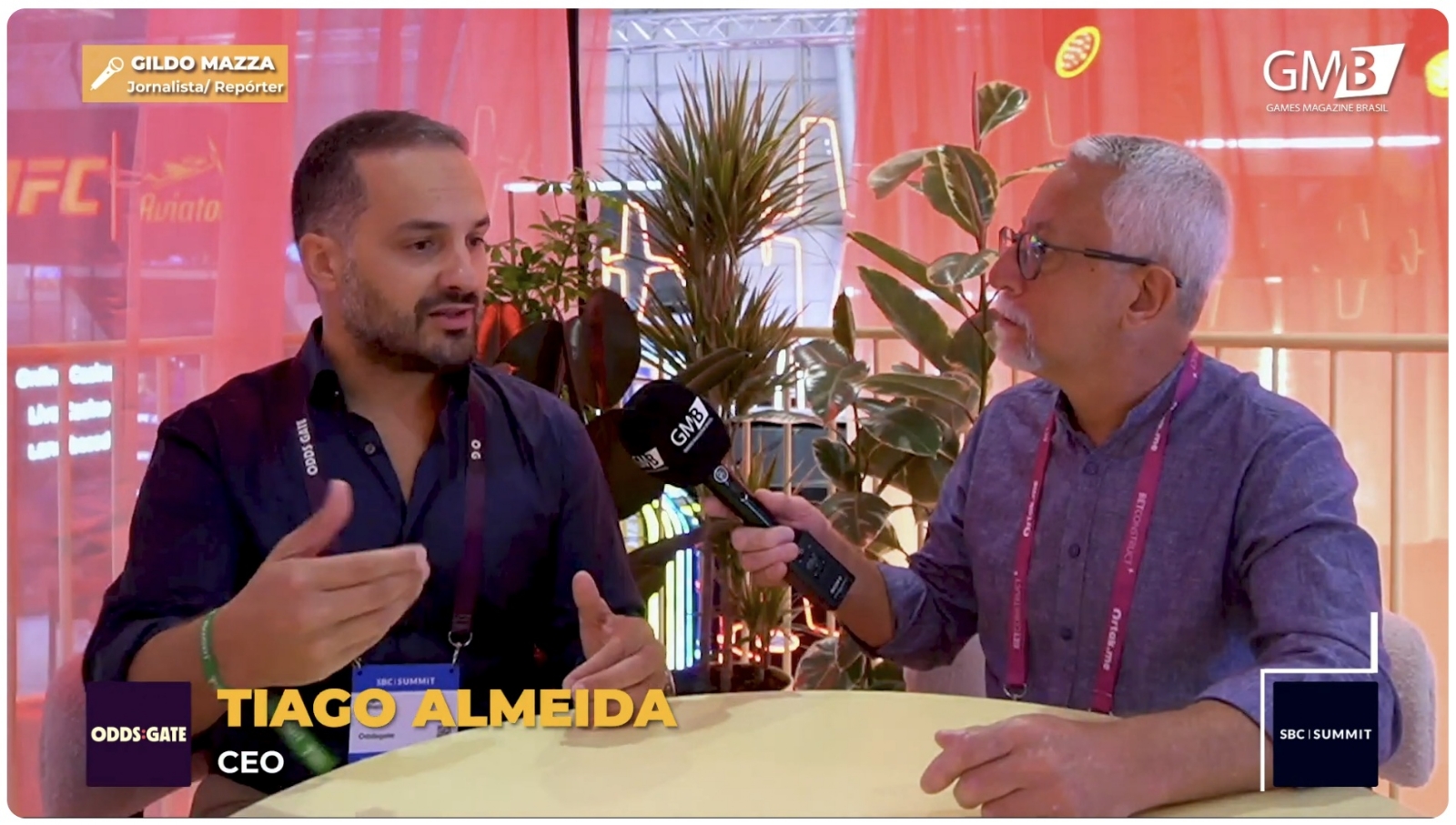
GMB – What were Oddsgate’s objectives in participating at SBC Lisbon, and what new developments did you bring to the event?
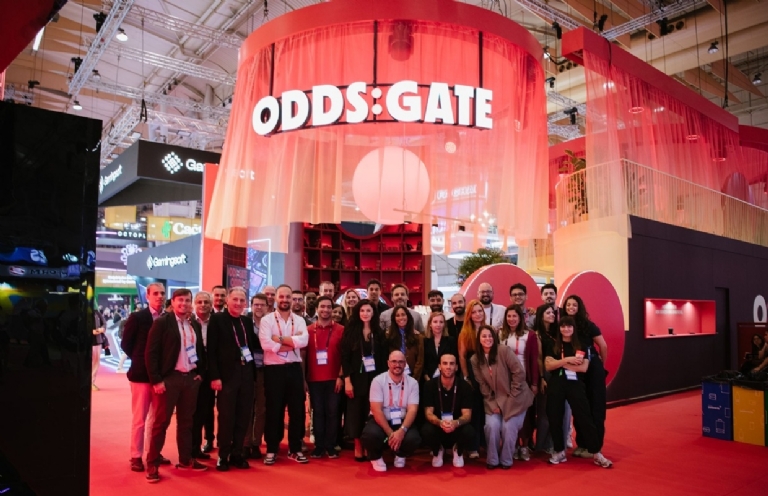
Tiago Almeida – This is our second time at SBC in Lisbon after our participation last year. It’s a wonderful event in this city that is our home and where Oddsgate’s headquarters are located. We’re very happy with the event’s growth, as well as the number of participants who are increasingly specialized in the industry.
We have already received directors, company owners, and senior professionals from these organizations, but we’ve noticed an improvement in the quality of that audience. Many of these organizations have been recruiting outside the iGaming industry, bringing new nuances to our market, which has raised the overall quality.
Did you bring any new developments to Gaming?
After a year since the major turning point [in Brazil]—I remember the conversation we had a year ago here at SBC when this process was still being prepared—today it’s consolidated. We serve seven brands in Brazil, the same seven as a year ago. We’re not seeking new clients or partnerships this year. Instead, our focus has been on improving quality, technological stability, and technical compliance with Sigap/SPA to ensure our partners have stable conditions for growth.
Having achieved that, we’re now adding modules to our platform technology to foster innovation. For example, we’re announcing a partnership with The Power Plugin. At our stand, we’re showcasing several activations, such as Messi’s Ballon d’Or, Pelé’s Career Ballon d’Or, and a jersey worn by Messi when he won the World Cup. These are items that players can redeem points for—unique and exclusive experiences. Each site can have its own marketplace tailored to the specifics of its audience.
This allows us to reduce CAC, increase LTV, and bring originality beyond the typical bonuses or free spins—because we believe it’s not healthy to educate users with that type of offer. We seek partner operators who understand the importance of ensuring their business’s sustainability, which often comes from access to entertainment rather than just gaming.
So, it’s about increasingly engaging the end user with experiences different from bonuses?
Exactly—not only because we’re following the market harmonization taking place, but because we believe that competing through bonuses can distort the market. It gives players an artificial financial incentive and inflates operators’ financial results. With the current heavy taxation being discussed, we know operators must look for original and innovative alternatives to attract players through unique experiences, not purely financial incentives.
Innovation is the keyword in iGaming. How do you stay up to date in the gaming and betting industry?
Every day we intentionally “forget,” in a good sense, the experiences we’ve already had. We don’t believe in knowledge that isn’t constantly tested. Throughout 2025, we’ve been pursuing innovation—not only through new languages and development methodologies but also by expanding our team. This allows us to maintain relevance and continuously seek more agile technologies.
More than ever, players want faster front ends, native mobile apps, seamless technology integration, and, of course, technical compliance. This is only possible when we redesign the entire development methodology and time-to-market process, ensuring faster and more stable operations.
Brazil launched its regulated market in January, which is still quite new. Do you think it’s already consolidated?
We’re far from that. There’s still a lot of work to be done regarding illegal betting, which is one of the major challenges facing our beloved industry. Even here in Portugal, we’ve faced illegal betting issues since 2016. It will never disappear completely, but it can be mitigated. The recent measures by Brazil’s Central Bank restricting unauthorized IPs with certain transaction volumes are good news, as they may limit Pix access.
Criminalization is one path, and it should be pursued and strengthened, but another crucial path is education. Players must be taught to distinguish between illegal and legitimate bets. That takes time, patience, and protection from federal authorities. It’s also their responsibility to ensure the stability of this industry, which creates thousands of jobs and generates billions in revenue for Brazil—a sector we want to continue growing and strengthening.
I believe the market will reach about R$34 billion (US$6.37m) in gross gaming revenue this year, and over the next two or three years that number could grow by 20–30%, possibly doubling within five years.
Can Brazil be considered a benchmark for other Latin American jurisdictions like Peru and Chile that are also regulating their markets?
Absolutely—not only because of Brazil’s continental scale but also its regulatory diversity, with both federal and state licenses. I think it’s a success story. It took Brazil a few years to build this case, as the political and technical conditions weren’t there before. But once it happened, it moved very quickly. We created an industry, brought an existing sector into formality, and now have revenue and consolidation. The operators are heroes.
All our seven brands—our seven partners—are local heroes. They operate in a highly competitive environment yet continue to grow. If any of these clients or partners want to enter the Peruvian or Colombian markets, they will likely succeed, because succeeding in Brazil is extremely challenging and prepares them well for any Latin American market.
Do Oddsgate’s partners operating in Brazil plan to expand beyond the country?
Several of them are exploring this path, and we’re in advanced discussions on those projects. So yes, that mission exists.
Is Oddsgate prepared to enter new markets through these operators?
Certainly. We already hold GLI-19 and GLI-33 international certifications, as well as local ones for several markets, and we’re fully ready to find the right partnerships to deliver our technology and help our partners grow.
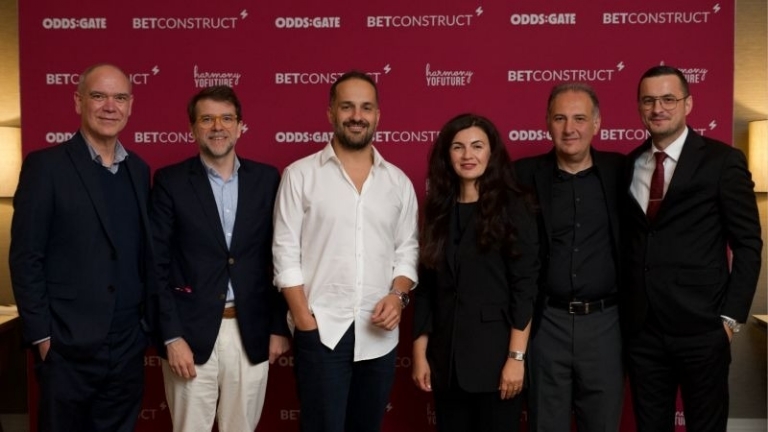
Can you tell our readers about Oddsgate’s major announcement for the Brazilian market, which we’ve learned about in advance?
Yes, we’re very excited. We’re taking advantage of this pivotal moment for Oddsgate. We’re already one of Brazil’s largest tech companies, but we can’t stand still. Our commitment to partners, shareholders, and employees drives us to keep growing.
So, we’re thrilled to announce the merger of our operations with BetConstruct. This will give us access to better technology, more products, and additional development layers on top of our own platform, allowing us to scale further. We have already planned to expand our team in Barueri/SP, but with this agreement, we’ll be hiring 200 people.
Will it be a new platform, or will functionalities be added to Oddsgate’s existing one? How will that process unfold?
It will be a gradual rollout of new features, allowing our partners to progressively add functionalities—new content, gamification tools, CRM capabilities, and most importantly, dynamic and adaptive front ends tailored to the customer journey. They’ll be able to modify the lobby, game thumbnails, registration and login flows, and KYC verification at any point in the player’s journey—and in real time.
How are Oddsgate’s current platform users reacting, and what are their expectations for the final product?
They expect to move away from a purely turnkey model—a closed solution where all development must go through the platform provider. We never believed in that model. We saw it as a necessary stage of standardization and technological maturity when we began. Now, partners need access to the code and a staging environment that allows near real-time changes. This reduces impact, improves time to market, and ensures that teams in Brazil can access international technology, localize it with their own resources, and co-develop with us—two, four, or even eight hands, within their own facilities.
So, this is part of Oddsgate’s “2050” migration project, which you recently presented. What’s your vision for 2050?
Our vision for 2050, starting now in 2025 and accelerated by this merger, is to create the conditions for hyper-customization. We truly believe in it—and in a continental country like Brazil, it can transform the customer journey, whether for new or experienced players. Hyper-customization, immersive reality, and artificial intelligence aren’t just future concepts for us; they’re already being developed, and our partners will start seeing them in their operations in the coming months.
The Portuguese caravels set sail in 1500 to discover Brazil—are you now rediscovering iGaming in Brazil?
We’ve done work in Brazil that really allows for that analogy, which I love and identify with. But more than that, I think it was Brazil that discovered Portugal. Why? Because while we had the technology and many years of experience in the Brazilian market, I’ve learned so much from those on the other side—the energy, the discipline, the motivation to work, and above all, the creativity. When creative marketing, acquisition, and communication combine with technological stability and European experience, wonderful things happen—and I think that’s exactly what we’ve achieved.
Source: Exclusive GMB