




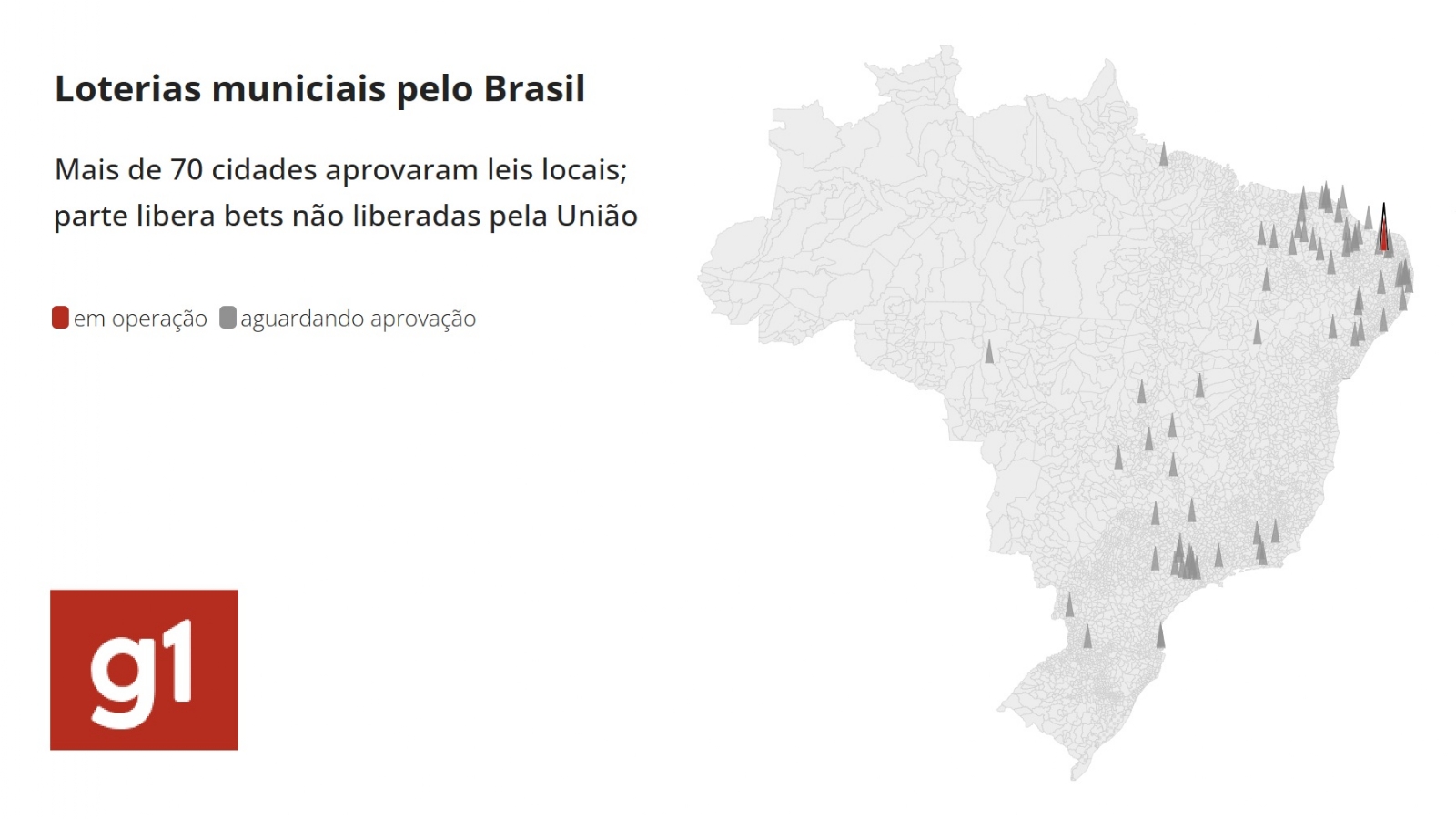
A G1 survey of municipal lotteries found that:
- Three cities have approved laws that have yet to be sanctioned by their mayors;
- 39 laws have been sanctioned but have not yet progressed;
- 17 municipalities are in the study or implementation phase;
- 17 are awaiting the completion of bidding processes to select operators for their lotteries and/or 'Bets'
- And one — Bodó (RN) — already has a functioning lottery.
Among the 77 municipalities with lottery-related laws, 10 plan to operate specifically in 'Bets' market while others include traditional lottery draws based on numbers and scheduled dates.
According to documents reviewed by G1, the main goal of these municipal initiatives is to raise revenue quickly and efficiently to fund public services such as health, education, and social assistance. Some local laws establish taxes on gaming operators ranging from 2% to 5%.
The “legal loophole” and the municipalities’ interpretation
Despite this wave of initiatives, the Secretariat of Prizes and Betting (SPA) of the Ministry of Finance considers the creation of municipal lotteries illegal. The agency argues that Law No. 14.790/2023, which regulates fixed-odds betting, stipulates that only the federal government, states, and the Federal District are authorized to operate such services. The law makes no mention of municipalities.
Additionally, in 2020, the Federal Supreme Court (STF) ruled that the federal government no longer holds an exclusive monopoly over lotteries and extended this right to the states. The absence of specific legislation addressing municipalities, however, has created a gray area open to interpretation.
“Municipalities interpret that, since there is no explicit prohibition, they are allowed to create their own lotteries. Because the law does not specifically address cities and the Supreme Court has not suspended their initiatives, they believe they can legislate and operate such services,” explained Telma Rocha, professor of Constitutional and Administrative Law at Mackenzie Alphaville University.
According to Luiz César Loques, a researcher at FGV Direito Rio and author of “Law and Regulation of Betting in Brazil”, “the boom in the 'Bets' sector has made municipalities more eager to explore this type of activity” as a way to raise funds while awaiting a Supreme Court ruling on the matter. The problem is that the Supreme Court has not yet issued a decision,” he noted.
The pending case, Arguição de Descumprimento de Preceito Fundamental (ADPF) 1212, will determine whether municipalities can legally operate such activities. The latest development occurred on September 17, 2025, when the case was forwarded to the Office of the Prosecutor General (PGR) for review.
How municipal lotteries work
So far, only one city has actually implemented and launched its lottery: Bodó, in the state of Rio Grande do Norte. The Lotseridó Lottery was approved on July 3, 2024, by Mayor Marcelo Mário Porto Filho (PSD).
Companies seeking to operate virtual games must register with the municipality’s platform, submit detailed monthly transaction reports, and transfer 2% of their gross revenue. According to the approved law, the funds raised are allocated to social assistance programs and local development initiatives.
Bodó has authorized 37 companies to operate municipal lotteries — none of which are licensed by the Ministry of Finance’s Secretariat of Betting. The federal government has stated that it maintains an official list of authorized fixed-odds betting companies on its website and that it requests the telecommunications regulator (Anatel) to take down unauthorized gambling sites as they are identified.
As reported by G1 in February, Bodó — a town of 2,363 inhabitants — had already accredited 38 betting operators, averaging one company for every 64 residents. At the time, city officials said each company paid a R$ 5,000 (US$940) licensing fee and that the authorization was valid only within municipal boundaries.
G1 later asked the Bodó City Hall how much revenue had been collected since the lottery’s launch and why it had authorized companies not approved by the Ministry of Finance, but no response was received by the time of publication.
The Ministry of Finance confirmed that it notified the municipality in February, warning that issuing betting licenses violates current federal lottery regulations.
Risks and next steps
Experts warn that the spread of municipal lotteries poses risks to both the betting market and players, including:
- Reduced consumer protection: Federal law requires betting companies to pay a R$ 30 million (US$5.6m) licensing fee and comply with strict compliance standards. Local legislation often bypasses these requirements, lowering consumer safeguards.
- Increased regulatory complexity and cost: Professor Telma Rocha points out that if every municipality were to establish its own lottery, the federal government would have to monitor over 5,000 local operations, far beyond the 181 sites currently authorized at the national level — significantly increasing enforcement costs.
Source: G1