




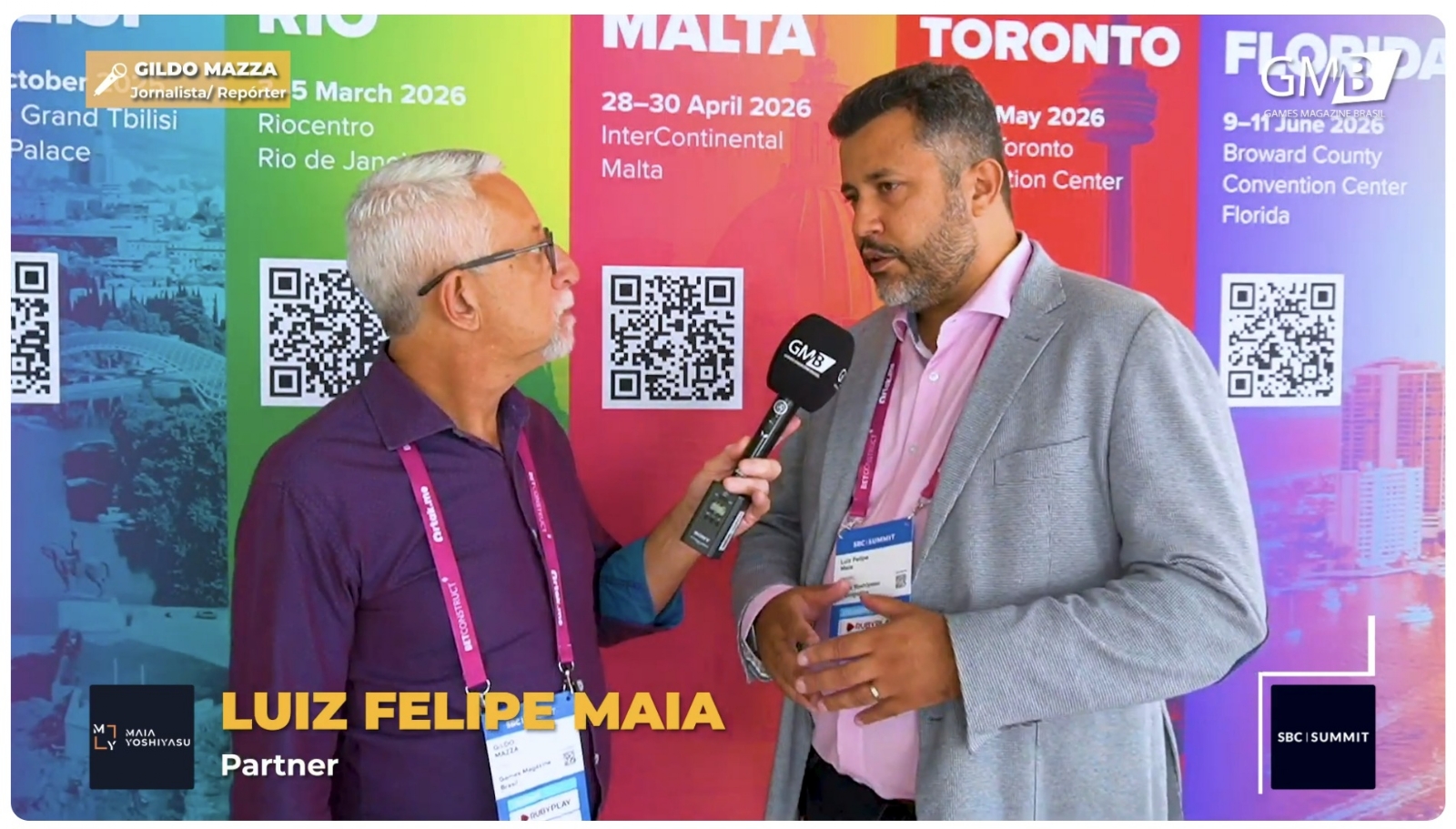
GMB – How do you assess SBC Lisbon 2025?
Luiz Felipe Maia – I think it’s an excellent event. Last year it was already huge, and this year it seems to be consolidating itself as one of the two or three major global industry gatherings. The fact that it takes place in Lisbon and attracts so many people from Brazil shows that, for the Brazilian community, this is an unmissable event.
We can clearly see that, as you mentioned, there’s a strong interest from Brazilians in being here. What are they looking for, considering that Brazil is now one of the largest regulated jurisdictions in the world and attracts so much global attention?
I think these events serve several purposes. Of course, there’s the commercial side—meeting with multiple providers and clients at once—and also networking. I see representatives from Brazilian companies here, both B2B and B2C, and from what I’ve been hearing, many deals were made. The event has been very successful in that sense. Unlike other events focused on different jurisdictions and markets, Brazil has had a prominent role here.
That relevance was also clear in the conference panels, where Brazil’s regulation was a central topic. How do you view the current regulatory landscape, now eight months into the official market launch?
Brazil’s regulation is very solid in many respects. Naturally, as with any regulatory framework, there’s always room for improvement and areas of friction. While we have strict rules regarding onboarding and bonuses, the regulator—understandably—sought to create a highly secure foundation for a newly formed market. Now that the market is starting to mature, some of these restrictions can be revisited.
When it comes to customer onboarding, there’s unnecessary friction. Given that Pix is Brazil’s main payment method and it’s fully identifiable, this brings a level of security to the industry that doesn’t exist in other jurisdictions. That security should translate into a smoother onboarding process. There are other aspects too, but we’re still getting a full picture of everything.
This first year has been full of challenges for both the regulator and the operators. But things are moving in a good direction in regulatory terms.
Operators who applied for licenses in Brazil are now facing, just six months after the market officially launched, a government proposal to increase GGR taxation by 50%. From a legal standpoint, could this be challenged?
We’re facing several threats of increased tax burdens. This is one of them—alongside the selective tax that will come with the broader tax reform and the creation of the CIDE-Games levy. But it’s important to clarify: these measures aren’t coming from the regulator. The Provisional Measure came directly from the government, not from the regulator, and it’s now being debated in Congress. That’s where we need to be especially cautious.
Brazil is struggling with a major challenge in channelization—bringing players into the legal market. The regulator is doing excellent work on what I call “attacking the supply side”: blocking illegal sites, penalizing payment processors that work with them, and going after those who advertise for illegal operators. However, there’s another equally important side, the demand side. We need to make Brazilian players prefer the legal market. That will only happen if the legal market offers a strong user experience and competitive odds. For that, we need reasonable taxation.
We also need less friction in onboarding and fewer restrictions on bonuses or rewards. This will come with greater maturity and the understanding that focusing solely on supply-side measures isn’t enough. We must also address demand—and that depends on product quality. In other words, the Brazilian player must look at a local licensed site and prefer it over an illegal one. Until that happens—and if taxes rise—channelization, which is estimated at about 50% today, could fall to 40% or even 30%. That benefits no one.
So, would you say that’s the main challenge facing Brazil’s iGaming industry today?
I’d say there are two major challenges. One is exactly that—preventing tax increases. But I believe the biggest challenge for the industry, and something I’ve been stressing for a long time, is unity. The industry must come together. We need to be united to properly advocate for our sector’s interests and have real representation before Congress and the government.
Right now, we have five different associations representing the sector, sometimes with conflicting messages. The result is a weakened voice. If we’re already “taking hits” from all directions, division will only make it worse. The 2026 election year will be especially tough for the industry. There’s always a target, and I have no doubt that our sector will be one of them—because, unfortunately, it looks good for candidates to attack the betting industry. If the sector isn’t united to respond and position itself, the consequences will be very negative.
Source: Exclusive GMB