




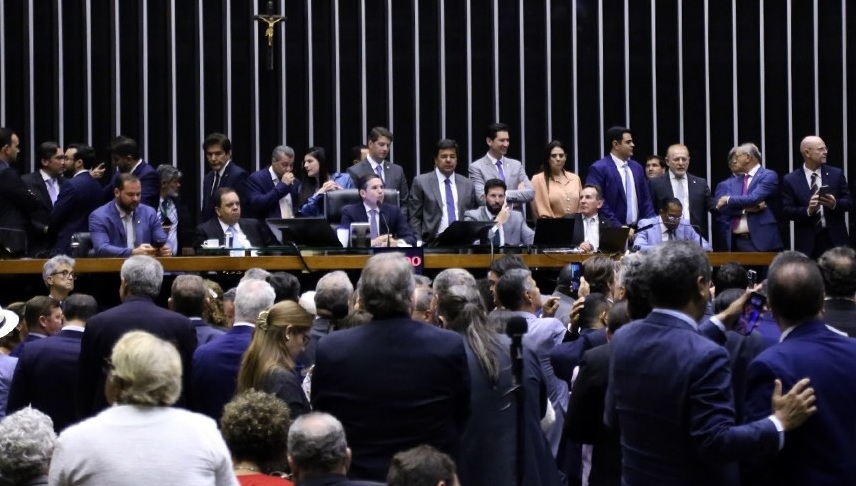
The Chamber of Deputies decided to let the Provisional Measure — edited as an alternative to the increase in the Tax on Financial Operations (IOF) — expire. The measure aimed to tax investment securities and collect retroactive taxes from ‘Bets’.
With a tally of 251 to 193, the majority voted for the measure not to be analyzed by the plenary. Since the text was valid only until Wednesday (8), the decision effectively rejected it.
Despite lengthy negotiations and concessions, Zarattini’s final report was approved on October 7 by the joint committee analyzing the MP — by just one vote. To reach an agreement, Deputy Carlos Zarattini, the rapporteur, withdrew the proposed tax increase on ‘Bets’.
The government’s original proposal aimed to raise the tax on ‘Bets’ from 12% to 18% on GGR (Gross Gaming Revenue) — that is, gross betting revenue, the total collected minus payouts to players.
That section was removed from the version voted on Tuesday, October 7. However, Zarattini included in the new substitute text a provision for retroactive taxation on betting companies that operated in Brazil before the sector’s regulation — with expected revenue of about R$ 5 billion (US$934m).
Finance Minister Fernando Haddad had also announced that same day that fixed-odds betting companies would be charged a retroactive 30% fee, composed of 15% in taxes and 15% in penalties for operating without paying taxes.
Haddad explained that the repatriation program would have generated around R$ 5 billion (US$934m) in revenue — roughly equivalent to three years of taxes, if the original proposal had been maintained.
With the setback, the government faces a negative impact of R$ 46.5 billion (US$8.7bn) on the budget through next year — including R$ 31.6 billion (US$5.9bn) in lost revenue and R$ 14.9 billion (US$2.8bn) in spending cuts.

The rejection marks one of President Luiz Inácio Lula da Silva’s biggest defeats in Congress, coming exactly one week after the approval of a bill exempting Income Tax (IR) for those earning up to R$ 5,000 (US$934).
The measure originally sought to boost federal revenues by increasing taxes on ‘Bets’, fintechs, and certain financial assets, such as Real Estate Credit Bills (LCI) and Agribusiness Credit Bills (LCA) — initiatives that also faced strong resistance from the productive sector.
It also proposed increasing the Income Tax rate on Interest on Equity (JCP) distributions from 15% to 20%, and restricting improper tax compensations.
With the measure struck down, the government must now find new sources of revenue. One possibility, according to Senator Randolfe Rodrigues, the government’s leader in Congress, is to expand this year’s budget freezes, including cuts to parliamentary amendments, potentially reaching R$ 10 billion (US$1.8bn).
Government officials, however, see the defeat as an opportunity to reinforce the narrative that Congress legislates in favor of the “three Bs” — banks, ‘Bets’, and billionaires. This strategy has been in the works since July, amid criticism from Centrão lawmakers and market representatives over the presidential decree that raised IOF rates.
Recent nationwide protests, sparked by the rushed vote on the so-called Shielding Amendment (PEC da Blindagem), also fueled the government’s intention to strengthen this narrative.
Source: GMB