





In theory, platforms authorized only by states like Rio de Janeiro and Paraíba should operate exclusively within those federative units.
In practice, however, 87% of state-licensed sites remain accessible to bettors from other states, according to monitoring carried out by Aposta Legal between July and September.
A survey by G1 also identified six platforms licensed only by states that accept bets outside the permitted territory.
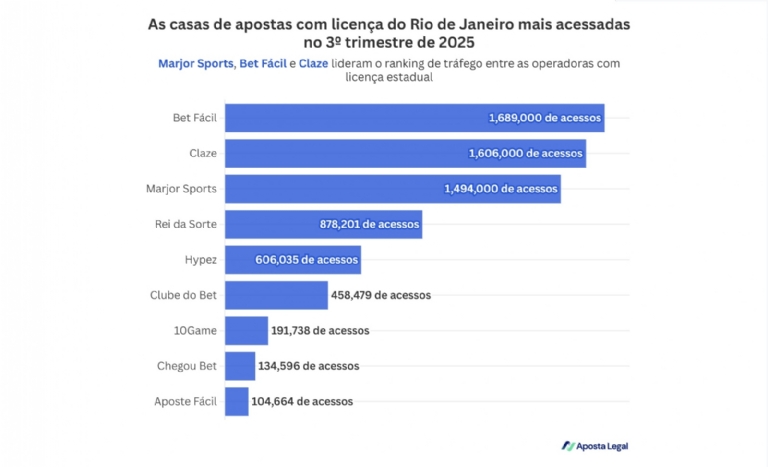
One example is Bet Fácil and MajorSports, the most accessed betting sites licensed by the State of Rio de Janeiro, which registered around 15 million visits in the last quarter.
This volume is equivalent to about three accesses per adult resident in the municipality of Rio de Janeiro for each betting site during the period. This number suggests local popularity, but also indicates possible access by users from outside the state, which is considered illegal under current rules.
According to estimates from Aposta Legal, the revenue of establishments with exclusively state licenses in the quarter represents a potential loss of up to R$ 2 million (US$375,000) in federal tax revenue.
The calculation was based on the relationship between traffic and revenue observed in the legal betting market, released by the Ministry of Finance this year.
State-level ‘Bets’ and the legal impasse
The scenario of legal uncertainty is reinforced by recent decisions of the Supreme Federal Court (STF). In September, the court judged Direct Action of Unconstitutionality (ADI) 7.640, proposed by the governors of São Paulo, Minas Gerais, Acre, Mato Grosso do Sul, Rio de Janeiro, and the Federal District.
The Court decided that state lotteries can be operated by the same economic group in more than one state and that the advertising of these operations can have national reach.
The decision reinforces the previous understanding of ADI 4.986, which removed the Union's monopoly on lottery services and prohibited differentiated treatment between states in federal legislation.
On the other hand, Law 14.790/2023, which regulated fixed-odds betting, establishes in article 35-A that states and the Federal District can only operate lotteries within their own territories. The text maintains the principle of territoriality but does not define digital control instruments to ensure that this limitation is respected.
Geolocation suspended
This gap became evident when the Loterj (Rio de Janeiro State Lottery) notice removed the geolocation requirement that was present in previous versions of the document.
The measure, originally intended to prevent bets from being placed by people outside the state, was ultimately suppressed. Without this technical filter, any user in the country can access platforms licensed only locally.
In practice, the absence of geographic blocking creates a gray area: state-level sites end up competing for the national audience, even though federal legislation prohibits betting outside the concession territory.
The regulatory uncertainty has direct implications for the consumer. Those who bet on a platform with only a state license, but reside outside the authorized state, may lose the right to legally challenge any problems with the betting site, such as non-payment of prizes or account blocking.
Source: Aposta Legal