




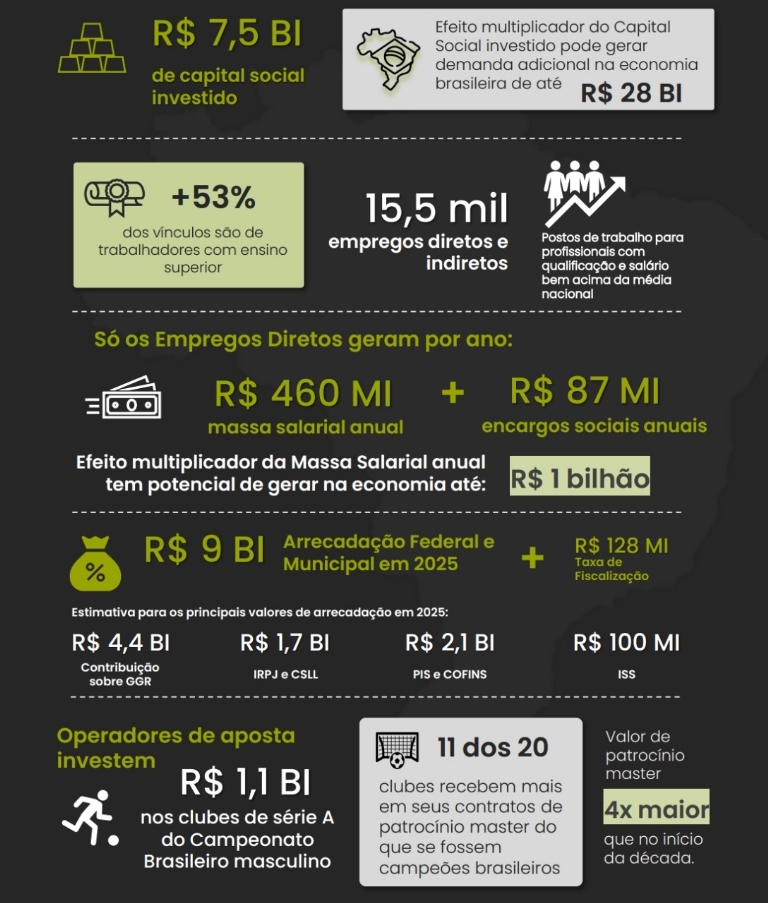
The research also shows that the formal betting market is expected to generate R$ 36 billion (US$6.8bn) in revenue for operators in 2025 alone, and to account for 10,000 direct jobs and 5,500 indirect jobs.
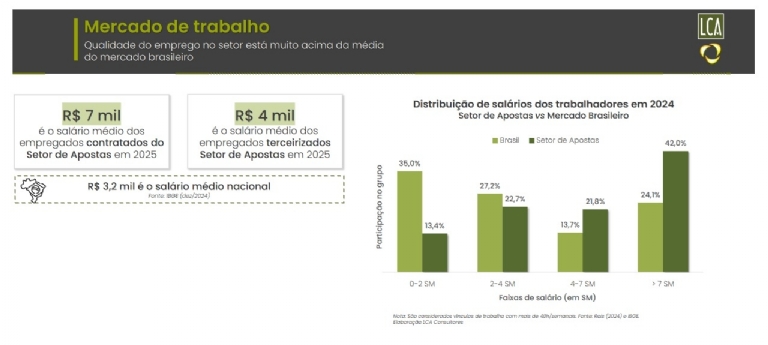
Formal employment links have tripled since the approval of Lei nº 14.790/2023, with emphasis on highly qualified professionals: 65 % have completed or incomplete college, and 47 % occupy roles that require either technical or higher education, as shown by the Annual Social Information Report (RAIS). The average salary in the sector is R$7,000 (US$1,320) — more than double the national average (R$3,200, per IBGE) — and 63.8 % of workers earn above four minimum wages.
Direct employment in the legal betting sector generates an annual wage bill of R$460 million (US$86.6m), in addition to R$87 million (US$16.4m) in social security taxes that fund social protection segments. This income volume has a significant multiplier effect, potentially turning into R$ 1 billion (US$188m) in total national income over time.
An LCA estimate shows that, according to its Input-Output Model (MIP), each R$1 (US$0.19) of direct income generated in the betting sector may represent up to R$2.21 (US$0.42) of total income in the economy, covering direct, indirect, and income effects.
Furthermore, with formalisation, the regulated market has driven the creation of 67 new formal job categories, demanding competencies and specialisations tied to technological and managerial complexity. Examples of these new roles include system developer, market research analyst, product designer, and risk analyst.
“The regulated betting market represents a new cycle of opportunities for Brazil — with investments, formal jobs, and social contribution. This is a newly regulated, high-technology and high-value sector, driving an entire production chain linked to sport, marketing and entertainment,” said André Gelfi, founding director and co-founder of IBJR.
Tax revenue and social impact
Total revenue estimated by LCA for the sector by the end of 2025 is R$9 billion (US$1.7bn), including taxes such as corporate income tax (IRPJ), social contribution on net profit (CSLL), PIS, COFINS, ISS, and the 12 % contribution on gross gaming revenue (GGR). This amount is earmarked for social areas, equivalent to funding 5,136 police officers, 7,421 basic-education teachers, and 23 basic health units (UBS) nationwide.
“The regulation of the betting market is already showing its ability to produce concrete results for the country. Billions of reais are returning to society in the form of taxes, investments and qualified jobs. This is the effect of a sector operating within the rules and contributing directly to Brazil’s economic and social development,” said Plínio Lemos Jorge, president of ANJL.
National football: major partnership
The study shows the betting sector has become the main sponsor of national football. In 2025, 18 of the 20 clubs in Brazil’s top men’s division (Série A) have betting-operator principal sponsorships, amounting to R$1.1 billion (US$207m) in seasonal investments.
For comparison, that value equals the prizes for winning five Libertadores titles, eight Copa do Brasil titles, or 23 national championships. On average, clubs in the top division receive 2.6× more in sponsorship contracts with betting operators than in sporting prizes.
“Sponsorship from legalised operators plays a decisive role in keeping football competitive and financially healthy. The illegal market, which does not pay taxes nor supports the sport, is the real threat to the future of betting,” added Gelfi.
Regulation and future
Regulation has brought an unprecedented milestone of security and transparency to the sector, with rules for licensing, payment traceability, facial ID and responsible-gambling mechanisms. The advancement of regulation — covering suppliers, payment methods and advertising — is essential to consolidate the business environment, protect the bettor and combat the underground market, which still accounts for about 50 % of bets in the country.
“Progress in regulation is what guarantees predictability, legal security and confidence for operators and consumers. We are building a solid, transparent and competitive market, capable of attracting new players, protecting bettors and combating the illegal game, which only brings harm to the country,” said Lemos.
IBJR
Founded in 2023, the Brazilian Institute of Responsible Gaming (IBJR) brings together major betting firms in Brazil and worldwide. Its mission is to build an online-betting ecosystem that is integral, sustainable and responsible, always advocating for a regulated market.
Its operation is based on two essentials: fighting the illegal market and promoting responsible gaming. “That’s why we work actively to confront illegal bets, which operate outside the law, harm the industry and put all society at risk,” states the institute.
ANJL
Launched in March 2023, the ANJL defends the interests of its members, the sector, and responsible and integrity-driven gaming, always guided by the promotion of sport, betting security and contribution to national economic development.
LCA
LCA is a consultancy specialising in tailored applied-economics solutions for business. It assists industry-leading companies, top law firms and major investors with strategy, tactics and regulatory, antitrust and legal-technical support.
With a team of economists with strong academic and professional backgrounds, LCA has built long-term partnerships rooted in quality, flexibility and senior-level service. It has exported services to over 25 countries and completed more than 450 projects annually. It operates in the areas of Law & Economics and Corporate Investments & Finance.
Source: GMB