




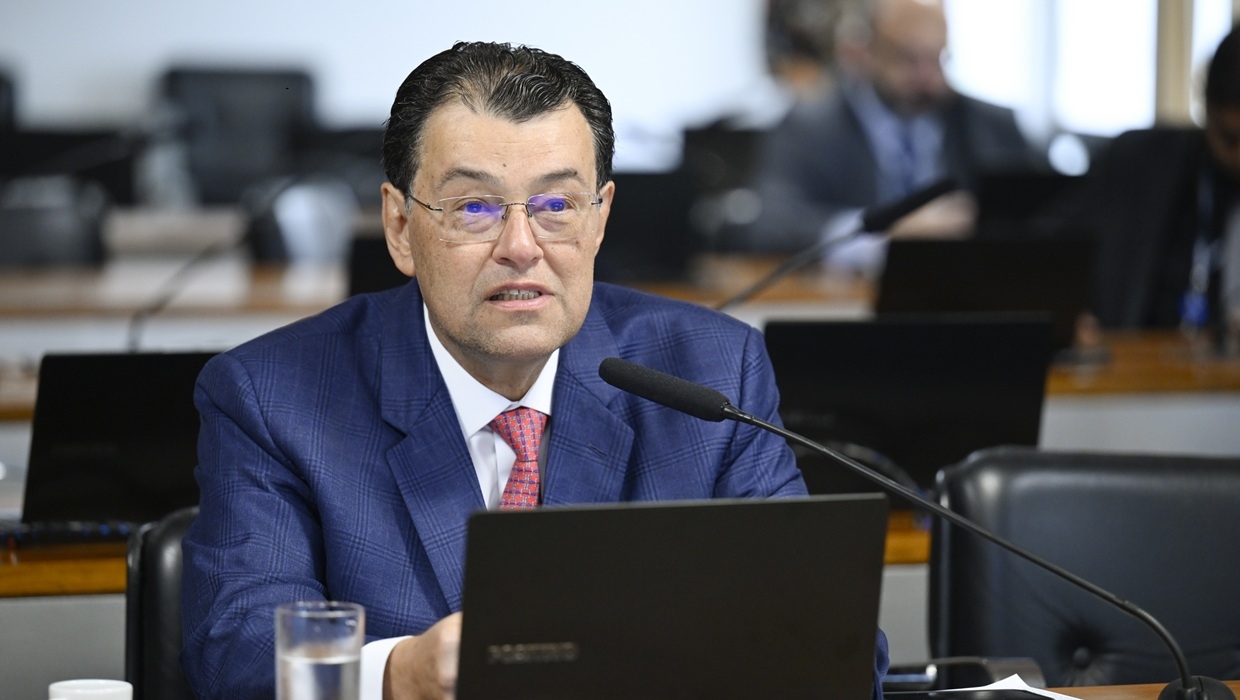
Considered an ally by the Presidential Palace, the senator also said that the narrow Senate vote to reconfirm Prosecutor General Paulo Gonet was a “worrying warning” for President Lula. Gonet received only four votes above the minimum needed for a new term leading the investigative body.
A former governor of Amazonas, the senator also states that public security must be a shared responsibility and argues that the country must abandon the “hypocrisy” of delegating the fight against crime exclusively to the states.
The so-called ‘Bets’ currently pay 12% on gross gaming revenue, and Senator Renan’s proposal sets that at 24%. What rate will you propose?
First, we must understand that a portion of betting operators do not pay 12% — they pay nothing, because they operate illegally. So it makes no sense to raise taxes from 12% to 24% on those who are legal without shutting the door on illegality. Otherwise, we will only increase illegality. The operator that complies with the law will say: “I’m a fool, I pay taxes, I play by the rules, and now I’ll pay double, while my neighbor here doesn’t pay a single cent and nothing happens to him.”
The government’s first homework is to shut down what’s happening with illegal fintechs and illegal payment processors — which are the gateway for money flowing in and out of illegal betting, organized crime, and money laundering.
You said the bill could be voted on next week if the Ministry of Finance does its ‘homework.’ What exactly is missing?
I’m still waiting. I spent 30 minutes this morning speaking with (Central Bank President Ricardo) Galípolo and telling him: “I’m waiting for you to do your homework.” The Federal Revenue Service identified, in round numbers, R$50 billion (US$9.45bn) in transactions involving illegal fintechs and illegal betting operators. If we want to combat organized crime, we must have control over the money. Brazil has digitized 93% of its circulating money, but it still cannot properly oversee the digital environment.
Are you referring to Pix?
Paper money represents no more than 5% to 7% of the circulating supply today. All the money is stored in banks and moves through digital payments or credit cards. Illegal betting operators, illegal fintechs, organized crime funds, and money laundering — where is all of that moving? Through bank accounts and Pix keys. I don’t need to control Pix itself; I need to control transfers to electronic keys with atypical transaction patterns. If a thousand, two thousand, ten thousand people send Pix transfers to the same address, that is an atypical movement.
Are you considering a progressive tax structure for legal betting operators?
If we shut the door on illegality, bettors will stop using illegal platforms. They will migrate to the legal market. If they bet legally, volume, profitability, and revenue will increase. Then I can gradually increase taxation — and no one will complain.
Do you believe that raising taxes could make these companies leave the country?
If they stop operating in the country, that would be the best thing in the world. The tragedies these betting companies are causing are horrific. If I had the power, I would put an end to betting altogether. The amount of information I receive about desperate, depressed people — and some who have taken their own lives due to debt with betting operators — is alarming.
Regarding the CSLL, the bill raises the rate for banks from 15% to 20%, and for fintechs from 9% to 15%. Will you keep these rates?
It all depends on the overall scenario. We cannot analyze this in isolation. The sector needs to contribute in a balanced and proportional manner. We must differentiate — fintechs have much higher profitability.
Will the bill offset the R$18 billion (US$3.4bn) in revenue lost due to the income tax exemption?
If it is true that tax evasion from illegal fintechs and illegal betting operators reaches R$100 billion (US$18.9bn), just the 12% they should be paying today would yield R$12.2 billion (US$2.3bn). If we close the door on illegality, part of that will move to the legal market. The tax base will expand. I don’t need to go to 24%; I can implement a gradual increase. And we will reach R$18 billion (US$3.4bn) much more easily.
The opposition has criticized the government for raising taxes instead of cutting spending. Do you agree with that criticism?
The criticism has a political bias, but where there’s smoke, there’s fire. The biggest problem in government today is the quality of spending. If spending becomes more efficient, results will be much better — and they are already positive. What the opposition does not mention is that we have brought inflation back within the target range, we are concluding the fourth consecutive year of GDP growth, we have one of the lowest exchange rates in history, and we are breaking records in the stock market.
For months, I have advocated for a Senate-approved bill that establishes a review of infraconstitutional tax benefits. It is stuck in the Chamber. That measure alone would cut spending by 10% — somewhere between R$30 billion (US$5.65bn) and R$40 billion (US$7.55bn) per year.
Source: O Globo