




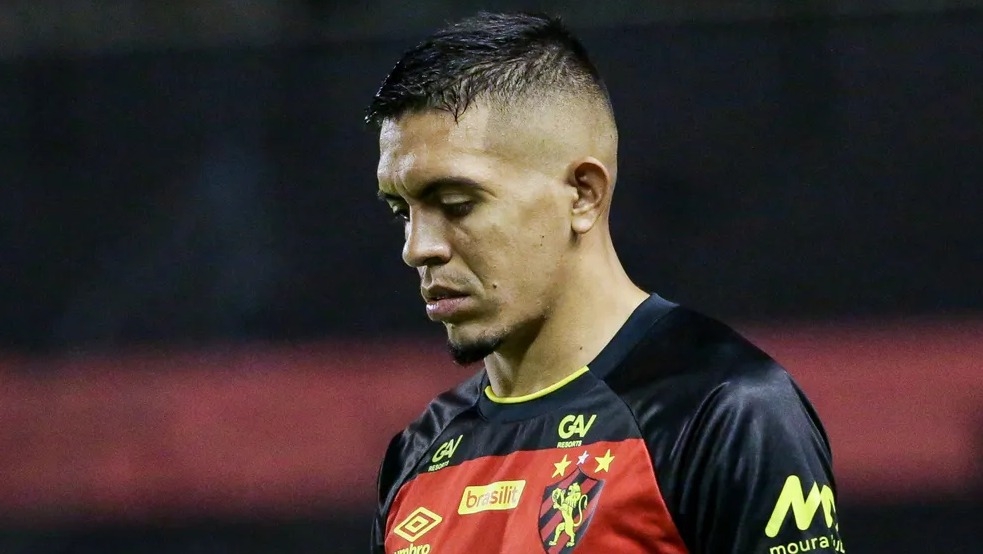
The Habeas Corpus hearing began in August, when the rapporteur, Minister André Mendonça, voted to reject it.
Shortly thereafter, Minister Gilmar Mendes requested further review (“vista”). He returned the case in early November but no date is set yet for when the matter will be resumed by the STF’s Second Panel, which still includes Ministers Kassio Nunes Marques, Dias Toffoli and Luiz Fux.
Cariús was denounced under Article 198 of the General Sports Law, which states: “To request or accept, for oneself or for others, a patrimonial or non-patrimonial advantage for any act or omission intended to alter or falsify the result of a sports competition or an event associated with it.”
The prescribed penalty is two to six years imprisonment, plus a fine.
The main discussion is whether a yellow card has the power to influence the outcome of a competition “or an event associated with it,” as the Law states.
This debate resembles the defense arguments of forward Bruno Henrique, of Flamengo, who was judged by the STJD on Thursday. The Full Tribunal dismissed the denunciation for acting to harm his own team and influence the match result.
The player was ultimately sanctioned for failing to comply with the CBF regulation — an article that does not provide for suspension — and was fined R$ 100,000 (US$18,900).
Bruno Henrique also faces a criminal action in ordinary courts – he is defendant for having shared with his brother that he would receive a yellow card in a game against Santos in 2003. His brother and other associates used that information to place bets.
Cariús’s defense contends that the General Sports Law deals only with frauds in match results.
“If you observe, the article is included in the section ‘crimes against the uncertainty of the sport result’, it is not against sporting ethics,” said the athlete’s lawyer, Vinicius Costa Rocha.
He rejects the argument that the article’s phrase “to alter or falsify the result of the sports competition or event associated with it” refers to smaller episodes within a game.
“The event would be the match itself, the result of it. That concept cannot be interpreted as an episode occurring during the match.”
According to the lawyer, a possible STF understanding that forcing a yellow card is not criminalized would not automatically interfere in other cases, but given its relevance, the player’s defense has asked the Court to later analyze the matter as one of general repercussion.
The original process is in the Goiás Justice System, at the witness-deposition phase. Cariús has not yet been heard.

Experts fear risks from the decision
A possible STF decision that accepts Cariús’s arguments may generate risks to sports integrity, say experts interviewed by ge.
Yellow card bets — or, for example, corner-count bets — are part of the so-called secondary market. These are specific events in a match that are not directly tied to the result, such as the score or winner.
It is in this secondary market that fraudsters, according to investigators, prefer to act, because they need only one athlete’s cooperation and it is harder to monitor these situations.
Because of this, Congress has debated the possibility of banning bets on this kind of event — but the issue faces resistance from regulated ‘Bets’, which argue that the ban would push bettors into illegal houses.
For example, legal companies sounded the alarm about suspicious yellow card betting involving forward Ênio, of Juventude; the player was subject to a search-and-seizure operation by the Rio Grande do Sul Public Prosecutor’s Office one month later.
“Forcing a yellow card is already morally condemnable. Now, receiving a forced card to benefit bettors — then manipulation is clearly characterized, someone obtained an illegal financial advantage from that card,” said integrity consultant Fred Justo, who worked at the Secretariat of Prizes and Betting of the Ministry of Finance during the regulation of the ‘Bets’.
“A card counts as a tiebreaker criterion — at the end of a competition it can decide a title or relegation. That alone already makes it quite clear that a card can interfere with the result of a sports competition. Clubs and players who subject themselves to that also need to be punished,” he added.
The regulations of the Brazilian Championship place the lowest number of red and yellow cards as the fifth and sixth tiebreak criteria in classification, after wins, goal difference, goals scored and head-to-head.
“Forcing the application of a card for betting purposes is manipulation of result, since the scientific literature recognizes spot-fixing — manipulation of specific events within a match — as an established form of sports corruption that compromises competitive integrity and the essential unpredictability of sport,” defended Felippe Marchetti, PhD in integrity and anti-corruption in sport.
“Game manipulation goes far beyond simply altering the final score. Fraud occurs when there is an intentional act or omission that aims to improperly alter the course or any aspect of a competition. Forcing a specific event, such as a card or a corner, to obtain undue advantage in bets, directly harms the unpredictability inherent to sport and breaches its integrity, even if the final result remains unchanged,” said Eduardo Musa, Sports Manager and Curator of an integrity course in sport.
Former STJD Attorney-General and now President of the Integrity Committee of the São Paulo Football Federation, Paulo Schmitt, understands that the “events associated” with a competition, as the law treats them, include statistics and tiebreak criteria.
“The legislation clarifies that the protection of sports integrity is not limited to the final result but covers all circumstances that may affect the fairness and transparency of the sport. Therefore, the practice of forcing a yellow card — which can influence standings in championships — is a serious offence subject to severe penalties.”
Lawyer Talita Garcez believes that a yellow card doesn’t directly change the match result, but does influence the game’s dynamics.
“If it is proven that the action aimed to defraud the competition, with athlete enticement and payment or promise of undue advantage, regardless of the result, the conduct can indeed be criminalized,” she analyzed.
Leonardo Henrique Roscoe Bessa, adviser to the Federal Council of the Brazilian Bar Association (OAB), stresses that, in his view, proof of intent and receipt of advantage is necessary: “Without these elements, the conduct — however morally reprehensible — should stay in the domain of Sports Justice, which has its own sanctions for unsporting behaviour.”
For Tiago Horta, Director of Integrity for Latin America at Genius Sports, who monitors betting-pattern data, attention is needed even to cases where the athlete receives no bribe to force a card.
He acknowledges the discussion of clubs and players deliberately forcing cards when a player is one yellow away from suspension just before a less-important match, but points to the risk of that information leaking and benefiting bettors.
“When a player improperly verbalises what they intend to do on the field and that information ends up used for winnings in betting markets by others — that type of leak is irregular and, in my view, constitutes a disciplinary offence,” said Horta, citing Article 103 of the CBF General Competition Regulations.
The clause V states that it is punishable “to share sensitive, privileged or internal information that may ensure an unfair advantage and result in financial gain or use for betting.”
“This practice is comparable to what would be insider trading in the financial markets,” he added.

The case of Bruno Henrique, of Flamengo
That argument of sharing confidential information was used by Flamengo’s lawyers in the defense of forward Bruno Henrique during his STJD hearing, concluded on Thursday. The majority of the Tribunal Pleno dismissed the original accusation in favour of a lesser charge.
Lawyers interviewed by ge, speaking anonymously because they work regularly before the STJD, criticised the decision. They argue that the FIFA Code of Ethics should have been applied.
These professionals admit the CBJD (Brazilian Sports Justice Code) needs updating, as stated by the STJD president Luís Otávio Veríssimo during his vote.
The document leaves gaps for cases like the forward’s — who did not receive payment to force a card, but who, according to Federal Police investigation, knew that his brother would place bets based on that information.
These professionals say that in cases where the code is silent, one may resort to Article 283, which opens the possibility that “international norms” be adopted when the CBJD leaves a gap.
The FIFA Code of Ethics is tougher. Article 17 punishes leaking confidential information with a fine of 10,000 Swiss francs (US$126,000) and suspension up to two years.
Article 27 deals specifically with manipulation: It prohibits anyone subject to the code from participating, “directly or indirectly,” in bets or similar games related to football, and states they must not have a financial interest, reinforcing that “interests include gaining any possible advantage by the person subject to the code or a related third party.”
This article prescribes sanctions of 100,000 Swiss francs (US$126,000), plus suspension up to three years.
However, the STJD Full Tribunal condemned the Flamengo player under Article 191 of the CBJD for failing to comply with CBF General Competition Regulation, which prohibits players from “betting on themselves, or allowing someone in their environment to do so” and from “sharing sensitive information that may lead to financial gain or its use for betting.”
The maximum penalty applied was a fine of R$ 100,000 (US$18,900).
Source: ge