




It is a disaster on several fronts. First, it casts a cloud of doubt over Brazilian football. By failing to properly punish someone who clearly distorted the game for personal gain, the STJD has established a precedent that encourages other players to break the rules. Fans and bettors alike will no longer know for certain whether what is happening on the field results from fair competition or prearranged schemes.
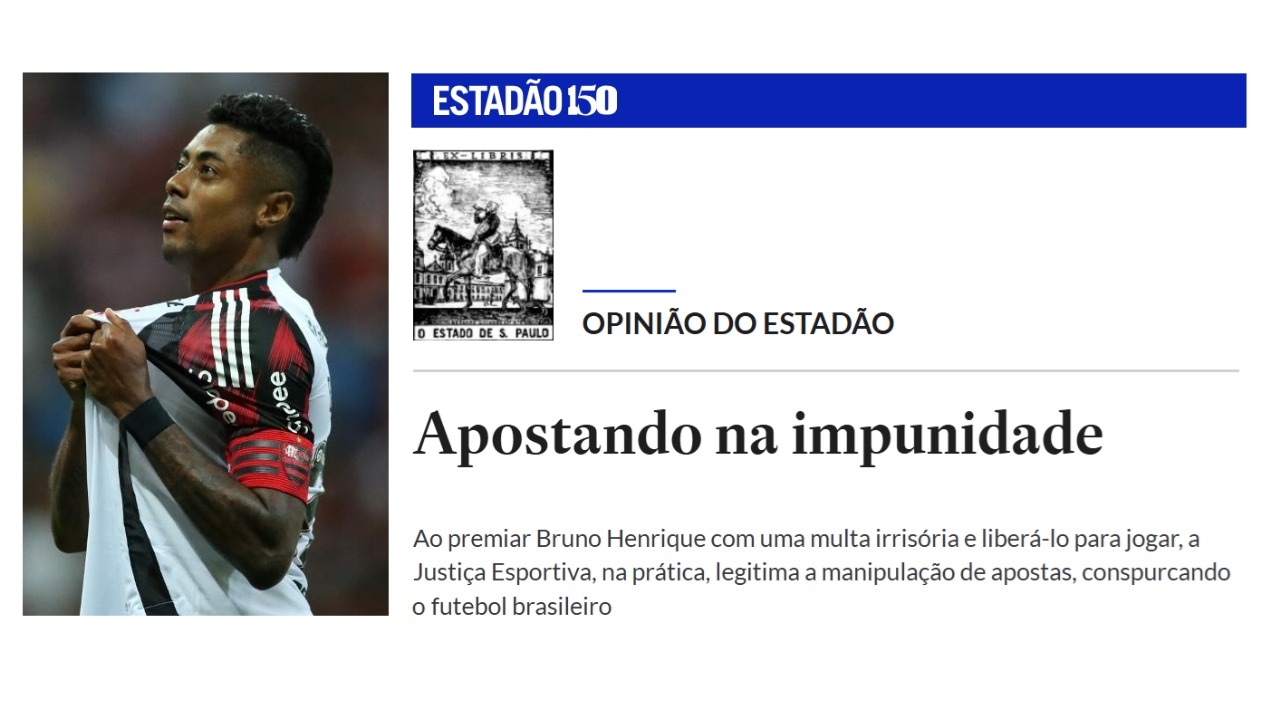
Caught in Federal Police (PF) investigations coordinating with his own brother to force a yellow card in a 2023 match against Santos for betting purposes, Bruno Henrique had been playing normally for Flamengo under a suspensive effect.
In an initial ruling last September, the STJD suspended the player for 12 matches. Now, Bruno Henrique has been acquitted of the accusation under Article 243-A of the Brazilian Code of Sports Justice (CBJD), which covers conduct contrary to sporting ethics with the intention of altering the result of a match or competition.
Despite the compelling messages released by the PF (in one exchange, Bruno Henrique’s brother speaks of “saving the money” to secure what he called a “successful investment”), the STJD overturned its previous decision and cleared the player to return.
The STJD punished Bruno Henrique only with a token fine of R$100,000, (US$18,900) based on an article that provides sanctions for those who fail to comply with or hinder compliance with tournament regulations.
The STJD’s lack of consistency is glaring. In 2023, Eduardo Bauermann, then a Santos defender, was banned from football for 360 days and prohibited from playing anywhere in the world for agreeing to receive a yellow card in a Brazilian Championship match to benefit a gang that manipulated bets. And the defender did not even carry out what had been arranged with the criminals.
Although the cases are identical, Bauermann and Bruno Henrique were punished in completely different ways. One cannot dismiss suspicions that leniency toward Flamengo may have stemmed from the club’s economic and social clout.
As if the ruling were not bad enough, the STJD’s decision comes after an inexplicable delay. Between appeals, dismissals, reopenings, and requests for review, the case involving a deliberately provoked yellow card in November 2023 was only concluded two years later.
Meanwhile, in other countries, the link between sports betting and suspicious yellow cards has sparked highly relevant discussions. In Australia, for example, players have asked the local football federation to ban sports bets tied to yellow cards — something Brazil would do well to emulate.
The reason is obvious: players can deliberately trigger situations that warrant a yellow card. These are not random events but manufactured ones, which are clearly susceptible to manipulation.
The laughable punishment handed to Bruno Henrique reinforces the feeling that, in this sport, those who play by the rules are fools.
Source: Estadão