




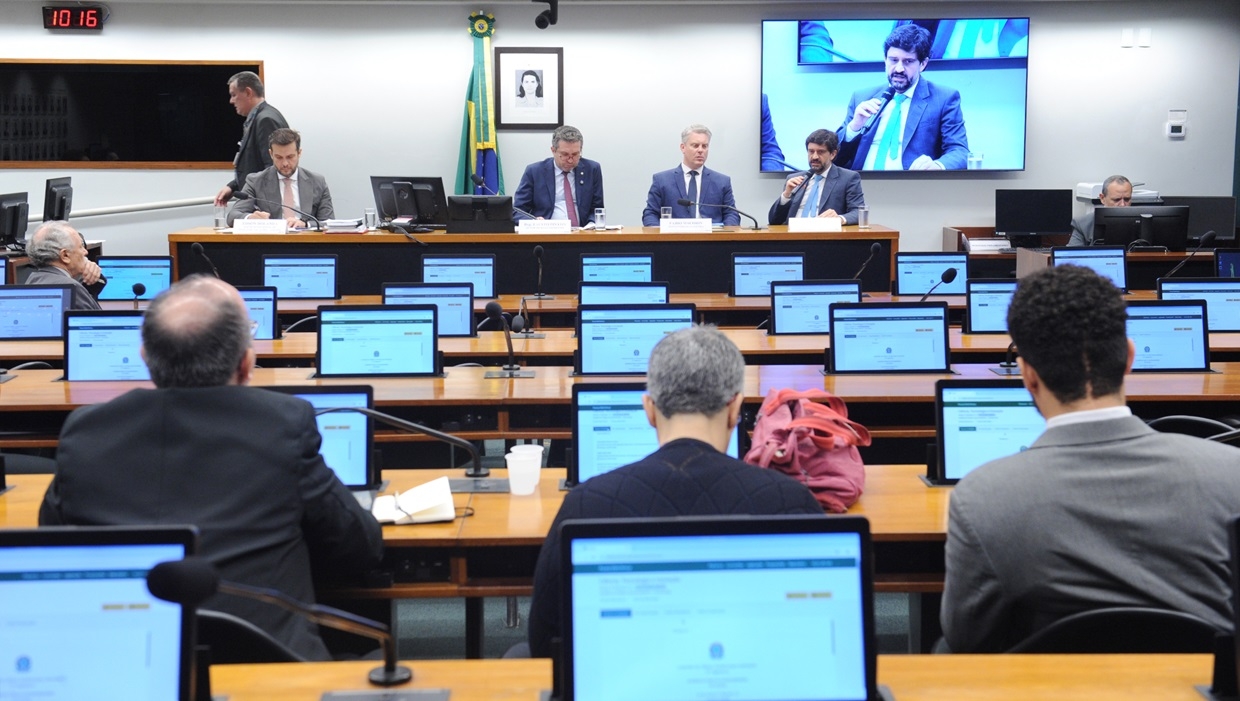
Giovanni Rocco Neto, National Secretary for Sports Betting at the Ministry of Sports, was clear in stating that combating illegal websites must be a government priority. According to him, only by doing so will the online betting and gaming ecosystem offer legal certainty to operators and guarantee users a safe and regulated environment.
He acknowledged that football today is completely dependent on funding and sponsorships from betting companies. “This market is inflated by at least five times,” he said. He argued that it was irresponsible of the previous government not to regulate the market when the activity was legalized. “Thousands of betting sites were created, and SPA has already sent more than 23,000 blocking requests for betting sites to Anatel.”
However, he stressed that this is a massive task because when one site is blocked, another immediately takes its place. “We need technological mechanisms to prevent this,” he said.
“At the Ministry of Sports, we created the National Policy for Combating Match-Fixing. The goal is to help protect Brazilian sports from illegal practices. Sporting integrity is the most valuable asset in the entire sports betting ecosystem. If we compromise the unpredictability of sports results, we jeopardize the credibility of competitions and the entire operation,” he explained.
For the secretary, the state is obligated to combat illegal sites. “If 100% of sites are legalized, it becomes much easier to fight match-fixing. We can cross-check information and, based on bets, identify manipulation patterns,” he said.
Giovanni Rocco also recognized the difficulties faced by the National Telecommunications Agency (Anatel), especially due to legal limitations on blocking sites. “A specific legal change is needed to allow the practical suspension of websites.”
Oversight began in 2024
SPA’s Deputy Secretary of Oversight, Fabio Macorin, explained SPA’s structure and highlighted that the first Regulatory Agenda fulfilled its objective of regulating and segmenting the market as of January 1 of this year.
“Since then, we have created the entire regulatory ecosystem, involving payment systems, licensing, and other activities. After extensive analysis, we approved a first group of operators, totaling 64 companies; today there are 82, with 180 authorized brands,” he said, noting that the bet.br domain is the best way for bettors to identify legal operators.
According to Macorin, the fight against illegal websites began in 2024. “At that time, it was established that only those who applied for a license could remain online.” This created the need to establish procedures so the Ministry of Finance could exercise oversight authority.
“The Ministry was given the power to order the blocking of internet applications—apps, websites, or any other online service. Without a court order, we can order site blocking. We signed a Technical Cooperation Agreement with Anatel, which receives reports on illegal websites and carries out the block through internet providers.”
In the first list, 2,000 sites were blocked, and throughout 2025 monitoring identified thousands more illegal domains. “More than 23,000 sites have been blocked based on our reports, but effectiveness is low because many are hosted outside Brazil. Some regions are considered ‘cyber havens,’ where we cannot enforce blocks,” he said.
Macorin also highlighted other globally available services that prevent SPA and Anatel from fully identifying unauthorized sites.
Because of this, SPA started working with payment systems. “Besides identifying platforms offering illegal betting, we now act directly with payment method companies, checking who provides Pix keys,” he explained. “No company in the financial system may offer payment services to illegal sites.”
More than 400 accounts and payment gateways have been sent to the Central Bank for action. Discussions with Febraban and Caixa Econômica Federal aim to automate identification of payment companies involved.
Macorin also said SPA has agreements with major BigTech companies such as Google, Meta, Kuaishou and TikTok. “We established direct channels to report illegal advertisements. More than 900 reports were filed, resulting in over 200 social media pages removed and more than 300 posts taken down.”
The Ministry of Finance now seeks to regulate the suppliers of sports betting operators, such as platform providers, game developers, odds suppliers, and data providers. “Our new Regulatory Agenda already includes supplier regulation. A draft order is ready and will go to public consultation to define the process and oversight methodology.”
“By doing this, we will be able to require the entire supply chain to offer products only to the legalized market,” he stressed.
25,000 blocks
Anatel Commissioner Edson Holanda highlighted that the Agency carried out more than 25,000 blocks between 2024 and 2025, complying with orders from the Ministry of Finance. The determinations are sent to 17,000 telecommunications providers across the country, including fixed and mobile broadband services.
Holanda emphasized the challenges the Agency faces in blocking operations across a continental country with providers ranging from small local operators in towns of 3,000 residents to large carriers in major cities.
“Often, Anatel inspectors must take an educational approach to explain how blocking should be done,” he said.
He also noted the technical challenges caused by VPNs, which mask the real IP addresses of illegal sites. “When you use a VPN, you hide the final destination. You access it through a VPN that may be inside or outside the country, and at that point blocking becomes more complex,” he explained.
As a solution, Holanda said Anatel drafted a bill currently under review in the Senate proposing a more effective approach: controlling content through CDNs (content delivery networks) and public DNS servers. “This means acting at the wholesale level. It’s much easier and more effective to control those who provide infrastructure than to supervise 17,000 last-mile providers,” he argued.
He stressed that fighting illegal betting requires strong coordination among government bodies. “This digital ecosystem requires coordination and cooperation among all involved: the Ministry of Finance, Central Bank, Anatel, and others,” he said.
“We need this legislative change to make oversight more effective and to make it clear that Anatel has the authority to issue orders to CDNs and public DNS providers,” he concluded.
Source: GMB