





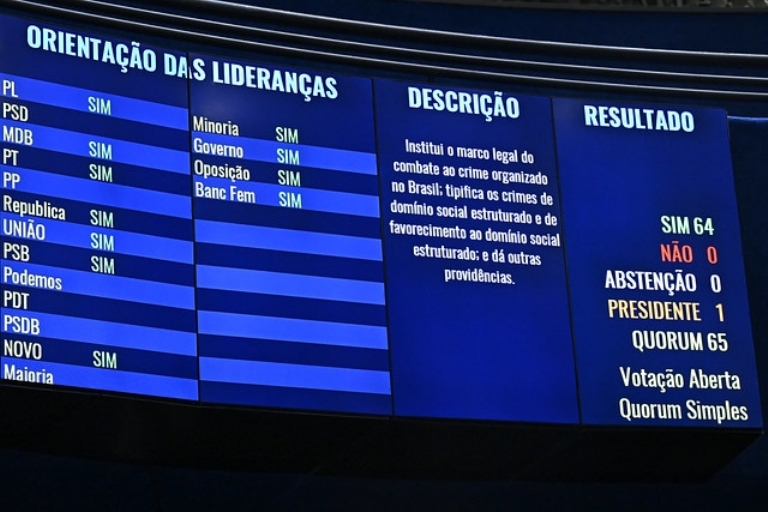
The text, which also passed this Wednesday (10) in the Constitution and Justice Committee (CCJ), increases the penalties for members of criminal groups: leaders may receive sentences of up to 60 years, with the possibility of increasing penalties in specific cases to as much as 120 years, according to the rapporteur.
The bill also tightens the rules on prison-regime progression and requires that heads of criminal factions and private militias serve their sentences exclusively in federal maximum-security prisons.
The rapporteur included the creation of a tax (CIDE) on online betting, with a 15% rate applied to transfers made by individuals to betting platforms. This contribution will remain in effect until the full implementation of the Selective Tax created under the tax reform, and the revenue will be allocated to the National Public Security Fund. The estimated revenue is R$ 30 billion (US$5.5bn) per year.
With this measure, the sports betting and online gaming sector argues that the illegal market is being granted a bonus by the government, as clandestine sites will not collect this 15% at the time of deposit, while licensed operators will be required to tax bettors at the point of entry. As a result, they warn that competition with illegal operators will drive bettors toward the black market.
Alessandro also proposes a temporary regularization mechanism for betting companies operating without a license, with an expected additional revenue of up to R$ 7 billion (US$1.3bn).
The rapporteur removed the changes made in the Chamber of Deputies regarding the allocation of seized assets to security funds. Instead, he determined that the government must present and regulate, within 180 days after the law is enacted, all federal funds related to the security area.
The text also restricts space for clandestine betting operators, which are used for crime, money laundering, and unfair competition. Alessandro Vieira included an amendment, aligned with the Federal Revenue Service and the Ministry of Finance, that provides measures such as joint liability for payment companies and financial institutions.
“An illegal betting site only operates because someone sponsors its advertising and because some institution enables the payment,” he stated.
The text now requires that at least 60% of the revenue from the Cide-Bets be executed in a decentralized manner through transfer mechanisms already provided by law, including fund-to-fund transfers, as long as the resources are kept in specific accounts within state public security funds, earmarked exclusively for actions against organized crime and for the expansion and improvement of the prison system.
Since the bill has been amended, it will now return to the Chamber of Deputies for another vote. In the lower house, the text is expected to be reported by Congressman Guilherme Derrite (PP-SP), former São Paulo Public Security Secretary. Derrite was responsible for the version of the report previously approved by the Chamber in November.
Source: GMB