




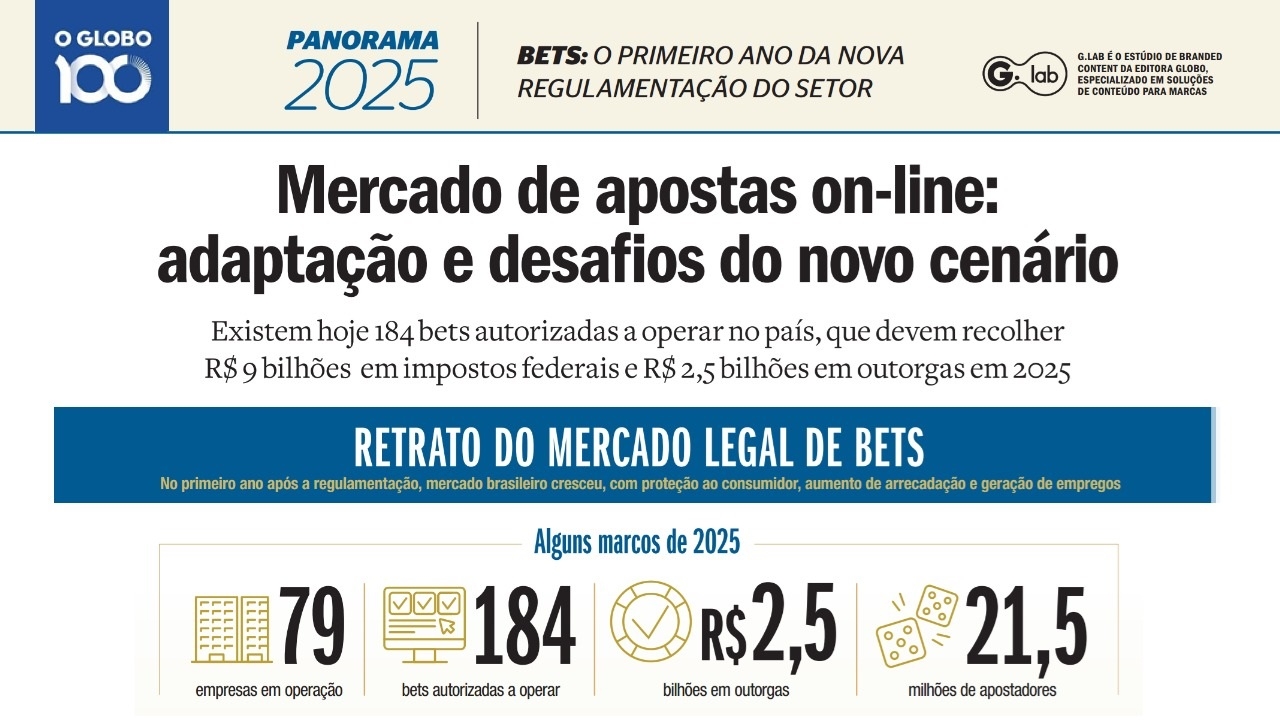
The special report provides a detailed overview of the new regulated landscape, which came into force in January 2025, highlighting the role of the Secretariat of Prizes and Betting (SPA) of the Ministry of Finance in authorization, supervision, and the fight against the illegal market. According to the supplement, Brazil already ranks as the fifth-largest betting market in the world by revenue, with 184 authorized betting operators and more than 21 million bettors.
Among the main topics covered are revenue figures—with estimates of BRL 9 billion in federal taxes and BRL 2.5 billion (US$461m) in license fees—job creation, economic impact, and the social allocation of Gross Gaming Revenue (GGR) funds. The material also details actions to combat illegality, such as blocking clandestine websites, closing bank accounts, and partnerships with digital platforms and regulatory bodies.
The supplement features interviews with key figures in the sector, such as Plínio Lemos, president of the National Association of Games and Lotteries (ANJL), and André Gelfi, CEO of the Brazilian Institute for Responsible Gaming (IBJR), who advocate balanced regulation as the path to protecting consumers and reducing the activity of illegal operators.
There is also space for the government’s perspective, with statements from Secretary Regis Dudena and the Ministers of Finance and Health on responsible gaming policies and the national self-exclusion platform.
In addition to editorial content, the special report has sponsorship and institutional support from brands and entities in the regulated sector, such as Flutter Brazil (Betnacional and Betfair), IBJR, ANJL, and international industry events, reinforcing a commitment to compliance, integrity, responsible advertising, and the protection of minors.
Educational campaigns such as “No More the Elephant in the Room” and tools like BetAlert are highlighted as initiatives to guide the public in identifying legal platforms.
By bringing together information, economic data, and messages of social responsibility in one of the country’s largest newspapers, the special supplement signals a coordinated movement by legal operators to consolidate the sector’s credibility, engage with society, and influence public debate at a decisive moment for the future of betting in Brazil.
Online betting market: adaptation and challenges in the new landscape
With 184 betting operators in operation and 70 companies authorized by the Secretariat of Prizes and Betting (SPA), Brazil has become the world’s fifth-largest market, reaching more than BRL 22 billion (US$4bn) in revenue and a total of BRL 2.5 billion (US$461m) in license fees alone. A study published by O Globo indicates that there are already 21.5 million bettors, nearly a quarter of the population.
Measures to combat the illegal market have been intensified, with 25,000 websites blocked and hundreds of accounts closed. Companies are required to have a national subsidiary and headquarters in the country, and the sector is expected to share results with society, focusing on entertainment and risk mitigation.
Since August 2024, 25,000 illegal websites have been blocked nationwide. During this period, the SPA opened 78 supervisory proceedings against 101 betting operators through September of this year, issued 801 notifications regarding transfers to illegal companies, and closed 483 bank accounts.
Since the beginning of 2024, following the enactment of Law No. 14,790, numerous ordinances and normative instructions have been issued to regulate the market. In addition, two regulatory agendas were published to define the thematic axes of action of the Secretariat of Prizes and Betting, ensuring a healthy market, combating illegal gambling, promoting Responsible Gaming, and fostering a balanced regulatory environment.
Since December 1, for example, a single self-exclusion platform has been created so that bettors at risk of gambling addiction can be prevented from betting. The measure, created by the SPA, received broad support from companies authorized to operate sports betting and online gaming in Brazil.
A safe market for entertainment
The publication includes an interview with Plínio Lemos Jorge, president of the National Association of Games and Lotteries. In it, he points to the fight against illegal betting operators as the sector’s greatest challenge. According to him, the increase in taxes on the activity and the recent creation of the CIDE-Bets tax encourage the illegal market, which pays no taxes and continues to offer betting without the tax burden that can reach 40% for companies authorized in Brazil.
He emphasizes that no country in the world has succeeded in taxing betting deposits and explains why: “When users perceive taxation on the deposited amount, they migrate to clandestine operators. And there’s more: betting operators act as custodians of customers’ funds—which remain the bettor’s property even after being deposited on the platform. Taxing this stage would be equivalent to charging a tax for depositing money into a bank account or loading a prepaid card.”
According to the executive, what Brazil needs is a more transparent and secure market with strict responsibility rules. In addition, the fight against illegal betting houses must be intensified by the government, one of the most effective ways being the financial strangulation of unauthorized websites and the shutdown of payment companies that operate with illegal platforms.
Bettor at the center
O Globo’s special supplement highlighted the importance of the agreement signed between the Ministries of Finance and Health to implement integrated and strategic actions aimed at prevention, harm reduction, and healthcare for people with mental health issues related to gambling.
The initiative has support from the private sector, which was already required to offer self-exclusion mechanisms on its own platforms and which has now been expanded to allow bettors to block themselves across all platforms.
The document also presents a figure that should serve as a warning to authorities. According to a survey by Instituto Locomotiva on illegal betting in Brazil, 78% of bettors acknowledge that it is difficult to know for sure which platforms are regulated. The study also indicates that 87% of bettors believe public authorities should combat irregular platforms.
Fighting illegality
André Gelfi, president of the Brazilian Institute for Responsible Gaming (IBJR), points out that countries such as the United Kingdom, Denmark, Italy, Spain, and Sweden are the most successful in channeling bettors to the legal market. This is due to balanced regulation and fair taxation that does not push bettors toward the clandestine market.
According to him, in addition to applying taxation that does not compromise the operation of regulated sites, it is essential for the government to combat operators that continue to operate in the black market, which still accounts for more than 50% of bets placed in Brazil.
The IBJR carried out a broad campaign on TV and social media to reinforce the importance of bettors checking whether the company they bet with is authorized by the government to operate. The “No More the Elephant in the Room” campaign symbolizes clandestine betting operators so that bettors become aware of the risks of betting on illegal sites. Alongside the campaign, the BetAlert website was launched, allowing bettors to check whether the platform they intend to use is licensed.
Advertising must follow rules and promote Responsible Gaming
The supplement emphasizes the importance of operators complying with rules on advertising and the promotion of Responsible Gaming, with actions aligned with the determinations established by the Secretariat of Prizes and Betting and the National Council for Advertising Self-Regulation (Conar).
Plínio Lemos Jorge defends the role of advertising in combating illegal gambling. “If I remove advertising from the regulated market, I destroy it and turn this country into a land of illegal betting operators. Advertising by legalized operators is the only way legal betting companies can reach players,” he emphasizes.
The document also points to international events—ICE Barcelona, iGB Affiliate, SBC Summit, and SiGMA Europe—as fundamental to the consolidation of the global gaming market, and highlights SBC Summit Rio and BiS SiGMA South America as key references in Brazil for operators, affiliates, regulators, and technology providers in the sector.
BRL 2.14 billion (US$395m) for social areas in H1 2025
In the first half of 2025, allocations of taxes paid by the betting sector reached BRL 2.14 billion (US$395m), according to a Ministry of Finance report presenting the main indicators of the segment for the period from January 1 to June 30.
The amount collected follows the provisions of Law No. 14,790 of December 29, 2023, which allocates 12% of gross revenue to areas with social initiatives. Total GGR revenue for the period—from January 1 to June 30, 2025—amounted to BRL 17.4 billion (US$3.2bn).
The main areas legally designated to receive the collected funds are sports (36%), tourism (28%), public security (13.6%), social security (10%), and education (10%). Each of these sectors received, respectively, BRL 767 million (US$141m), BRL 601 million (US$111m), BRL 290 million (US$54m), and BRL 216 million (US$40m) for the latter two areas.
Betting companies are also taxpayers of other levies, such as Corporate Income Tax, PIS/Cofins, CSLL, and ISS. According to the Secretariat of Prizes and Betting (SPA), the tax burden cannot be so high as to make legal companies economically unviable, nor so low as to harm the economy.
Overall, the effective tax burden paid by licensed betting companies exceeds 40%, and increases in taxes on the activity tend to drive players to unlicensed sites, which pay no taxes and can offer more attractive odds.
Ten thousand direct jobs
In 2025, ten thousand direct jobs were created, including in-house and outsourced positions, and indirect jobs reached 5,500. This is the result of a survey conducted by LCA Consultores and Cruz Consulting, in partnership with the National Association of Games and Lotteries (ANJL) and the Brazilian Institute for Responsible Gaming (IBJR). The number of formal employees in the sector tripled, and 67 new occupations were institutionalized.
The average salary of hired employees reaches BRL 7,000 (US$1,290), while that of outsourced workers is BRL 4,000 (US$738). Meanwhile, the national average salary is BRL 3,200 (US$590). These figures result in a payroll of BRL 460 million (US$85m) and BRL 87 million (US$16m) per year in social charges, such as INSS and FGTS.
With all this information, the sector provides clear evidence of the importance of the activity to the economy, serving as a warning to society and the government that the Brazilian market has a high impact and must be protected to prevent the growth of illegal operations that do not contribute to the country.
Source: GMB