




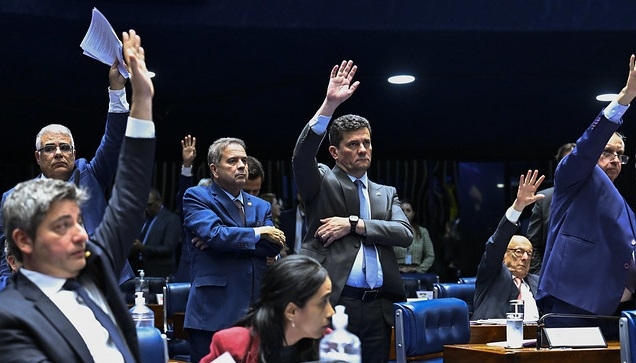
The announcement of the vote on Bill 2,234/2022 was made at the start of the Senate’s final deliberative session of the year by Senate President Davi Alcolumbre. Previously approved by the Chamber of Deputies, the bill received a favorable opinion from its rapporteur in the Senate, Senator Irajá (PSD-TO), who accepted suggested amendments and proposed adjustments.
The bill has been under review in the Senate since 2022. The text was approved by the Constitution and Justice Committee (CCJ) on June 19, 2024, and has since awaited a plenary vote. The original proposal was introduced in the Chamber in 1991 by then-Deputy Renato Vianna (PL 442/1991).
Lawmakers opposed to the bill—especially members of the evangelical caucus—argued that it could encourage gambling addiction and crimes such as money laundering, trafficking and prostitution.
“The matter is controversial. Gambling massively indebts the population, taking money away from productive activity and channeling it to magnates. The project has the DNA of a Spanish group. It will not only target people who currently gamble abroad, but also the poorest, because bingo is included,” said Senator Eduardo Girão (Novo-CE).
Senator Weverton (PDT-MA), however, defended moving forward with the bill. “I think it’s hypocritical for a country the size of Brazil, with so many tourist areas—like Maranhão—to oppose casino activity. I’m not addicted nor a betting player,” he said.
“A physical casino, with rules, will generate taxes in my state, and I’m supposed to say I’m against it? We need to review rules for online casinos, not for physical casinos, which have strict access and gaming rules,” he added.
The proposal creates a broad regulatory framework for the gaming and betting sector, establishing rules for licensing, oversight, taxation and anti–money laundering mechanisms.
The bill authorizes casinos to operate exclusively within integrated leisure resorts, which must meet certain requirements, such as a minimum of 100 hotel rooms and facilities for large cultural events. Gaming areas will be limited to 20% of the total space, and interested companies must prove a minimum capital of R$100 million (US$18m).
The text allows one casino per state with up to 15 million inhabitants, two in states with populations between 15 and 25 million, and three where the population exceeds that level. Amazonas and Pará, despite not meeting the population criteria, may have two casinos each due to their large territorial size.
For bingo halls, the rule allows one establishment for every 150,000 inhabitants, and for jogo do bicho, one operator for every 700,000 people, requiring a minimum capital of R$10 million (US$1.8m).
The bill also states that regulatory authority will be exclusive to the federal government, exercised by the Ministry of Finance, which will be responsible for setting policy, regulating, supervising, inspecting and applying penalties related to gaming and betting activities.
The text establishes specific taxes for the sector, including the creation of a 17% Contribution for Intervention in the Economic Domain (CIDE-Games) on gross revenue from gaming operations.
In addition, the modalities will pay a quarterly Gaming and Betting Oversight Fee (Tafija). Casinos will be charged R$600,000 (US$109,000) per establishment, while bingo halls and jogo do bicho operators will pay R$20,000 (US$3,650) per establishment or entity, respectively.
Source: GMB