




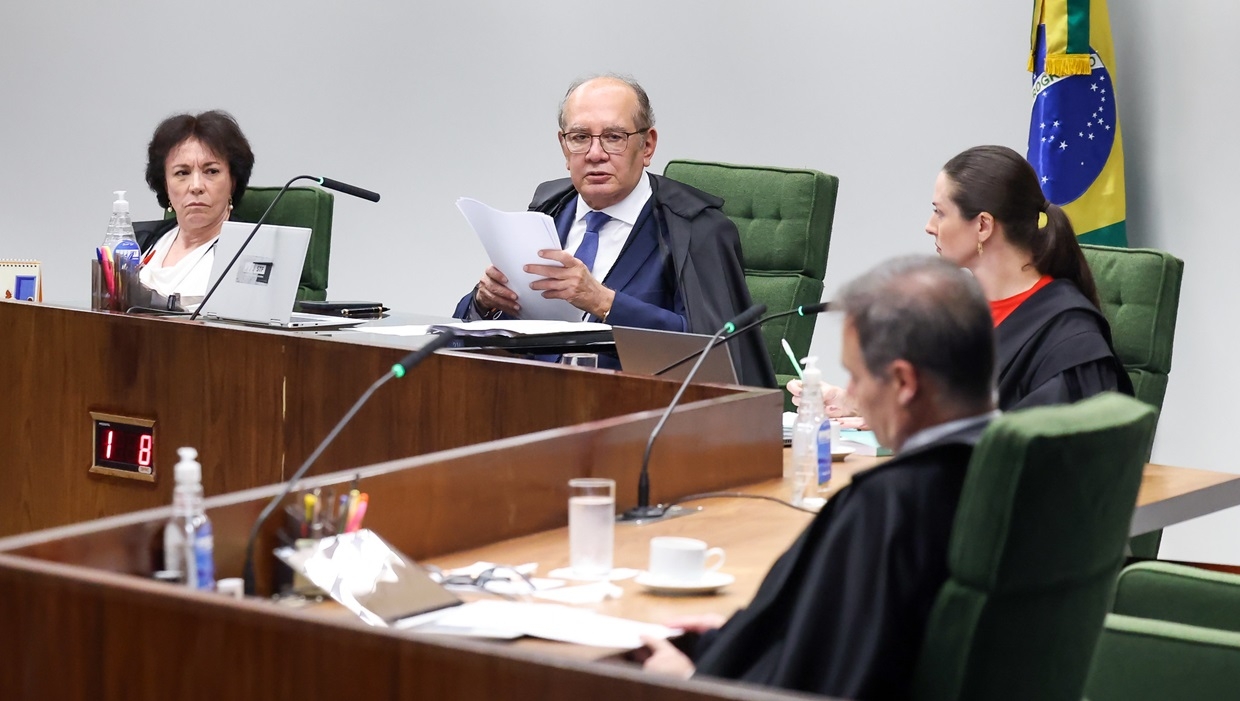
The case’s rapporteur, Justice André Mendonça — who had previously voted to deny the appeal — was outvoted. The prevailing position was that of Justice Gilmar Mendes, supported by Justice Dias Toffoli. They argued that the conduct was “atypical,” meaning the law does not expressly criminalize the act. Justices Nunes Marques and Luiz Fux did not participate in the ruling.
With this decision, the criminal case against Cariús is suspended. Cariús had been charged under Article 198 of the General Sports Law, which states:
“To request or accept, for oneself or for another, any financial or non-financial advantage or promise of advantage, in exchange for any act or omission intended to alter or falsify the result of a sporting competition or an associated event.”
Justice Gilmar Mendes endorsed the defense’s argument that the player’s action was not intended to alter the outcome of the match or the championship, but rather to ensure the success of a sports bet — which, according to Mendes, is not criminalized under the General Sports Law.
Gilmar rejected the understanding of the Superior Court of Justice (STJ), which had denied habeas corpus on the grounds that yellow cards are used as tiebreakers in the Brazilian Championship and that, therefore, intentionally forcing such penalties would affect the event's outcome.
“I believe that the act of taking a single yellow card is not sufficient to alter the result of a competition,” Gilmar stated during the reading of his vote.
The decision contradicts the position of sports integrity specialists, who advocate for criminal penalties for athletes who deliberately receive cards at the request of bettors.
“The law makes clear that protecting sporting integrity is not limited to the final result but encompasses all circumstances that may impact the fairness and transparency of the sport. Therefore, deliberately forcing a yellow card, which may influence league standings, is considered a serious violation subject to severe penalties,” said Paulo Schmitt, former Attorney General of the Superior Sports Justice Tribunal (STJD) and currently the chair of the Integrity Committee of the São Paulo Football Federation.
Within the Sports Justice system, Cariús was punished. He was suspended for one year for having allegedly received R$ 30,000 (US$5,600) from bettors to force a yellow card during the 2022 match between Cuiabá and Atlético-MG.
The STF ruling does not automatically apply to all similar cases. Flamengo forward Bruno Henrique, for instance, is currently facing prosecution for allegedly taking a yellow card in 2023 to benefit his brother and other acquaintances in sports bets. He was acquitted by the STJD.

The defense team of Igor Cariús — attorneys Vinicius Costa Rocha, Ademar Rigueira, and Rafael Carneiro — issued the following statement:
“Today, in a session composed of Justices André Mendonça, Gilmar Mendes, and Dias Toffoli, the STF’s Second Panel granted, by majority, a writ of habeas corpus (AgRg in RHC No. 238757) to dismiss the criminal proceedings arising from ‘Operation Maximum Penalty III,’ due to the manifest atypical nature of the conduct attributed to athlete Igor Aquino da Silva (Igor Cariús) of Sport Club do Recife.
The conduct described in the indictment involved accepting an undue advantage in exchange for receiving a yellow card during the match between Atlético-MG and Cuiabá (the team he played for) in the 2022 Série A of the Brazilian Championship — which, according to the Goiás State Public Prosecutor’s Office, would constitute the crime provided for in Article 198 of the General Sports Law (Law No. 14,597/2023).
The defense’s argument focused on the atypical nature of the conduct in light of criminal-law analysis, since Article 198 of the General Sports Law criminalizes only undue advantage agreements intended to alter or falsify the outcome of a sporting competition.
In the December 2 session, Justice Gilmar Mendes accepted the defense’s thesis, granted the Internal Appeal, and awarded the habeas corpus, stating that ‘since the criminal provision applies only to conduct aimed at altering or falsifying the result of a sporting competition or an associated event, recognizing the atypical nature of the conduct is mandatory in this case.’
Justice Dias Toffoli agreed, noting that ‘the conduct is atypical due to the lack of any impact capable of compromising the competition's outcome, as alleged in the indictment."
With the dismissal of the criminal action, all criminal effects against Igor Cariús immediately cease, preventing him from remaining subject to an unjustified proceeding and eliminating any risk of conviction for conduct that does not constitute a crime. Beyond fully restoring his legal status as an innocent party, the decision enables him to resume his career without the shadow of an improper criminal charge and safeguards his moral integrity in the face of accusations that exceeded the bounds of strict legality.
Source: ge