




The business model of digital organized crime
The “as a Service” concept transformed the software industry by enabling scalability without major infrastructure investments. Organized crime simply replicated this successful model.
Today, on specialized marketplaces and encrypted channels, it is possible to acquire complete packages of fraudulent tools with the same ease as hiring any corporate service.
What do these packages include?
* Verification bypass tools: systems specifically developed to circumvent standard KYC processes, including technologies that manipulate data flows in real time.
* Validated databases: complete and verified personal information (CPF, ID, address, family data), often already tested in credit bureaus, enabling the creation of synthetic identities with high automatic approval rates.
* Emulation infrastructure: services that simulate thousands of unique mobile devices, altering hardware fingerprints, geolocation, and IP addresses to replicate the behavior of distinct legitimate users.
* Automation scripts: bots configured to systematically exploit vulnerabilities, bonus rules, and promotions at massive scale.
This “democratization” of fraud tools has eliminated the main barrier to entry: specialized technical knowledge. Anyone with some initial capital can outsource their illicit activities, exponentially increasing both the volume and sophistication of attacks.
Why is iGaming the preferred target for fraudsters?
The iGaming sector presents characteristics that make it particularly vulnerable and attractive to FaaS-based operations:
* High daily transactional volume: billions of reais in movement
* Need for high operational speed: short detection windows
* Competitive pressure for conversion: minimal onboarding friction
* Digital and decentralized nature: complicates traceability
The cost of FaaS for operators
To understand the real impact of FaaS on operations, it is necessary to look beyond direct losses. The structural damage lies in the waste of Customer Acquisition Cost (CAC).
Operators invest substantial amounts in:
* Paid marketing and traffic
* Influencer partnerships
* Affiliate programs
* Media campaigns
When these investments attract synthetic identities or accounts run by criminal organizations, the expected return simply does not materialize.
Even worse: aside from the heavy LTV (Lifetime Value) losses, these accounts:
* Drain resources through systematic promotion abuse
* Overload compliance and risk analysis teams
* Contaminate the database with fraudulent information
* Expose the operation to severe regulatory sanctions
FaaS also enables money laundering at an industrial scale. Large sums are broken down into thousands of seemingly legitimate transactions, exploiting the impossibility of manual monitoring in high-volume operations.
The failure of traditional controls
Given the sophistication of FaaS operations, security systems based on static rules have become inadequate:
1 - Static rules are predictable: blocking based on IP, region, or the number of attempts is easily bypassed using residential proxy infrastructure and high-fidelity emulators.
2 - Manual analysis is mathematically impossible: even highly trained analysts cannot detect sophisticated manipulations in real time. Scaling teams to manually review thousands of daily registrations leads to:
* Critical operational bottlenecks
* Friction for legitimate users
* Prohibitive labor costs
* Unacceptable human error rates
3 - Technological asymmetry is fatal: criminal organizations use automation and artificial intelligence in their attacks. Defense must necessarily exceed this level of technology.
The current battle is not fought at the visual or document level, but in the analysis of metadata, invisible behavioral patterns, and data orchestration within milliseconds.
What Is needed to combat FaaS?
Effectively combating Fraud as a Service requires a multidimensional Risk Scoring approach capable of simultaneously analyzing different risk vectors, such as:
* Advanced device fingerprinting
Identifying real devices vs. emulators by analyzing inconsistencies in battery, gyroscope, sensors, and hardware patterns.
* Intelligent geolocation
Monitoring beyond surface-level IP, analyzing signal latency, VPN/Proxy usage, and “Location Jump” (physically impossible location changes).
* Biometrics with manipulation detection
The ability to distinguish live faces from masks, screens, or digital forgeries—without adding friction to legitimate users.
* Link and pattern analysis
Cross-referencing data to identify connections between legitimate CPFs and organized group behavior, even when individual information appears valid.
* Real-time orchestration
Integrating hundreds of public and private databases and processing information in under 30 seconds without harming user experience.
Is your operation truly secure?
Traditional fraud prevention systems based on static rules (“if the IP is X, block it”) are ineffective against FaaS. Because criminal infrastructure is dynamic, static rules are always one step behind.
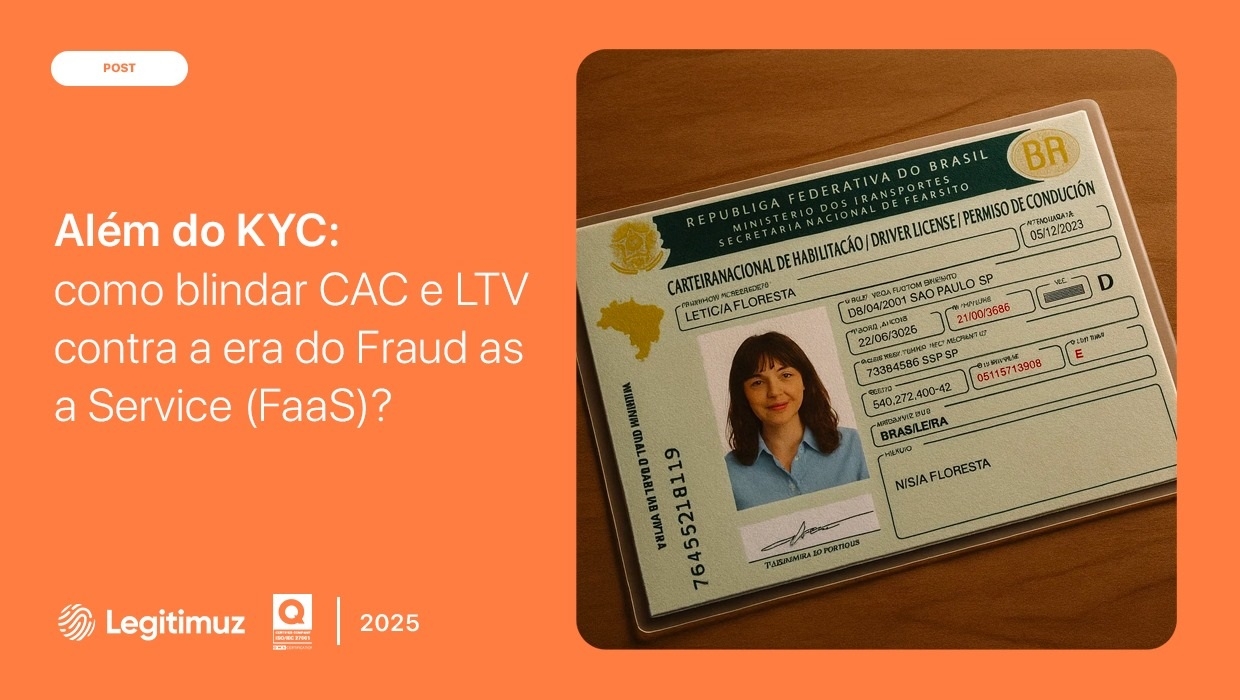
Additionally, simple document verification (OCR) is no longer a sufficient barrier. Perfectly edited digital documents are available for mass purchase. Operators relying solely on “digital paper” checks are, in practice, inviting FaaS risks into their platform.
To fight an organized and technologically skilled industry, the response cannot be manual. Defense architecture must assume that FaaS is the standard threat in today’s market.
Static verification gives way to behavioral and contextual analysis, with advanced OCR and multiple layers of verification focused on connection integrity, device movement physics, and metadata consistency.
While the FaaS market attempts to scale the number of attacks, operators must stay ahead by scaling the quality of their defense—ensuring growth through real users and protecting CAC and licensure.
Vitória Marques
Media & SEO Specialist at Legitimuz
Legitimuz is a Brazilian company specializing in compliance solutions for the regulated market, offering KYC with facial recognition, geolocation monitoring, and automated AML/CFT systems aligned with all current regulations, certified under ISO/IEC 27001.