




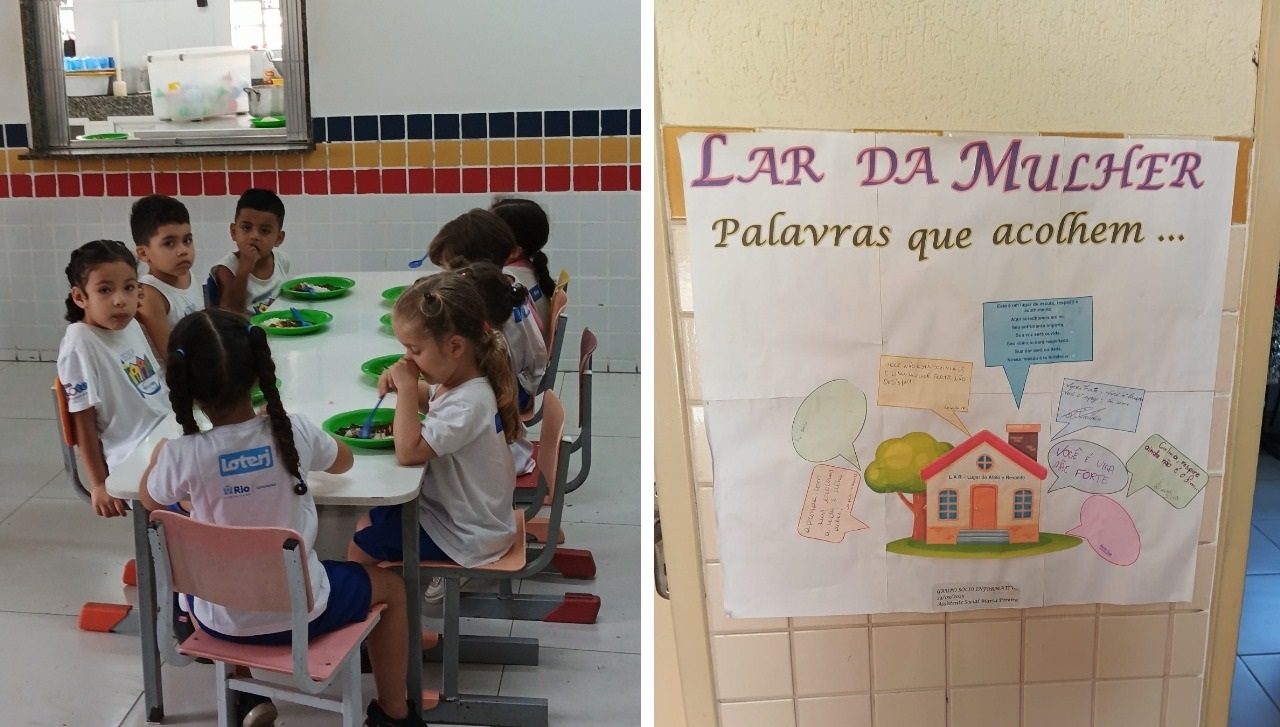
One of the pillars of this work is the partnership with RioSolidário, which is responsible for maintaining early childhood education centers in areas such as Vila do João, Cidade de Deus, and Jardim Batam. In these locations, children aged 6 months to 3 years and 11 months find much more than care. Services include four daily meals, pedagogical support, specialized teachers, uniforms, educational materials, family assistance, and programs that encourage mothers’ development — contributing to income generation, autonomy, and inclusion.
At the daycare center in Vila do João, in the Maré complex alone, the project can serve up to 250 children, offering full-day care from 7 a.m. to 5:30 p.m., with a multidisciplinary team, comprehensive educational materials, social monitoring, and structured meals. The facility also includes nine special inclusion cases, reinforcing the comprehensive nature of the assistance.
The daycare centers also serve as points of safety and stability amid the adverse routine faced by residents in these areas — where recent shootings, barricades, and the presence of armed groups remain part of daily life. All children are treated with dignity in a cheerful and welcoming environment, with spacious and air-conditioned rooms, organized nurseries, appropriate bathrooms, and well-maintained playgrounds.
One detail stands out: the spaces were decorated for the year-end festivities, with photos of the children on murals, windows, and doors — simple, colorful images full of symbolism. The handmade wreaths, the improvised Christmas tree, and the children’s joy at the decorations contrasted with the outside reality, emphasizing that, for many families, those few square meters represent refuge, relief, and hope.
For Loterj president Hazenclever Lopes Cançado, the results embody the essence of the agency’s public mission: “When we multiply resources, we are not just expanding numbers — we are multiplying dignity, hope, and future. Every bet placed in Rio de Janeiro must return to the people of the state in the form of care, protection, and opportunity. That is what drives us.”
Between data and people, numbers and stories, the 40-fold increase in social investments eloquently reflects an institutional movement toward responsibility: an act of betting on what matters most.
Women’s shelter
Children are not Loterj’s only priority. The agency also reinforces its role in the state’s social protection network by ensuring the maintenance of the Lar da Mulher (Women’s Shelter), a facility run in partnership with RioSolidário since 2009.
With capacity to house up to 60 people for periods of up to six months, the shelter operates at a confidential and monitored location, guaranteeing privacy and safety for the women and their children. The structure includes a nursery, playroom, library, dining hall, beauty salon, legal assistance, and psychosocial support, as well as food, clothing, and essential items for the children.
Loterj’s ongoing support also ensures access to psychological care, educational activities, document issuance, health services, and educational programs — measures that promote autonomy, strengthen self-esteem, and offer real conditions for a fresh start.
Between August 2023 and August 2025, Loterj allocated R$ 5.3 million (US$975,000) to supporting women and children in situations of vulnerability. With renewed funding in August 2025, an additional R$ 3 million (US$551,000) was secured for the continuation of the project through August 2026. In total, R$ 8.4 million (US$1.55m) will be invested over three years of cooperation.
The women arriving at the shelter carry stories marked by ruptures and challenges, but also by courage and hope — a point highlighted by Loterj president Hazenclever Lopes Cançado.
“When we look at each woman welcomed here, we see far more than a situation of vulnerability; we see strength, dignity, and a profound desire to start over. The Women’s Shelter is a place where lives are rebuilt with love, care, and respect. Supporting this shelter means believing that no one should face violence alone — and that protection and care can transform destinies. Watching these women reclaim their dreams is one of the greatest proofs that sensitive, well-implemented public policies truly change realities,” he said.
Source: GMB