





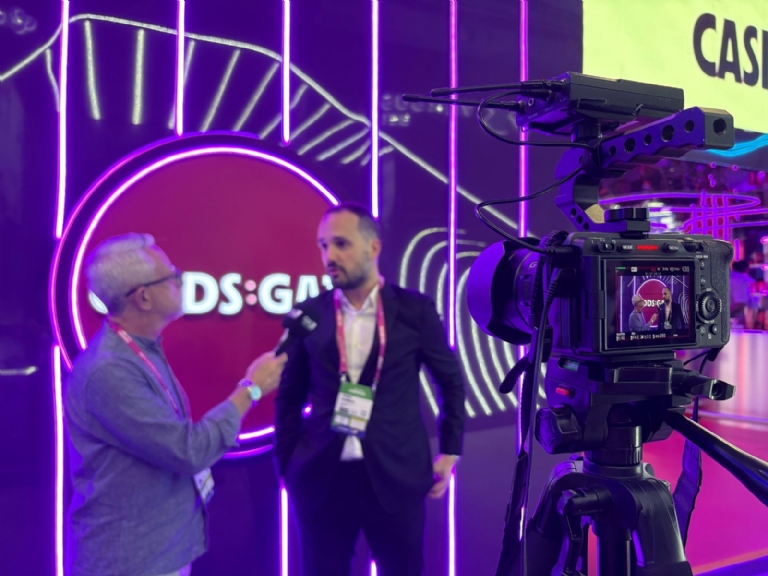
GMB – What were Oddsgate's goals at BiS SiGMA, and how is business going in Brazil?
Tiago Almeida – We came with the goal of presenting a new version of our technology for Brazil’s regulated betting market. Today, we’re helping seven operations make the transition from the emerging market to the regulated one. We’re here with a lot of enthusiasm, because we’re starting to see the fruits of years of investment—developing brands, developing our partners—and realizing that this bet was a winning one. Not only did these seven brands manage to transition, but we’ve already surpassed December’s gross revenue figures.
That’s crucial, since there was a sharp drop at the beginning of the regulated market!
There was. January was a very critical month, not only because — something we’ve had the opportunity to talk about—many elements were being connected for the first time, new systems that not everyone was familiar with, including ourselves. And also, how the flow would behave.
Naturally, we had to understand that players weren’t used to biometric authentication or uploading their documents. It was all a new process. But we now know that this process was created to build a safer, fairer, and more sustainable environment. So, what’s happened after these four months? We see that the initial friction has passed, players feel more protected, more confident, and most importantly, they feel like they’re having a responsible and long-term entertainment experience.
And the websites and entrepreneurs behind these operations also feel that they have legal certainty to continue operating and contributing—not only by paying taxes in Brazil but also through the solidarity tax, the charitable contribution, which is a significant amount that brands are indeed paying.
How important has the partnership been between platform providers, operators, and other ecosystem suppliers like payment and identity verification methods for a sustainable and truly contributing market?
Well, I think first of all we have a symbiotic relationship. Why? No matter how good the technology of a company like Oddsgate is, it doesn’t work alone. We really need payment providers, biometric partners—companies like Legitimuz, with whom we’ve had a great partnership that adds a lot of value. And what’s interesting is that everyone is “wearing the jersey,” meaning everyone understands their role in this ecosystem that we’ve helped to build.
That gives everyone the confidence to ensure their specialized products are increasingly authentic, aligned with what players need, and also ensure legal certainty throughout this ecosystem where the player interacts—and where the government, through the Secretariat of Prizes and Bets (SPA), also needs to engage.
How has technology brought benefits to both operators and end users? For example, artificial intelligence in game development and platform customization—how has that played out?
I think this regulation process revealed the magnitude of previously hidden figures. What do I mean by that? Today, we’re seeing monthly betting volumes slightly over R$7 billion, with tens of millions of active customers. What happens is that many times there are opportunities for improvement that operators weren’t even aware of. Why didn’t they know? Because in the race for market share, there was a big push to close major sponsorships, hire influencers, and form partnerships—it was like a race against time. Today, that race is more of a marathon.
Everyone understands that focusing only on big sponsorships or partnerships without doing the groundwork doesn’t help. And that groundwork is what companies like ours have been focused on—saying: “Look, there’s a segment of your user base being underutilized,” or “There’s a content provider delivering below our operational margin benchmarks.” We make these comparisons not only with our six other operations but also with international markets.
We’ve been able to bring content improvement opportunities that worked, for example, in Mozambique, and apply them in Brazil. Many times, from this cultural and business exchange, great opportunities arise to explore certain content or optimize flows— resulting in that 0.5% margin improvement I mentioned earlier, which is exceptional considering the scale of these sites.
And all this using truly cutting-edge technology?
Yes. Not only things we’ve developed over the past three years at Oddsgate, but also through partnerships we’ve established—with Legitimuz, which helps us a lot, and Smartico, which we use for big data, gamification, and other tools that are key to giving customers a smoother, more reliable, and more entertaining experience.
Now with the market consolidated and, as you said with profitability returning to pre-regulation levels, what are Oddsgate’s plans for the rest of 2025 in Brazil?
Our number one priority is to always thank our partners and clients for their trust. We know we have a huge responsibility—as 100% allies—and that we cannot fail. We really strive to add quality and be the lever that the operator can pull, knowing we’ll help improve that extra 0.5% or 1%.
That’s what operators need to stay relevant and continue growing, taking full advantage of all the verticals available. Regulation was very generous, allowing operators to explore not just sports betting, but also casino games, traditional games, peer-to-peer games, and increasingly hybrid gaming formats—which I believe could become a very interesting part of the offering.
So, an Oddsgate gateway of opportunities?
Yes, a portal of probabilities. That’s our major competitive advantage as a platform and technical aggregator. It’s being able to maintain strong relationships with our partners, knowing that we’re almost like a store where they can stop by and find everything. We currently support over 300 integrations, and that number keeps growing because we’re always looking to improve.
Source: Exclusive GMB