




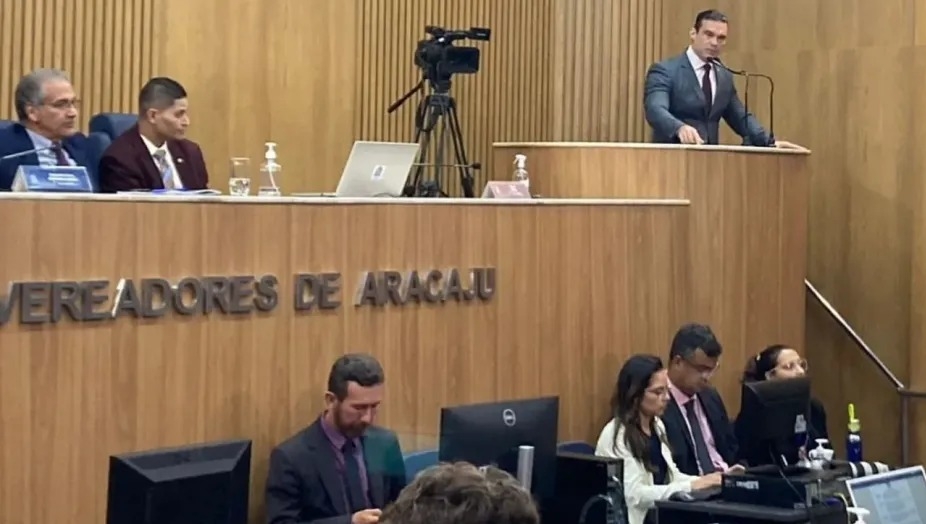
The objective is to promote a broad and democratic debate on the topic, which has generated repercussions in Aracaju society.
Among those invited to speak is Roberto Lasserre, national coordinator of the Brazil Without Gambling movement, nationally recognized for its actions against the legalization of gambling, such as the so-called ‘Bets’ platforms.
The initiative by councilman Lúcio Flávio aims to bring different points of view to the discussion, contributing to the population's awareness and the formation of a more informed decision by the Municipal Parliament.
Proposed by the leader of the government in the House, Isac Silveira, the bill provides for the exploration of any lottery modality provided for in federal legislation, such as sports betting (fixed odds).
The objective, according to the councilman, is to “provide the municipality with the opportunity to raise new revenue and allocate resources to areas of social assistance,” which, according to him, are “needy.”
The debate in Aracaju follows a national trend, supported by an interpretation underway at the Federal Supreme Court regarding the competence of states to manage their own lottery services. In 2020, when analyzing a lawsuit from Rio de Janeiro, the Court's ministers decided that economic exploration should not be concentrated in the hands of the Union.
It is based on this understanding that city governments have been moving forward with municipal lottery projects. Today, the operation of online betting and gaming is only authorized at the national and state level by the Secretariat of Prizes and Betting, linked to the Ministry of Finance.
To operate in the country, for example, these companies must pay a fee of 30 million reais, in addition to fulfilling other obligations. In the municipalities, however, the amounts are much lower – which is why many owners of 'Bets' are enthusiastic about regulating lotteries. In March, the Solidariedade party filed a lawsuit with the Supreme Federal Court to block what it considers a “circumvention” of federal legislation.
This would be the case of Bodó, a city of 2,700 inhabitants in the interior of Rio Grande do Norte. There, since last year, at least 38 companies (one for every 62 residents) have obtained a license to operate the service at a cost of 5 thousand reais. The amount charged corresponds to only 0.2% of the fee set by the department headed by Fernando Haddad, where none of the 'Bets' have the authorization to operate.
Solidariedade requested an injunction to temporarily suspend the services until the end of the process, but the rapporteur decided to ask for information from the more than 13 municipalities that have their own lottery systems before making a statement. Also urged to take a position, the Attorney General's Office is the author of another action that seeks to nullify rules that allow the exploitation of 'Bets'.
One of the entities interested in legalization, the National Association of Municipal and State Lotteries (ANALOME), entered the game. In a petition to the Supreme Court, it requested to act in the case as amicus curiae (a kind of third party interested in the process) and alleged that the exploitation of gambling by municipalities is an "important source of resources to overcome contemporary financial contingencies."
According to ANALOME's calculations, regulating the activity would generate an annual revenue of 11.6 billion reais for the federal government.
For lawyer Bernardo Freire, a specialist in 'Bets' regulation, the decentralization of the betting sector must be accompanied by parameters to avoid the “disorderly proliferation of municipal grants” and legal uncertainty. Without this, the specialist explains, there is a risk that municipalities “will become a shield for the national operations of illegal operators.”
“This movement must be closely monitored so that, if validated, it will have the same level of regulatory care adopted by the Union. The lack of clear rules on compliance, responsible gaming, user registration and prevention of money laundering in municipal regulations puts institutional control of the sector at risk,” he points out.
Source: GMB