




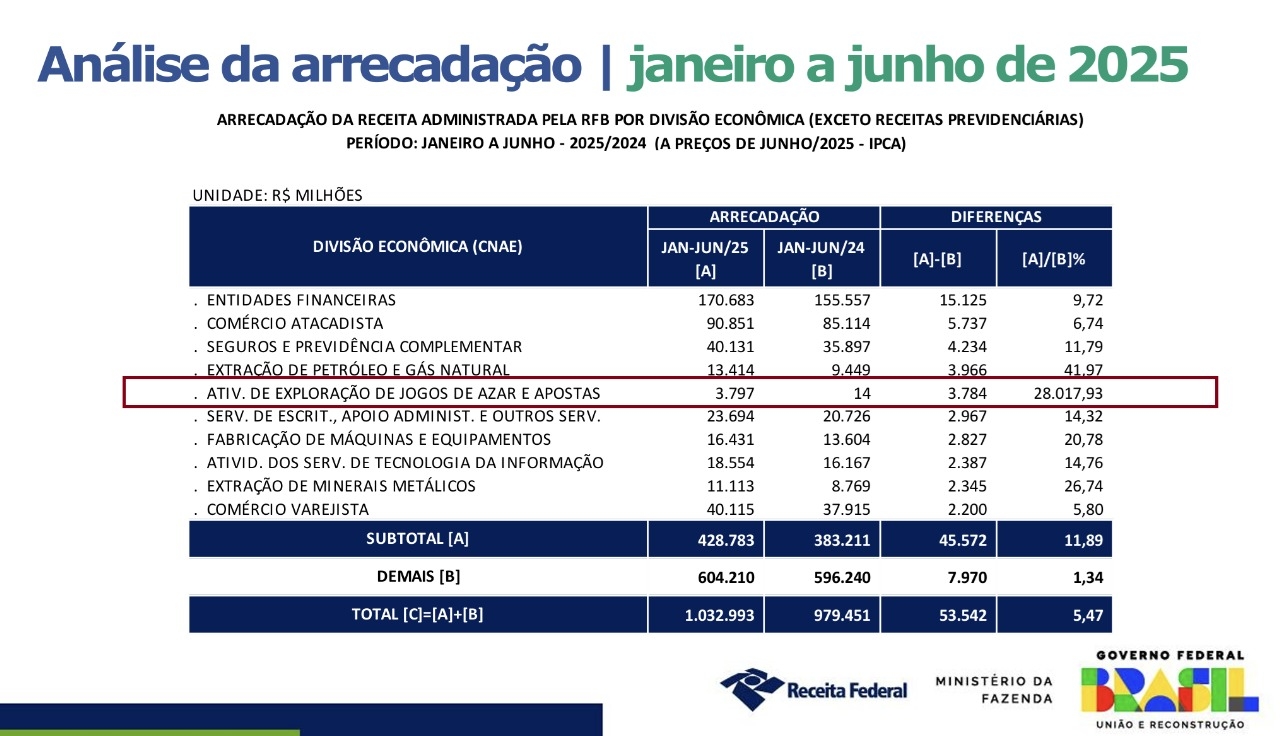
With the market now regulated, the sector’s tax performance has outpaced traditional economic segments such as education (R$516 million / US$93.5m), retail (R$507 million / US$92m), and machinery and equipment manufacturing (R$408 million / US$74m).
The total revenue from gambling operations between January and June skyrocketed compared to the same period last year, when only R$4 million (US$725,000) was collected. “In June last year, the activity wasn't regulated,” explained Claudemir Malaquias, head of tax studies at the Federal Revenue, highlighting the significant increase in tax collection.
The sports betting sector welcomed the result. “The beginning of regulation brought more predictability and security,” said André Baldavira, Head of Marketing at GingaBet.
“The sports betting sector contributes significantly to the country’s budget as it boosts the national economy, generates jobs, and pays taxes,” emphasized Alex Rose of InPlaySoft.
“The regulation of sports betting ensures the presence of serious companies in the betting sector and creates new opportunities to attract international operators, solidifying Brazil as one of the world’s most relevant betting markets,” stated Leonardo Henrique Roscoe Bessa, a consultant for the Federal Bar Association (OAB) and partner at Betlaw, a law firm specialized in gaming and betting.
Illegal ‘Bets’ moves more than twice as much as regulated operators
Even so, it’s estimated that Brazil still loses R$10.8 billion (US$1.95bn) annually due to its failure to combat the illegal betting market, according to a study conducted by LCA Consultores and supported by IBJR (Brazilian Institute for Responsible Gaming), carried out between April and May of this year.
The study also found that 61% of respondents admitted to having placed bets on irregular platforms this year—often without awareness of the risks involved.
Another 78% found it difficult to distinguish between legal and illegal websites, while 72% said they were not always able to verify platform legitimacy. Furthermore, 73% of bettors reported having used at least one of the illegal platforms identified in 2025.
Although there is no official number, industry professionals estimate that the illegal market today accounts for nearly 40% of the betting industry. This is a high figure compared to one of the most structured betting markets in the world—such as the UK—where authorized operators dominate, yet 13% of the market remains underground.
To illustrate with figures, a study by Germany’s GGL (Gemeinsame Glücksspielbehörde der Länder), the national online gaming regulatory authority, estimated gross revenue from the illegal market at 4% of the total, between €400 million and €600 million.
Meanwhile, a study by Leipzig University, led by economist Gunther Schnabl, found that around 49% of online bets in Germany occur via unlicensed operators.
Crackdown on irregular sites
With the enactment of Law No. 14.790/2023 and its corresponding regulation, Brazil has established a clear and objective regulatory framework for fixed-odds betting. The legislation aims to ensure an environment of integrity, transparency, and social responsibility in betting operations, protecting consumers and securing proper tax revenue for the State.
Within this context, the law requires companies operating in this sector to hold provisional or permanent licenses issued by the competent regulatory authority, the Secretariat of Prizes and Betting (SPA).
However, some companies have been found to be operating irregularly, ignoring regulatory requirements. These practices undermine market competitiveness, erode bettor confidence, and constitute violations of the law.
For government-licensed betting companies, it's crucial that clandestine operators cease to function in Brazil.
“Combating illegal operations is essential to consolidating a regulated and trustworthy betting market in Brazil. Blocking illicit sites is a major step forward in consumer protection, anti-money laundering efforts, and recognizing the value of companies that operate in compliance with the rules. This measure strengthens the sector’s credibility and reinforces the country’s commitment to a more transparent and responsible betting industry,” said Talita Lacerda, COO of the Ana Gaming Group, which operates brands such as 7K, Cassino, and Vera.
According to experts, one effective measure against unregulated platforms would be for payment providers to block transactions to and from illegal sites—whether for accepting bets or paying out winnings. This would practically force users to open accounts abroad. Some institutions have already adopted such procedures.
“Payment facilitators play a crucial role in preventing illegal sites from operating in Brazil (...) refusing to process payments for unlicensed operators is a responsibility that must be shared by all payment processors in the sector. Without financial means, these illicit operations lose the ability to function—protecting players, legitimate companies, and the entire ecosystem,” said João Fraga, CEO of Paag, a techfin that facilitates financial transactions and is launching products to help betting companies comply with the new regulations.
For Raphael Paçó Barbieri, a lawyer specializing in sports law and a partner at CCLA Advogados, effective action by the Secretariat of Prizes and Betting is key to ensuring a functional regulatory environment and legal certainty for operators who comply with legal requirements.
“With the requirement for official authorization now in force, one of SPA’s main duties will be identifying and blocking the domains of non-compliant websites that attempt to bypass the regulations and continue operating in Brazil without meeting the necessary conditions,” he said.
Source: GMB