




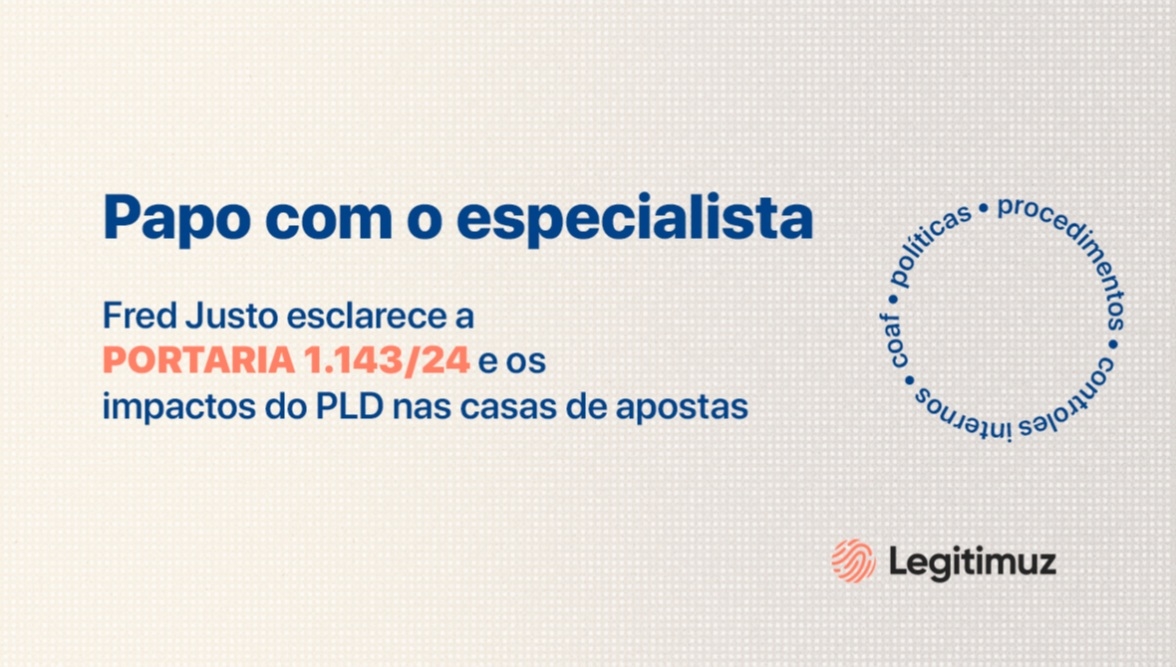
Today, as Director of AML at Legitimuz, Fred Justo leads the development of strategies and solutions that enable organizations to identify and monitor risks related to money laundering and terrorist financing, ensuring regulatory compliance in an efficient and integrated way through the most robust and comprehensive anti-fraud solution on the market.
SPA/MF Ordinance No. 1,143 must be clearly understood by operators
SPA/MF Ordinance No. 1,143 has just turned one year old and, since its publication, has clearly marked significant progress in the process of regulating betting operators in Brazil.
It is no secret that criminal organizations, as well as bad actors, attempt to use betting platforms for the illegal practice of money laundering.
History shows that over time, many jurisdictions have created specific AML/CFT regulations for the sector, due to its high vulnerability.
SPA/MF 1,143: Brazilian regulation is robust and modern in money laundering prevention
In this context, the Brazilian regulation dedicated to preventing money laundering, terrorist financing, and the proliferation of weapons of mass destruction proves to be both robust and modern.
Ordinance 1,143/24, the result of extensive research, dialogue, and cooperation, does not aim to suffocate betting operators, but rather reflects the Brazilian regulator’s concern with protecting the market, the financial system, and society.
An initial analysis shows alignment with international guidelines, such as the recommendations of the FATF (Financial Action Task Force), which are also adopted by sectors like banking.
The 4 pillars of SPA/MF 1,143/24
While there is always room to improve existing legislation—something that will naturally occur over time and through practical application—the Brazilian regulation is dynamic and constantly evolving.
Upon analyzing Ordinance 1,143/24, it becomes clear that it is structured around four essential pillars:
* Policies
*Procedures
* Internal controls
* Communication to the Financial Intelligence Unit (Coaf)
1. Integrity, compliance, and ESG pillars at the heart of regulation for ‘Bets’
In the Policies pillar, the regulation emphasizes highly relevant and current topics.
In addition to risk assessment policies, the regulator requires that the operator implement an integrity program to promote a culture of compliance and good governance, with a focus on ESG (Environmental, Social, and Governance) pillars—an essential agenda today.
Incorporating these elements into the AML/CFT framework reinforces compliance with Law No. 12,846/13, Brazil’s anti-corruption law.
2. Risk identification, assessment, and classification through KYC
The Procedures pillar represents the core of money laundering prevention, requiring identification, assessment, and classification of risks related to users, bettors, employees, service providers, and products offered by betting operators.
The acronym KYC (“Know Your Customer”) is critical in this phase, as it determines the risk of allowing a bettor onto the platform. Proper KYC verification prevents fraud and crimes such as money laundering and terrorist financing.
This verification must occur during the bettor's registration. Delaying it until deposit or withdrawal stages constitutes regulatory non-compliance and increases risk for the operator.
Collected data must be properly documented, kept up to date, and used in the development of the operator’s risk matrix.
3. Updating records and monitoring financial partners
Internal controls are essential to ensure that operators act ethically and legally, protecting betting platforms from operational and reputational risks and ensuring compliance with current laws.
Among the requirements is the need to keep updated records of bettors and other users. Outdated data increases fraud risk and hampers internal investigations, exposing the operator to sanctions.
Another key aspect of Ordinance 1,143/24 is the periodic verification and monitoring of compliance by payment and financial partner institutions. This helps avoid connections with payment methods tied to the illegal market, a practice expressly prohibited. Operators are also required to periodically review their AML/CFT policies.
In March, the SPA requested these policies from betting operators and found unsatisfactory policies and even instances of copied documents among competitors—situations that could lead to penalties during audits.
4. Reporting suspicious activity and lack of minimum value for communication
Reporting to Coaf is a frequent source of doubt among operators: what should be reported? What information is essential?
According to Law No. 9,613/98, betting operators are required to adopt identification measures and report suspicious money laundering activity to the Financial Intelligence Unit (Coaf).
Even though betting operators have limited investigative capacity, the obligation to report exists—and is critical.
Unlike the Brazilian financial system and many international regulations, Ordinance 1,143/24 does not set a minimum threshold for automatic reporting. Instead, it requires careful assessment and the submission of relevant information to the Financial Intelligence Unit.
There’s still a long way to go
As a newly regulated market, it’s natural for doubts to arise—evident in the high volume of reports received by Coaf in the first six months.
Over time, and with the implementation of AML technologies, the quality of these reports should improve significantly.
Until then, the maxim applies: when in doubt, report it. It’s better to err on the side of excess than omission, as the latter can result in serious reputational and regulatory consequences for operators—something to be avoided at all costs.
Do you want to deepen your understanding of AML regulations in Brazil and strengthen your compliance practices? Get in touch to clarify any questions and ensure your business is protected and compliant.
Source: Legitimuz