




PEP, or Politically Exposed Person, is a term widely used in the context of Anti-Money Laundering (AML), but it is often surrounded by concerns.
Many AML analysts are alarmed when a customer’s record indicates they are a PEP. But does this really represent a major risk?
To answer that question, it’s necessary to understand the origin and impact of this term on compliance practices.
What is a PEP and what is its association with money laundering?
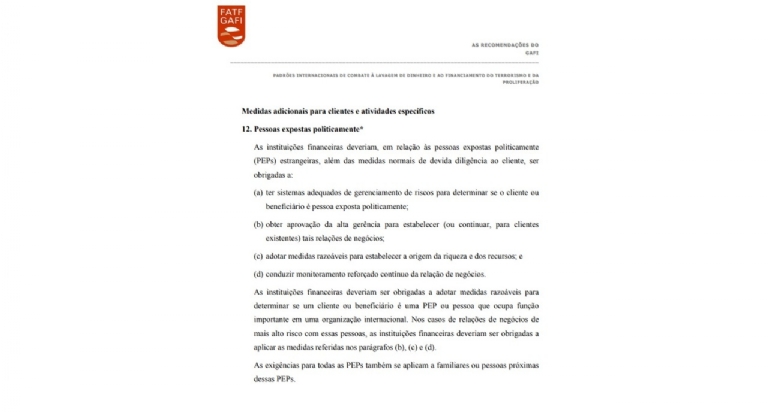
The term PEP was introduced by the GAFI (Grupo de Ação Financeira Internacional / FATF - Financial Action Task Force) in 1990, with the aim of creating international policies to combat money laundering and cross-border crimes.
At that time, the FATF drafted a set of 40 recommendations for member countries, establishing guidelines for combating these illicit practices.
In 1999, Brazil was admitted as an observer in the group and, the following year, became a full member. From 2003 onward, the PEP concept gained relevance in Recommendation No. 12, after a major review of FATF standards.
In Brazil, the definition of PEP was consolidated as part of anti-corruption and anti-money laundering efforts, formalized by the Financial Activities Control Council (Coaf) and the Office of the Comptroller General, which indicated that a PEP is an individual holding a prominent public position, whose relatives may also be classified as such.
These definitions are included in Coaf Resolution No. 40, dated November 22, 2021.
The risk of a PEP for financial institutions and betting operators
Accepting a PEP as a client may pose risks for financial institutions or betting operators, mainly due to the potential involvement in crimes such as corruption, money laundering, or bribery.
When these crimes occur, money is often introduced into the financial system in fragmented amounts, making it harder to trace. This can result in financial losses and irreparable reputational damage to the institution involved.
If a PEP becomes involved in a criminal scandal, any betting operator that had dealings with them may be seen as complicit or negligent, even if it did not act in bad faith.
That’s why it is crucial to consider PEPs as risky or even high-risk customers, depending on the institution’s risk assessment.
PEPs in the betting market: risks, rules, and Brazilian legislation
It is important to highlight that being a Politically Exposed Person does not mean being a criminal. Although there is often a negative perception surrounding political figures, generalizations cannot be made.
It is also worth noting that, in Brazil, gambling legislation does not prohibit a PEP from registering on a betting platform. However, Ordinance SPA/MF 1,143/24, in line with Law 9,613/98, requires betting operators to strictly monitor and classify PEPs.
Compliance measures required for betting operators
1- Customer Identification (KYC): Implementation of “Know Your Customer” procedures, ensuring the identification of PEPs.
2- Data verification: Use of databases and PEP lists from reliable sources to validate a client’s PEP status.
3- Enhanced Due Diligence: Implementation of stricter measures, such as collecting information on the source of funds and the nature of transactions.
4- Transaction monitoring: Ongoing monitoring of PEP transactions to identify suspicious activity, with real-time alert generation.
5- Suspicious activity reports and best practices to SPA: Obligation to report suspicious activity to Coaf and submit reports to SPA regarding AML actions, including all monitoring related to PEPs.
How to mitigate risks associated with PEPs in iGaming?
Monitoring and prevention tools are essential for betting operators, especially in Brazil, where anti-money laundering regulations are becoming increasingly strict.
To mitigate risks associated with PEPs, it is crucial to adopt a systematic and integrated approach that combines the use of technology with robust compliance practices.
Additionally, operators should establish clear communication protocols with competent authorities, such as Coaf, and comply with due diligence obligations to ensure all transactions are properly verified.
The combination of advanced technology and strict governance practices can help reduce risks associated with PEPs and protect both operators and the financial system from potential reputational and legal damage.
Finally, I am pleased to mention that here at Legitimuz, where I serve as AML Director, we provide comprehensive KYC and AML (Anti-Money Laundering) solutions, helping more than 67% of the regulated market meet AML requirements while protecting their businesses.
I am available to present in detail how these solutions can be applied in practice, discuss the specificities of each business, and explore how we can collaborate to ensure compliance and security in the PEP monitoring process.
Please feel free to reach out for a deeper conversation on the subject and the best risk mitigation strategies.
Fred Justo
AML Director at Legitimuz