




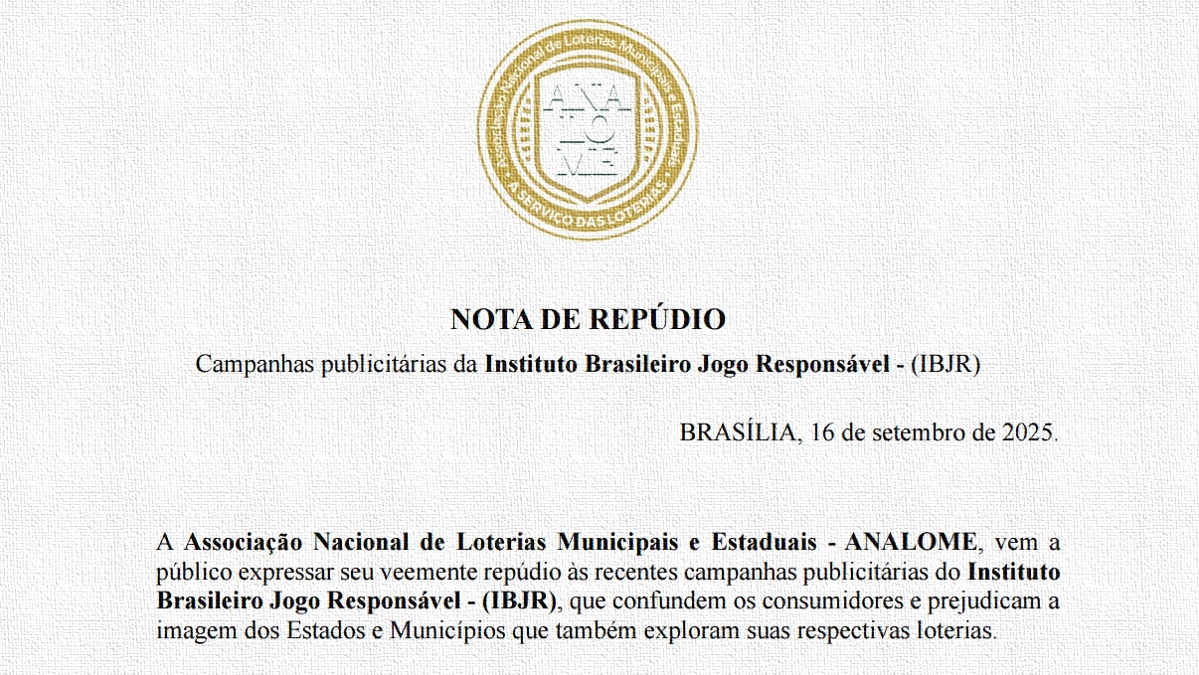
In a statement signed by president Camilo Roma de Brito, ANALOME argues that the campaigns “undermine the legitimacy of lotteries authorized by other federative entities, which lawfully compete with the federal government.”
The association highlights that, according to Supreme Federal Court rulings (ADPFs 492 and 493), the federal government does not hold exclusivity over lottery operations, which guarantees states and municipalities the right to regulate their own services within their constitutional powers.
In addition to criticizing the IBJR, ANALOME advocates for greater cooperation between industry entities and public agencies in combating illegal gambling, which is seen as a threat to bettor confidence and to the revenue allocated to areas such as health, culture, education, and public security.
Finally, the association calls for a “responsible and transparent” stance from both the IBJR and the National Secretariat for Prizes and Betting of the Ministry of Finance, in order to preserve the sector’s integrity and consumer safety.
In turn, IBJR provided GMB with its official position on this matter:
The Brazilian Institute of Responsible Gaming (IBJR) emphasizes that its focus is exclusively on the monitoring and promotion of sports betting regulated by the Federal Government.
All of the Institute’s communications clearly reflect this direction, including the appropriate disclaimer.
It is worth noting that IBJR has also referred to state lotteries on its landing page, always maintaining its commitment to transparency and accurate information for the public.
Context of the dispute
The clash takes place amid the rapid expansion of the country’s betting market. Since the Supreme Court overturned the federal monopoly on lotteries in 2020, several states have begun creating their own modalities, forming partnerships with private companies, and seeking new sources of revenue. Municipalities have also entered this market, increasing competition.
The IBJR, an entity formed by companies operating in the gaming and betting sector, has invested in campaigns focused on promoting so-called “responsible gaming.” However, according to ANALOME, these advertising efforts end up reinforcing the idea that only federal lotteries have legal backing, which, in the association’s view, misleads consumers and undermines the role of other federative entities.
Combating illegal gambling
Beyond the institutional dispute, ANALOME’s statement draws attention to a problem common to all: illegal gambling. “It is essential that all federative entities and industry associations join forces in combating illegal gambling, which undermines bettor confidence and the revenue directed to health, culture, education, security, etc.,” the text signed by Brito emphasized.
The association also calls for a position from the National Secretariat for Prizes and Betting, linked to the Ministry of Finance, and demands “responsibility and transparency” from IBJR as well. The goal is to prevent internal conflicts from weakening the sector’s credibility at a time of expansion and strong interest from foreign investors.
Source: GMB