




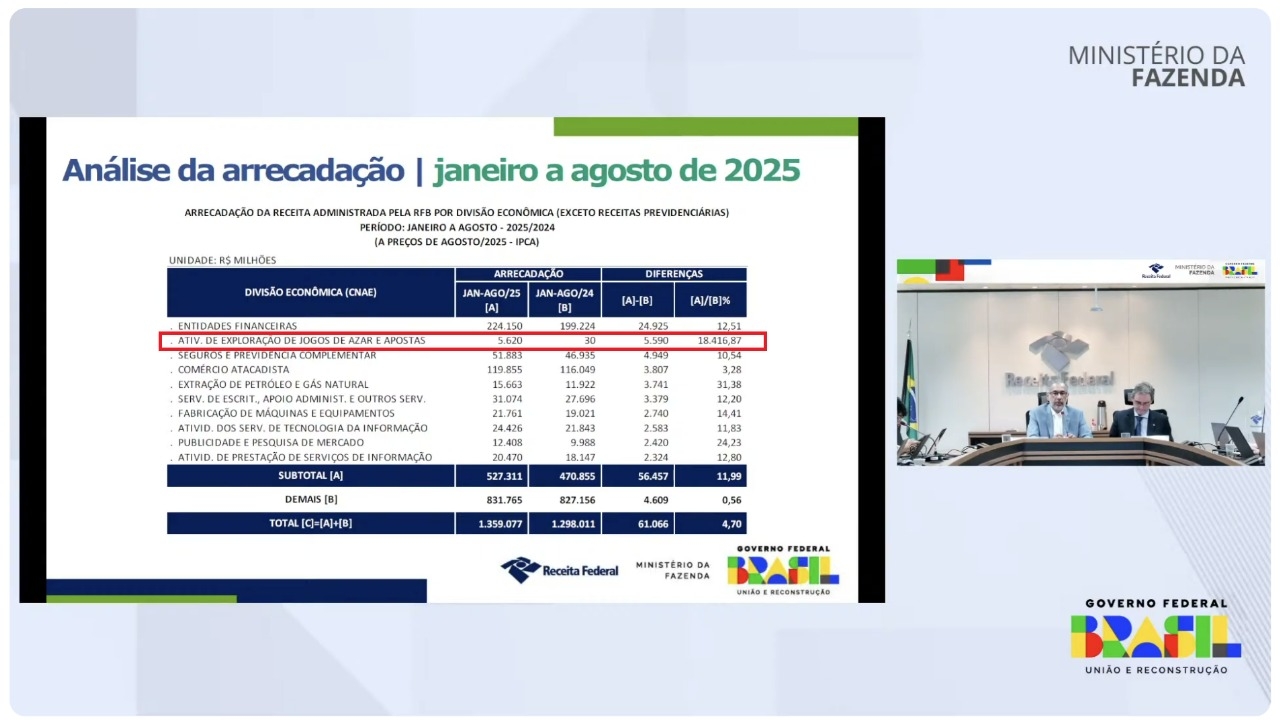
The amount includes different taxes paid by companies, such as Corporate Income Tax (IRPJ), Social Contribution on Net Profit (CSLL), PIS/Cofins, and also social security contributions. The figure stands out because it demonstrates the fast pace of growth of this market, which in the first half of the year moved around R$ 17.4 billion (US$3.3bn) in bets.
According to data released by the Federal Revenue, the collection up to August represents a significant increase (18,416.87%) compared to the same period last year, when the sports betting and online gaming sector had not yet entered regulated operation. From January to August 2024, the government collected R$ 30 million (US$5.6m) from the activity.
If the numbers from September to December follow the performance of the first eight months, total tax revenue from 2025 could exceed R$ 9.18 billion (US$1.7bn), consolidating the sector as one of the most impactful activities in the recent public budget.
The growth is directly linked to the regulatory process of the sector, which brought greater legal certainty, organization, and oversight for platforms, allowing the activity to migrate from informality to a formal business environment.
This movement not only attracted new operators but also increased consumer confidence, leading more and more Brazilians to bet on sporting events. With the popularization of the segment and the trend of constant growth, the outlook from the Federal Revenue is optimistic.
The money represents a market still in consolidation:
1) there is potential for further growth compared to other markets.
2) the trend is a reductio n in the number of betting houses and increased acquisitions.
3) betting houses have poured a large portion of these resources into advertising and sponsorships in football.
New measures could change the scenario
The government is counting on the approval of the Provisional Measure that raises the taxation of ‘Bets’ from 12% to 18% on GGR, in addition to other activities, to seek a primary surplus (excluding interest expenses) of 0.25% of GDP — about R$ 31 billion (US$5.8bn).
Approved by the Chamber of Deputies at the end of 2023, the taxation of ‘Bets’ was one of the measures defended by the government’s economic team to increase federal revenue. The rule requires the payment of taxes by companies and bettors, establishes rules for betting operations, and defines the distribution of resources collected by the government from the activity.
Currently, the tax rate on ‘Bets’ is 12% on net revenue (GGR), as established by law. The government issued a Provisional Measure raising the rate to 18% starting in October, with collection scheduled for November this year. The measure is already in effect but must be ratified by Congress.
In addition, major sporting events on the horizon, such as the 2026 World Cup and the 2028 Olympic Games, are expected to further boost betting volumes, expanding the potential for revenue generation and reinforcing the strategic importance of the gaming and entertainment sector within the Brazilian economy.
For IBJR, the numbers match its expectations
Figures from the Ministry of Finance indicated that the GGR (gross revenue) for the first half of the year was R$ 17.4 billion (US$3.3bn). Annually, this total would reach R$ 34.8 billion (US$6.5bn). From this total, 12% in taxes with legal allocations are deducted. Thus, betting houses retain R$ 30.6 billion (US$5.7bn).
The Brazilian Institute for Responsible Gaming (IBJR), which brings together the largest betting operators in Brazil, considers the figure aligned with its expectations. It expects the year to end with R$ 38 billion (US$7.1bn) in annual revenue.
“The illegal market still accounts for most of the Brazilian betting industry. We were able to confirm this through research,” said IBJR director André Gelfi, who highlights problems in the illegal market such as false promises, underage gambling, match-fixing, and tax evasion.
“Brazil is a very large country in terms of population and income. Looking at these numbers, there is still low penetration of this activity within Brazilians’ purchasing power. In consolidated markets, it represents 1% of GDP. Here, we are at 0.6% of GDP. There is development potential.”
At the same time, Gelfi believes that with regulation, the market is in a process of consolidation. According to the Ministry of Finance’s report, 78 companies are authorized to operate in the market, representing 182 ‘Bets’ brands. Each company can have up to three registered brands by paying its license fee.
“The market started operating in January with 80 companies. They are looking for their place in the sun, trying to survive. Most will be merged. You can’t sustain a market with 80 players,” he said. He also pointed to another effect of reducing the number of ‘Bets.’ “If taxes increase, there will be fewer companies. Their fixed costs will rise.”
It remains to be seen whether this will pass in Congress. The institute believes the effect will be an increase in the illegal market, where no taxes are paid. From January to August, the federal government collected R$ 5.6 billion (US$1.05bn) in betting taxes.
Advertising, publicity, and sponsorships
Another factor of consolidation for the future is advertising, publicity, and sponsorships. Contracts between ‘Bets’ and football teams and competitions have grown exponentially. Flamengo, for example, broke the record with its deal with Betano worth R$ 258 million (US$48.5m), plus R$ 10 million (US$1.8m) from an incentive law. Gelfi’s view is that these figures, in a more mature market in the future, should decline.
“There are companies at different stages of maturity. Companies planting today to reap tomorrow. Like any other business, you need volume to intermediate. You need to invest in marketing. There are companies that invest 150% of their revenue. And there are others that invest 30%,” Gelfi said. “Overall, I wouldn’t be surprised if some are investing more than they earn.”
The two market movements run in parallel. When there are fewer betting houses, this will certainly lead to a reduction in sponsorship money, as companies will have less need to fight for exposure.
But for now, advertising is the key differentiator between regulated and illegal houses. For this reason, Gelfi believes there should not be major legal restrictions on advertising.
“I think restricting advertising in an immature and newly regulated market is shooting yourself in the foot,” he argued. He explained that in the future, in an ideal situation, it might make sense to restrict advertising at certain times, as a bill currently in Congress proposes.
Source: GMB