




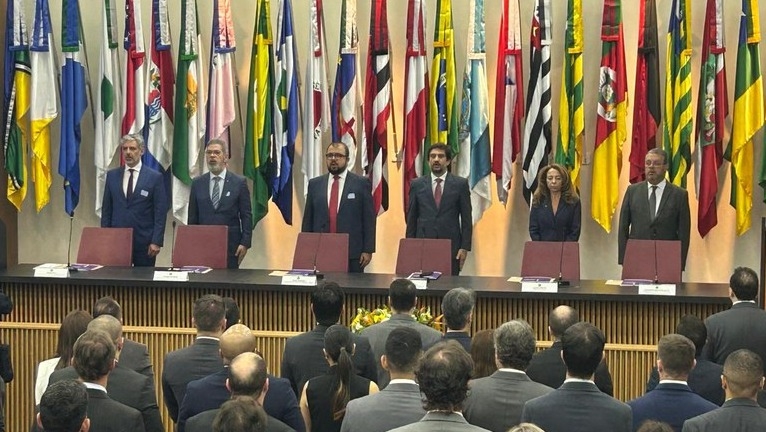
The expectation is that, by the end of the meeting scheduled for October 1, the first version of the digital platform created by the Working Group on Combating Sports Match-Fixing will be presented, along with a guidelines manual for preventive and repressive action, with the aim of expanding technical and methodological knowledge against this type of practice.
Both the platform and the manual were prepared by the working group composed of several ministries—Sports, Finance, and Justice—as well as the Federal Police. The first version of the Civic Digital Platform was developed by the Faculty of Science and Engineering Technologies of the University of Brasília (UnB).
The tool will allow the submission of anonymous reports, real-time monitoring of competitions, interactive data analysis dashboards, and automatic alerts using artificial intelligence to identify suspicious activities. It will also provide informational and educational content.

Dialogue
At the opening of the meeting, the National Secretary for Sports Betting and Economic Development of Sports, Giovanni Rocco Neto, emphasized that integrity in sports is not the responsibility of a single sector. “It is built through constant dialogue between government, sports entities, civil society, and the private sector,” he said.
Rocco, who is also the rapporteur of the working group, recalled the positive effects of sports for young people and adults, noting that in the case of children, it is a tool that helps education, especially in matters related to discipline and perseverance.
“An essential pillar is grassroots education. It is among young athletes, coaches, and families that we must sow, from an early age, the principles of ethics, respect, and transparency, in order to build a strong culture of prevention and awareness,” said the secretary.
Regulation
Also attending the event, the Secretary of Prizes and Betting of the Ministry of Finance, Regis Dudena, said that upon taking office in 2023, he recognized the need to address “all the gaps resulting from a very long period without regulation.”
“This brought us many social, economic, and also sporting problems,” he added, explaining that match-fixing also involves other crimes, such as fraud and money laundering, in addition to compromising the protection of people and the popular economy.

Content base
According to the Ministry of Sports, the meeting will serve to gather a “content base to train public agents,” leaving behind guidelines and best practices to be followed nationwide in the prevention and fight against sports fraud.
In this way, the qualification of professionals such as civil and federal police officers—considered by authorities to be the “central axis” for consolidating the state’s response to match-fixing—will be improved, as well as the refinement of investigative and intelligence techniques, with data cross-referencing and the use of technologies to identify suspicious betting.
Workshops, debates and training
“During the meeting, delegates from all states and the Federal District will participate in workshops, technical debates, and training sessions focused on the investigation and repression of sports fraud, with an emphasis on intelligence techniques, data cross-referencing, and the use of advanced technologies to identify suspicious bets,” explained the Ministry of Sports.
Expected outcomes of this training include the standardization of procedures, the strengthening of interstate cooperation, and the improvement of joint actions by security forces, in order to provide “greater agility in investigating irregularities and processing reports.”
Complex issue
In a statement, the Minister of Sports, André Fufuca, highlighted that the Working Group will establish an integrated and collaborative process for receiving and handling reports.
“The government recognizes the urgency and the need to address such a complex issue that affects the lives of so many people. Therefore, joint nationwide action is essential, moving efforts in the same direction to tackle match-fixing,” said the minister in the statement.
Federal Police
Among the program’s highlights are the presentation of the first version of the Civic Digital Platform, developed by the University of Brasília (UnB), which will allow anonymous reporting and real-time monitoring of competitions, and the launch of the Match-Fixing Response Manual, a document establishing national guidelines for preventing and combating this type of fraud.
The Federal Police’s Director of Investigation and Organized Crime, Dennis Cali, stressed the practical nature of the joint work: “This Working Group was not created to postpone decisions, but to deliver concrete results. The presentation of the Match-Fixing Response Manual is an example of this work, covering everything from legal aspects to cases and typologies that enhance our response to this challenge.”
“I want to thank all partners for organizing this meeting and for developing the Manual, which represents a collective achievement and the result of cooperation between institutions committed to protecting the integrity of Brazilian sports.”
Federal Police delegate Felipe Barros Leal, the PF representative on the Interministerial Working Group, emphasized the importance of civil society’s participation in combating fraud: “We already had information provided by operators and integrity companies, but we lacked a third fundamental pillar: the participation of organized civil society.”
“That is why we sought a partnership with the University of Brasília, which opened its doors to the technical group, enabling the development of the Civic Digital Platform. With it, we give citizens a voice, allowing them to anonymously provide information that, once processed and integrated, will enable more qualified investigations.”

By Wednesday (October 1), delegates from the Civil and Federal Police will participate in workshops, training, and technical debates focused on intelligence, data cross-referencing, and advanced technologies to identify suspicious betting. The goal is to standardize procedures, improve investigations, and strengthen the joint work of security forces, ensuring greater effectiveness in combating fraud and protecting the integrity of Brazilian sports.
‘Apita Cidadão’
At the same time as the event, the federal government launched a digital channel for reporting cases of match-fixing in sports. The platform, called ‘Apita Cidadão’ (Whistle Citizen) (apitacidadao.com), guarantees whistleblower confidentiality and analysis of the information by federal police officers.
The tool is simple: a four-step form in which the user must provide the date and location of the match, the alleged participants, and a brief description of the case.
This is one of the actions foreseen by the working group for the creation of a national policy to combat match-fixing in sports.
Source: GMB