





Of the fans interviewed, 3% said they always bet, 1.8% answered “frequently,” 5.9% said “sometimes,” and another 5.9% chose the option “rarely.”
That is the case of São Paulo supporter João Henrique Oliveira, 25. A graphic designer from a lower-middle-class background, he earns between one and two minimum wages per month, but every now and then takes on side gigs to supplement the household income he shares with his parents in Ruy Barbosa, a small town located in the Chapada Diamantina region of Bahia.
In his leisure time, his main form of entertainment is sports betting on football. João Henrique places a small wager every matchday, but doesn’t bet only on Bahia, the team he has “great affection” for. What matters most is proving to his friends that he knows more about football.
“I’ve bet on other sports, but football is the one I really stop to watch and talk about with my friends,” he says. “I like betting, but I at least need to understand what I’m betting on.”
Although he bets often, the young man spends an average ticket of R$20 (US$3.70), making it clear that it’s just “for fun,” since he sees gambling as entertainment and not a way to get rich.
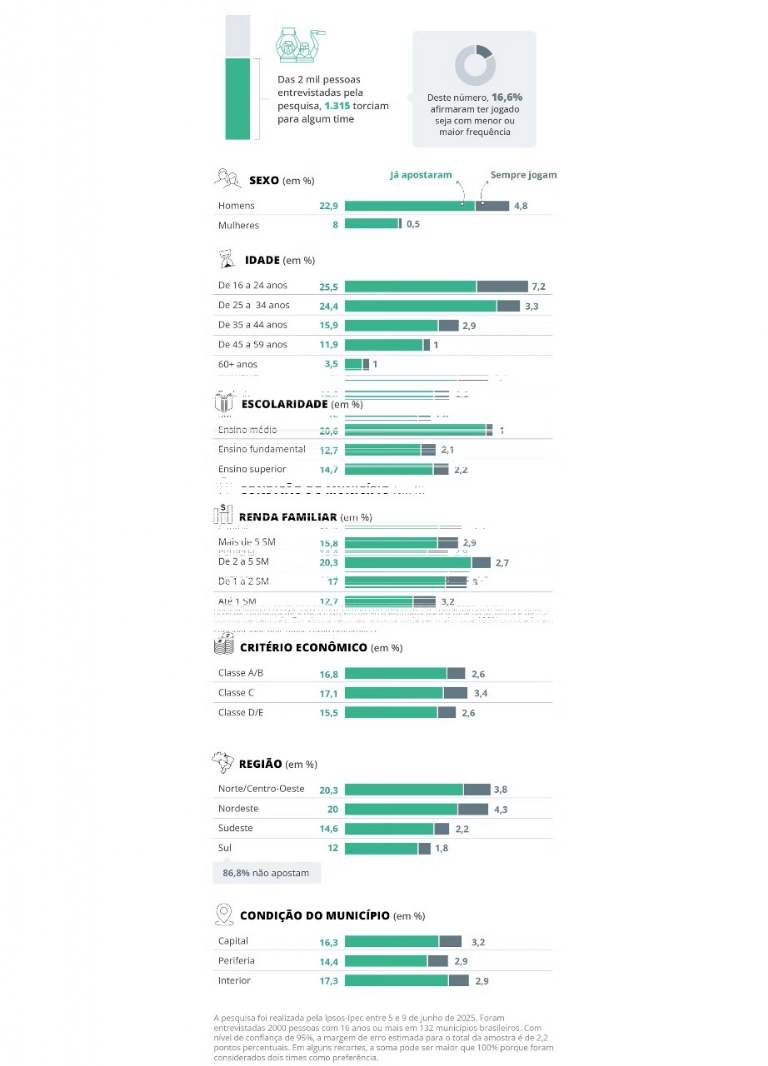
People with a family income of 2 to 5 minimum wages, like João, turned out to be the segment with the highest percentage of betting fans (20.3%), followed by those with 1 to 2 minimum wages (17%) and those with more than 5 minimum wages (15.8%). In the lowest income bracket, up to one minimum wage, the picture is different: there are fewer bettors (12.7%), but they bet more frequently.
The Midwest has the highest proportion of bettors (20.3%), but Northeasterners were the fans who most often claimed to be constantly gambling: 4.3%, compared to 3.8% in the North/Midwest. The Southeast comes next with 2.2%, and the South ranks last, not only as the region with the fewest regular bettors (1.8%) but also with the largest share of fans who reject betting altogether (86.8%).
Expanding the map to municipalities, it’s clear that rural areas hold the largest share of bettors (17.3% of the total fans who bet in this segment). The lack of cultural event diversity in these places may be one reason smaller regions stand out in betting prevalence, according to researcher Emílio Tazinaffo.
“We understand that betting is driven by pleasure. In small towns, what other sources of pleasure or distraction are there?” says the specialist.
Gamification
Football betting doesn’t generate much engagement among women: while men make up 22.9% of bettors, women are less than half that, at 8%.
Among young people, however, betting is a hit. Medical student Antônio Gomes Júnior, 24, started betting after seeing his friends play and admits he got excited, but over time managed to control himself.
“In the first week, I won 500 reais and kept thinking I had to win more,” he says, but then “came to his senses.” “Nowadays, no. I play for fun, more relaxed.”
According to the survey, young people between 16 and 24 bet far more often than other age groups. This youngest group has a betting rate very similar to adults aged 25 to 44 — 25.5% versus 24.4%, respectively. They are followed by adults aged 35 to 44 (15.9%), 45 to 59 (11.9%), and 60+ (3.5%).
But when looking only at fans who always bet, the gap is huge: young people more than double the percentage points (7.2%) of the next age group (3.3%). The rate decreases with age.
For Tazinaffo, beyond the desire to rise economically through betting, the gamification of gambling concepts during the pandemic played a key role in drawing young adults into betting.
“Teenagers tend to imitate others; it’s through social interaction that they develop. During the pandemic, all of that became limited to the internet, and they turned to games to stay connected,” says the researcher. “A large part of this overlaps with betting behavior.”
The survey was conducted by Ipsos-Ipec between June 5 and 9, 2025. Two thousand people aged 16 and over were interviewed across 132 Brazilian municipalities. With a 95% confidence level, the estimated margin of error for the total sample is 2.2 percentage points. In some breakdowns, totals may exceed 100% because respondents could choose two favorite teams.
Source: O Globo