



After regulation, the Brazilian market has become not only larger but also noticeably more fragmented in terms of player behavior. According to Pay4Fun, 94% of deposits in online gambling do not exceed 100 Brazilian reals ($18). This means users enter very cautiously: first to test the product, make a small trial deposit, and quickly decide whether it delivers excitement or not. This directly changes the requirements for game formats.
But let’s take it step by step. In this article, we break down what the gambling landscape in Brazil looks like today, who he is — the typical Brazilian player of 2026, and why Tap Games is starting to win the battle for conversions.
Let’s start with the basics. Brazil has always been a mobile-first GEO, and that hasn’t changed. But the attention economy has shifted significantly in recent years. Players have become worse at maintaining focus, especially on mobile: push notifications, social media, and messengers create intense competition for every second of attention.
The financial picture is also quite telling. The average monthly deposit in Brazil is almost twice lower than the global average — about $159 versus $327 worldwide. Players feel more comfortable making small test deposits: it’s perceived as a routine in-app action rather than a «serious financial decision». In other words, the smaller the ticket size, the lower the psychological resistance.
The demographic is very broad. About 2/3 of the audience is men, but the female segment is growing the fastest. The core user base consists of 18- to 40-year-olds: mobile-first users who are prone to rapid app switching.
If we put it all together, we get a fairly clear player profile. We’re looking at a smartphone user who loses focus quickly, plays in short bursts, and prefers to test the product with small bets.
And that’s exactly why the tap format has caught on so naturally in Brazil. It feels like a familiar mobile gameplay mechanic, requires almost no learning curve, and gives players a sense of control over the outcome. This is crucial for that initial emotional connection — and, as a result, directly boosts conversion rates.
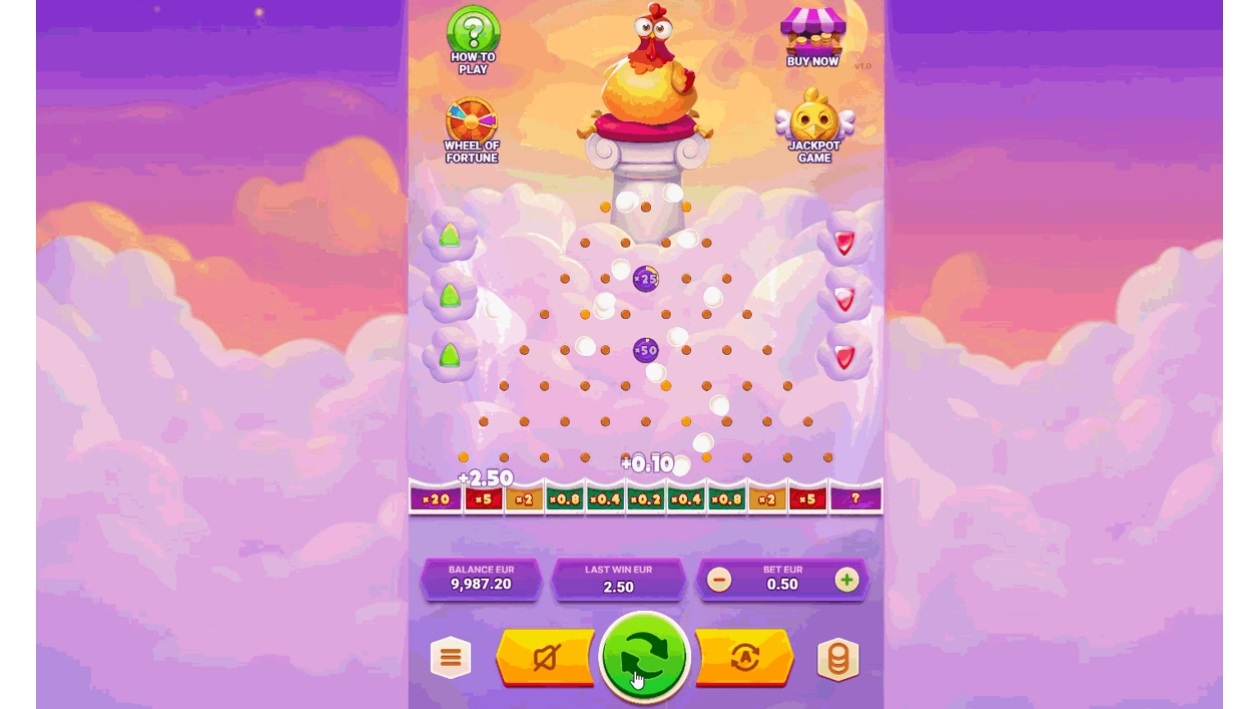
Tap Games are a hybrid of instant-win, arcade, and classic gambling UX. Everything is built around a simple loop: action and immediate result. In other words, the player doesn’t have to wait for a slot spin or a crash multiplier — they see the outcome of a tap almost instantly. One example of such a game is Chicken Plinko, where the pace of action breaks records.
In the roughly two seconds it takes for the slot machine to spin its reels, players in Chicken Plinko (and other Tap Games) can easily make 8–10 taps. This is a whole new level of pace, and this pace significantly impacts engagement levels.
Now, let’s talk about how and why Tap Games are growing so rapidly in Brazil and around the world. In short, the tap format is a perfect fit for the new attention economy. Players want fast-paced action and quick results — and that’s exactly what tap games deliver. But there’s more to it than that:
* Instant entry into the gameplay loop. The tap format dramatically shortens the path from opening the game to the first action. Users start playing almost immediately, without onboarding, which means they get engaged faster and stick to the session.
* The cognitive load is low. There’s no need to figure out paylines, bonuses, or complex game modes. You can grasp the entire game mechanic in just 1–2 seconds from the ad. This lowers the barrier to entry, even for cold traffic.
* Microbet safety. Players choose the stake per tap, and those same 100 reals can comfortably last an entire evening. The amount is split into dozens of quick actions, reducing psychological pressure and making each next decision much easier.
* Less casinorelated stress. Visually and in terms of gameplay, this product feels more approachable and resembles a simple game rather than a gambling offering. As a result, it doesn’t scare off audiences who don’t consider themselves «casino players».
Moreover, Tap Games unlock a segment of the audience that traditional formats struggle to capture. Yes, slots still dominate in terms of brand recognition and demand. Crash games remain strong as a high-intensity product. But there is a large segment of users who are hard to attract with slots or crash games: sports betting enthusiasts, casual mobile gamers, and social media audiences who never intended to play at a casino in the first place. For all of them, Tap games often serve as the entry point into gambling. And after that, some users smoothly transition to more «hardcore» formats.
There’s another practical advantage: the mechanics are easier to sell in ads. They can be explained on just a single screen. Tap games look great in TikTok demos, UGC creatives, short gameplay videos, and simple action banners. Essentially, these games simplify onboarding for both the player and the advertiser. And that also impacts conversion rates.
According to SiGMA, hybrid formats like Tap Games currently account for a mere fraction of the market — about 0.02% — but are showing very aggressive growth:
1. approximately +17% per year;
2. up to 57% monthly growth in certain markets.
In fact, we’re seeing a familiar pattern — a classic story of a new format: the volume is still relatively small, but the momentum already signals a shift in player behavior (much like when crash games first entered the market).
Importantly, the distribution is already in full swing; in other words, Tap Games titles are already available in the lobbies of operators that actively cater to Brazilian traffic — such as Betwinner, Spinarium, Leonbets, Betberry, and others.
The Brazilian market continues to grow, but as it grows, the players themselves are evolving. Mobile-first behavior, low average spend, and scattered attention make the audience highly sensitive to the product format. It’s no longer enough to simply display a slot — what matters is how quickly the user feels the action and emotion.
That is precisely why games like Chicken Plinko are seen as a new type of consumer product. They don’t replace slots or crash games — but they provide the market with an additional tool. A tool that better engages cold mobile traffic, accelerates the initial emotional connection, and helps expand the conversion funnel where traditional formats fall short.